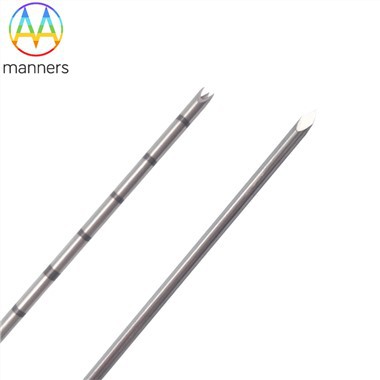
The Material Science Ingenuity Of Grade 304 Stainless Steel In V3 Infusion Needles
Jun 01, 2026
For infusion applications across food, tobacco and related industries, needles undergo prolonged, repeated contact with chemically diverse liquid media ranging from acidic fruit juices and oily flavor essences to saline seasonings and alcoholic extracts. The specification of AISI 304 stainless steel as the exclusive base material for the V3 Infusion Needle (manufactured by Manners Technology) stems from rigorous material science principles and practical engineering expertise.
Classified as an austenitic stainless steel, standard 304 stainless steel features a nominal composition of approximately 18% chromium (Cr) and 8% nickel (Ni), with the balance consisting of iron plus trace carbon, manganese and other alloying elements. Chromium serves as the core element delivering stainless corrosion resistance. At chromium content above 10.5%, an ultra-thin (typically 1–3 nanometres), dense and tightly adherent chromium oxide (Cr₂O₃) passive film spontaneously forms on the alloy surface in the presence of oxygen. This protective layer features self-repairing properties: any scratched surface exposing fresh chromium rapidly reacts with ambient oxygen to regenerate the barrier film. The elevated 18% chromium concentration equips V3 infusion needles with robust passive corrosion protection against weak organic acids and saline compounds prevalent in most food processing environments.
Nickel stabilises the underlying austenitic crystalline phase. Featuring a face-centred cubic crystal lattice, austenite endows 304 stainless steel with outstanding ductility, toughness and non-magnetic characteristics. Such properties permit substantial plastic deformation without cracking during forming processes such as rotary swaging, alongside superior resistance to impact and vibrational fatigue during field service. This microstructure-derived toughness is indispensable for V3 needles, which perform hundreds of piercing and dispensing cycles per minute on high-speed automated production equipment.
Nonetheless, proper raw material selection marks only the initial stage of production. Machining alters the near-surface metallurgical condition of the base metal. Cold-forming operations including turning and rotary swaging induce lattice distortion within the superficial layer, generating high-density dislocations and residual internal stress, while stray iron contaminants from tooling or processing surroundings may become embedded into the needle surface. These activated surface zones lose optimal passive film-forming capacity and act as preferential corrosion initiation sites, necessitating two critical post-machining finishing procedures for all V3 infusion needles: electropolishing and chemical passivation.
Electropolishing functions as an electrochemical levelling process. Immersed in specialised electrolyte solution with the needle configured as the anode, elevated current density concentrates on surface asperities, accelerating preferential metal dissolution at raised peaks to smooth out surface irregularities. The procedure removes several micrometres of the damaged outer metal layer to reveal uniform, uncontaminated base substrate. Critically, electropolishing inherently enriches surface chromium concentration: iron possesses a more negative electrode potential and dissolves faster than chromium under anodic conditions, raising the relative chromium fraction at the component surface and laying a favourable compositional foundation for subsequent formation of a denser, more corrosion-resistant passive oxide film.
Chemical passivation further reinforces this protective barrier, conventionally executed using nitric or citric acid solutions. The acidic medium dissolves free iron particulates trapped or embedded during machining; these exogenous iron impurities cannot form stable passivation and would otherwise trigger pitting corrosion. Meanwhile, acid treatment accelerates surface chromium oxidation to grow a thicker, more homogeneous Cr₂O₃ passive layer. Fully passivated 304 stainless steel achieves roughly an order-of-magnitude improvement in corrosion resistance compared with untreated counterparts.
Beyond alloy formulation and surface finishing, the material's mechanical properties are precisely engineered. The specified hardness range of HRC 22–25 (Rockwell Hardness Scale C) represents a carefully balanced design parameter. Excessively high hardness (HRC 60 and above typical for cutting tools) delivers superior wear resistance yet brings excessive brittleness, making needle tips prone to chipping upon accidental impact. Conversely, overly soft substrate leads to tip bending from repeated piercing against packaging and finished products. Attained via controlled cold working such as rotary swaging or customised thermal treatment, the intermediate half-hard HRC 22–25 grade strikes an optimal balance: sufficient rigidity preserves tip geometry and piercing force, while retained ductility cushions minor mechanical shocks during continuous operation.
In summary, the Grade 304 stainless steel deployed for V3 infusion needles is far from ordinary off-the-shelf industrial stock; it constitutes a refined engineered material system refined via systematic workflows of material selection, precision forming and targeted surface modification. Its final combination of excellent corrosion resistance, consistent mechanical strength and long-term dimensional stability arises from the synergistic interplay of inherent alloy chemistry, microstructure evolution induced by precision machining and advanced surface modification technologies. These engineered attributes enable reliable performance amid chemically complex food production environments, establishing the needle as a dependable precision metallic actuator for automated manufacturing lines.