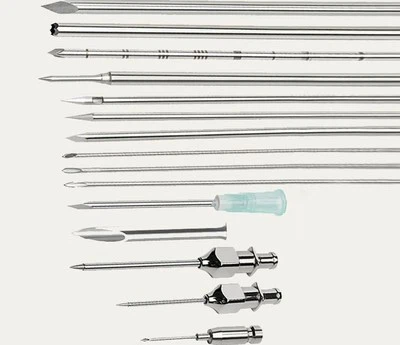
Materials Engineering Perspective | From Microstructure To Acoustic Performance: The Materials Science Code Of Echogenic Needles Medical Needle
Apr 10, 2026
Materials Engineering Perspective | From Microstructure to Acoustic Performance: The Materials Science Code of Echogenic Needles
Medical needle under the materials engineer's microscope, an echogenic needle is a meticulously designed "acoustic antenna system." Its core challenge is: how to make it an efficient ultrasound wave reflector through material selection and surface engineering without compromising the needle body's mechanical performance. This article reveals the materials science logic chain from nanostructure to macroscopic acoustic performance.
Acoustic Design Principles of the Material System
Multi-objective Optimization of Substrate Material:
mermaid
graph LR A[Material Selection] --> B{Performance Balance} B --> C[Acoustic Performance] B --> D[Mechanical Performance] B --> E[Biocompatibility] C --> F[High Acoustic
Impedance Mismatch] D --> G[Bending Stiffness
≥2.5 N/mm] E --> H[Cytotoxicity ≤ Grade 1] F --> I[316L Stainless Steel
45 MRayl] G --> I H --> J[Nitinol
(Limited Use Applications)]
Acoustic Engineering of Coating Materials:
Microbubble Polymer Coating: Encapsulates air bubbles 5-20 μm in diameter at 60% by volume within a polyurethane matrix, with bubble wall thickness of 0.1-0.3 μm.
Acoustic Mechanism: Strong reflection at the air/polymer interface (reflection coefficient R=0.9995).
Durability Challenge: 60% of bubbles rupture during skin penetration.
Ceramic Particle Composite Coating: Zirconia (acoustic impedance 28 MRayl) or barium titanate (33 MRayl) nanoparticles (50-100 nm particle size) dispersed at 30-40 wt% in epoxy resin.
Enhancement Mechanism: Hard particles create acoustically discontinuous interfaces within the polymer.
Advantage: Echo attenuation <3 dB after 100 punctures.
Acoustic Modulation via Surface Microstructure
Physical Optics Analogy of Periodic Groove Arrays:
Processing annular grooves on the needle surface using femtosecond lasers: depth 20-50 μm, width 30-80 μm, spacing 100-200 μm.
When the ultrasound wavelength λ (typical 150-200 μm) and groove spacing d satisfy the Bragg condition: 2d sinθ = nλ, coherent enhanced reflection occurs.
Clinical Effect: Echo intensity increases by 15-25 dB within a 0-30° incidence angle range.
Fractal Structure Design:
Etching the needle tip region with Koch curve fractal patterns (fractal dimension 1.26-1.50).
Advantage: Maintains stable echo enhancement across different frequencies (2-15 MHz) and incidence angles.
Manufacturing Process: Photolithography + electrochemical etching, structural precision ±2 μm.
Integration of Smart Responsive Materials
Temperature-Sensitive Hydrogel Coating:
Material: Poly(N-isopropylacrylamide) (PNIPAM), Lower Critical Solution Temperature (LCST) 32°C.
Working Principle:
复制
Body Temperature (37°C) → Hydrogel Contracts → Water Content decreases from 90% to 40% → Acoustic Impedance increases from 1.5 to 2.8 MRayl → Echo Enhancement of 8-12 dB
Clinical Significance: The needle tip automatically "lights up" upon entering a blood vessel (37°C) while remaining less visible in tissue (<32°C), reducing target obscuration.
Piezoelectric Composite Sheath:
Structure: PZT-5A piezoelectric ceramic fibers (20 μm diameter) embedded in epoxy resin in a 1-3 composite configuration.
Function: Actively emits 5 MHz ultrasonic pulses, forming an interferometric measurement with the external ultrasound device.
Accuracy: Measures the distance between the needle tip and vessel wall in real-time with 0.1 mm resolution.
Quantitative Evaluation System for Material Performance
Materials for echogenic needles must pass the following standardized testing protocols:
Acoustic Performance: In tissue-mimicking gel, using a standard ultrasound probe (7.5 MHz), measure the average echo intensity of the needle body during 0-360° rotation (≥-10 dB qualifies).
Mechanical Durability:
Bending Fatigue Test: Bend 90° on a 20 mm radius mandrel; after 1000 cycles, echo attenuation ≤20%.
Puncture Test: Penetrate a 0.5 mm thick silicone rubber membrane (simulating skin) 1000 times; coating delamination area ≤5%.
Biocompatibility: According to ISO 10993 series, including cytotoxicity, sensitization, intracutaneous reactivity, and 7 other tests.
Conclusion
The next generation of material innovation for echogenic needles will focus on dynamic acoustic modulation. Coatings based on ferroelectric polymers will allow continuous adjustment of their acoustic impedance between 5-25 MRayl by applying 0-10V, achieving "on-demand visibility/invisibility." Meanwhile, 4D-printed shape memory polymers will enable the needle body's surface microstructure to reconfigure at specific temperatures, optimizing echo characteristics at particular depths. Materials science is transforming the needle from a passive "acoustic reflector" into an active "intelligent acoustic interface."