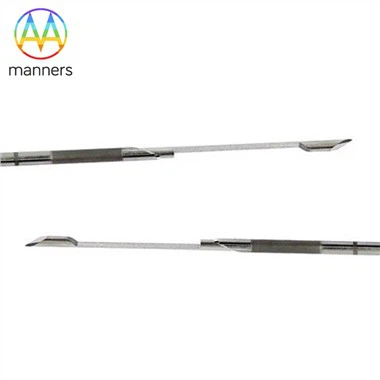
The Veress Needle In Laparoscopic Surgery — Technological Evolution And Future Horizons
Jul 11, 2026
https://en.wikipedia.org/wiki/Veress_needle
Since Dr. János Veress's invention over eighty years ago, the Veress needle has remained the gold standard for laparoscopic access. Yet, driven by relentless advancements in minimally invasive surgery, it continues to evolve, adapting to ever-escalating clinical demands. Future trajectories point toward smarter, more visual, and inherently safer iterations.
Integration of Smart Sensing represents a pivotal trend. Traditional reliance on tactile feedback and surgeon experience introduces subjectivity. Future Veress needles will embed micro-sensors-pressure transducers, accelerometers, even thermistors. These will relay real-time data regarding resistance shifts, needle trajectory, and tissue characteristics. Algorithms could analyze these inputs, identifying signature patterns upon fascial breach and alerting the surgeon via auditory or visual cues. This promises to reduce dependence on individual experience and elevate safety margins.
Convergence of Optical Visualization addresses the "blind" limitation. While conceptual "optical Veress needles" exist, miniaturization challenges have hindered widespread adoption. Future breakthroughs in micro-electronics and photonics will likely enable integration of 1–2 mm diameter micro-cameras within the needle shaft. Surgeons could then visualize tissue planes directly during insertion-a revolutionary advance for high-risk cohorts (prior surgery, morbid obesity, distorted anatomy).
Proliferation of Single-Use Designs is inevitable. While reusable needles dominate today, imperfect reprocessing carries inherent infection risks. Disposable variants eliminate this concern and permit lighter, more ergonomic designs. Declining manufacturing costs will accelerate this transition. Crucially, disposability facilitates integration of sensors or optical fibers without jeopardizing device integrity during sterilization cycles.
Application of Novel Materials will unlock new performance benchmarks. Beyond stainless steel, titanium alloys, high-performance polymers, and potentially bio-resorbable compounds may be employed. These materials offer enhanced biocompatibility, superior strength-to-weight ratios, or unique MRI compatibility. Non-ferrous needles, for instance, would be invaluable in MRI-guided interventions, remaining artifact-free and unaffected by magnetic fields.
Robot-Assisted Insertion Systems represent the vanguard of surgical evolution. Future robotic platforms may feature dedicated modules for Veress insertion. Leveraging pre-operative CT or MRI data, robotic arms could execute insertion with superhuman precision regarding angle, depth, and velocity. This would serve as a powerful adjunct, particularly for surgeons early in their learning curve.
In summary, the future of Veress needle technology brims with potential-transitioning from mechanical to smart, from blind to visual, from reusable to disposable. These innovations collectively herald a new era of safer, more precise, and efficient minimally invasive surgery. As clinicians and stakeholders, embracing this evolution is paramount to translating these advancements into tangible patient benefits.