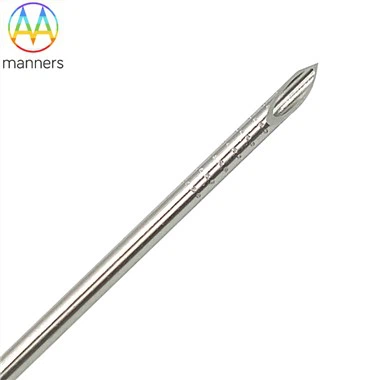
Material And Surface Treatment Of PTC Needle For Cholangiography Affecting Puncture Safety
Nov 11, 2026
1. Clinical Pain Points
Poor surface finish of puncture needles causes excessive friction during liver penetration, tearing hepatic capsule and small intrahepatic vessels, increasing bleeding risk. Residual machining impurities on needle tube surface may trigger local inflammatory reaction and biliary tract infection. Unqualified stainless steel material suffers corrosion after contacting bile and contrast medium, generating metal debris. Many adverse events are not caused by operator error, but by unstable needle manufacturing quality. In addition, fixed-size needles cannot adapt to special anatomical variants, forcing clinicians to use oversized needles for thin bile ducts, which raises bile leakage probability. Hospitals lack clear reference standards for selecting needle surface treatment schemes for different patient groups.
2. Working Principle of PTC Needle
The PTC needle uses hollow stainless steel tube as the main channel. The sharp tip penetrates liver parenchyma into bile duct lumen. After stylet removal, the hollow channel connects the syringe and bile duct cavity. Contrast medium is injected to fill the biliary tree for fluoroscopic imaging. Material performance determines the rigidity, bending resistance and corrosion resistance of the needle. Surface treatment controls the friction coefficient, surface cleanliness and biocompatibility. The needle's smooth surface reduces dragging injury to liver tissue during advancing and withdrawing. Stable inner wall ensures uniform contrast flow without turbulent flow and air bubble formation, guaranteeing clear X-ray images of stenosis, dilation and stone shadow.
3. Classification Based on Material and Surface Treatment
Base material classification: medical stainless steel is the mainstream raw material, featuring good rigidity and low cost for most diagnostic PTC. Custom alloy materials are optional for special anti-corrosion requirements. Classification by surface finish: polished needles have mirror smooth surface, suitable for atraumatic fine puncture; electroplated and plated needles enhance surface hardness and anti-corrosion performance; ultrasonic cleaned needles remove oil, metal chips and particulate contaminants, often used as final treatment step before sterilization. By customization mode: standard size series with fixed diameter 0.25–30 mm; custom versions manufactured according to 2D drawings, 3D models or customer samples, with adjustable tip angle, side hole layout and total length. Certification is ISO9001, packaging can be standard carton or customized packaging.
4. Operation Guide for Material and Model Selection
Before operation, match needle diameter according to bile duct dilation degree. Non-dilated intrahepatic ducts select fine polished needles. Moderately dilated ducts can adopt electroplated medium-size needles. For patients with high infection risk, confirm the needle has passed ultrasonic cleaning to reduce foreign-body related inflammation. During puncture, avoid excessive bending of thin stainless steel needles to prevent lumen occlusion. After bile aspiration, confirm unobstructed channel before injecting contrast medium. When withdrawing, slow and steady movement reduces scratch injury. Record intraoperative bleeding volume and image quality, and feed back to the supplier if the needle surface causes obvious tissue dragging.
5. Practical Experience
Polished fine needles achieve the lowest puncture resistance, which is very suitable for stationary intrahepatic cholangiolithiasis patients without obvious duct dilation. Operators report that ultrasonic cleaning is indispensable, because residual micro-particles may cause granulomatous reaction in liver parenchyma. Electroplated needles have better deformation resistance, less likely to kink when the puncture angle is steep. However, over-thick coating may reduce inner lumen diameter and affect contrast delivery speed. For patients with long-term biliary drainage history and high bile corrosivity, corrosion-resistant surface treatment is preferred. Operators should establish a selection log: thin polished needles for diagnosis, plated medium needles for complex anatomy, customized samples for special research or rare anatomical variants.
6. Summary
Material and surface treatment directly determine the safety, imaging quality and service life of PTC needles. Proper surface treatment reduces puncture trauma and infection risk. Stainless steel material balances mechanical performance and cost. Rich customized options solve the mismatch problem of standard needles for special clinical cases. The selection of polishing, plating or ultrasonic cleaning should be combined with patient duct condition and operation purpose.
7. Suggestion and Prospect
Manufacturers should strengthen online surface inspection to guarantee consistent roughness and cleanliness of each batch. They can launch a selection guide table matching surface finish with clinical indications. In the future, composite coating technology will further improve anti-thrombosis and anti-adhesion performance. Clinical teams should include needle surface performance in quality control of PTC operations. Distributors should provide both standard stock products and fast drawing customization service to support interventional radiology departments in different regions.
< img alt="news-1-1" src="/uploads/24240/news/202604241539186d0ff.png " />