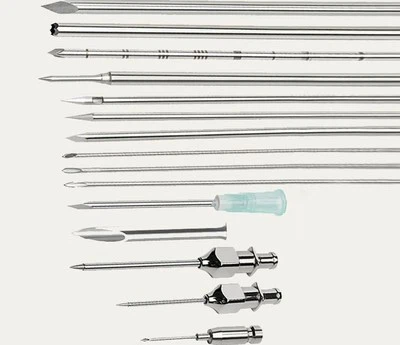
Manufacturing Process Perspective | The Significance Of The Needle Tip: Micro-Sculpting Under 5-Axis Mill-Turn Machining
Apr 11, 2026
Manufacturing Process Perspective | The Significance of the Needle Tip: "Micro-Sculpting" Under 5-Axis Mill-Turn Machining
In the field of precision manufacturing, the forming process of the Vacuum-Assisted Breast Biopsy (VABB) needle tip is akin to "micro-surgery" in the metallic world. This is not simple material removal but an extreme sport involving Citizen L12-1M7 sliding headstock lathes, 5-axis simultaneous machining, and precision tool management. On this sub-millimeter stage, every micron of cutting determines the final clinical outcome.
I. "Solving Spatial Puzzles" with 5-Axis Simultaneous Machining
The text mentions that the needle tip is the most difficult component to machine, requiring approximately 30 minutes of milling time per piece. The manufacturing logic behind this is extremely challenging, representing an ultimate solution to spatial geometry.
Geometric Reconstruction of Complex Surfaces: To achieve smooth penetration and efficient cutting, VABB needle tips are typically designed with asymmetric hyperboloids or multi-bevel structures. Utilizing a ∅0.4531 inch (approx. 11.5mm) flat end mill for interpolation machining perpendicular to the primary cutting path is significant because it reconstructs an aerodynamically streamlined profile within an extremely confined space. This "side milling" process places extremely high demands on CAM programming and machine rigidity.
Positioning Accuracy of ±0.005mm: This micron-level positional capability is the prerequisite for creating a "razor-sharp edge." The convergence of the three curved surfaces on the needle tip must form a continuous, stepped edge line. Any minor positional error or machine vibration can result in microscopic notches (Micro-notches) on the cutting edge. Such defects manifest during puncture not as "incision" but as "laceration," causing unnecessary tissue trauma and postoperative pain.
II. Collaborative Design of Cutting and Sampling Chambers
Precision Slotting of the Sample Notch: Utilizing lasers or precision turning tools to create grooves at specific angles on the side of the needle tube. These geometric parameters directly determine sampling efficiency. The significance lies in constructing a temporary "sample holding chamber" that captures tissue instantly upon cutting and directs it into the vacuum channel, preventing residue outside the needle tip.
Fluid Dynamic Significance of Internal Taper and Chamfers: Precision internal chamfering eliminates sharp right-angle transitions. This creates a "streamlined entrance" in fluid mechanics, significantly reducing the local resistance coefficient and preventing tissue cell accumulation and clogging at corners, thereby ensuring high-speed and smooth continuous sampling.
III. Permanent Identity Through Laser Marking
The laser marking mentioned in the text represents full-lifecycle traceability from a manufacturing perspective. Using high-energy lasers to induce oxidation or micro-melting on the metal surface creates marks with extreme wear and corrosion resistance. This ensures that even after hundreds of autoclave cycles, the needle tip's unique serial number remains legible, providing an immutable data anchor for quality tracking.
IV. "Digital Twin" from Virtual to Reality
The 30-minute milling time is, in fact, the result of countless simulation optimizations. Manufacturers must find a balance between material removal rate (MRR) and thermal deformation control. Excessive cutting heat can lead to annealing of the needle tip, destroying its hardness.
V. Conclusion
From a precision manufacturing perspective, the "significance" of the VABB needle tip is a perfect sculpture created by a 5-axis CNC machine at the microscopic scale. It translates geometric lines from a design blueprint into a physically sharp, precise, and durable entity-a dual crystallization of the precision of the machine tool and the spirit of craftsmanship.