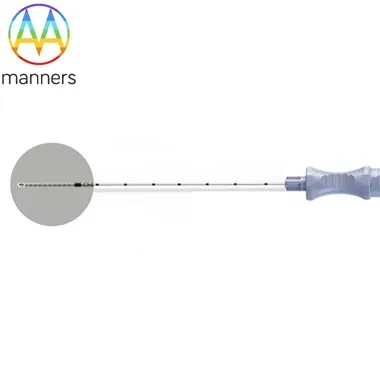
ISO 13485 Quality System, Testing Standards, And Compliance Requirements For PTC Needle Manufacturers
Jul 06, 2026
https://admin1.seo.com.cn/CustomerAdmin/S_News/Create?ru=%2FCustomerAdmin%2FS_News%2F
As a Class II or III interventional puncture device (depending on national regulations), PTC needle (Chiba Needle) manufacturers must establish and operate a full-process quality control system compliant with ISO 13485:2016 (Medical Device Quality Management Systems). This is not only a prerequisite for market authorization (CE Mark, FDA 510(k), NMPA registration) but also a core metric when large tertiary hospitals and multinational distributors audit suppliers.
- Design and Development Controls (DHF/DMR): Manufacturers must retain the product's Design History File, including user needs (clinical requirements for ultrasound visibility, compatibility with 0.018″ guidewires, etc.), design input/output, verification protocols (puncture force testing, guidewire passage, leakage tests), and risk management files (ISO 14971 FMEA-focusing on hazards such as needle breakage, broken tips, guidewire entrapment, and excessive EO residue). Design transfer must define process parameters and acceptable limits for each production stage.
- Incoming Material Inspection: SUS304/316L tubes require verification of material certificates (compliant with ASTM A269/A580 or equivalent national standards), dimensions, hardness, and surface defects. Plastic components (hubs, protective caps) require biocompatibility reports (ISO 10993-1).
In-Process Inspection and Key Process Monitoring:
Grinding:Random inspection of tip projection angle and edge integrity (200–400× microscopy), with records maintained.
Internal Lumen Smoothness:Verified via endoscopy or guidewire passage test (0.018″ guidewire passes the full length without resistance).
Markings and Visibility Marker Position:Measured by imaging or projector; distance error from the tip ≤ ±1 mm.
Assembly Bond Strength:Axial pull test on needle tube-to-hub (typically ≥5–10 N without separation).
EO Sterilization:Requires sterilization validation (ISO 11135), sterility testing (ISO 11737-2), and EO residual testing (ISO 10993-7, typically requiring EO residue ≤10 μg/device or per national limits).
- Finished Product Release and Traceability: Samples are retained from each batch. Before release, appearance, dimensions, patency, packaging integrity, and label correctness (including batch number, expiry date, gauge color code) are re-verified. Unique Device Identification (UDI) enables bidirectional traceability from production batch → raw material batch → sterilization batch, satisfying MDR and FDA requirements.
- Clinical Evaluation and Post-Market Surveillance: Manufacturers must collect adverse event reports (e.g., suspected needle breakage, infection-related complaints) and periodically conduct Post-Market Surveillance (PMS) and Periodic Safety Update Reports (PSUR). For PTC needles, the most common customer complaint is "guidewire cannot pass"-often linked to insufficient internal polishing or inadequately cleaned grinding debris. Therefore, online air-blowing/lumen passage inspection is standard practice for mature manufacturers.
In B2B promotions, PTC needle manufacturers can use "full-process ISO 13485 control + per-batch puncture force sampling + EO sterilization validation + UDI traceability" as trust endorsements. Especially when targeting European, American, and domestic tertiary hospital markets, transparency in quality systems is more persuasive than mere low pricing.