Specifications, Material Differences, And Manufacturers’ Configuration Strategies For PTC Needles Across Clinical Scenarios
Jul 06, 2026
https://admin1.seo.com.cn/CustomerAdmin/S_News/Create?ru=%2FCustomerAdmin%2FS_News%2F%3Fpage%3D2
Although the principle of the PTC needle (Chiba type) is unified, manufacturers offer multi-specification combinations to meet diverse patient physiques, biliary conditions, and operator preferences. Scientific selection guidance helps distributors and end-users procure correctly, reducing clinical failures caused by mismatched specifications.
Gauge (Outer Diameter) Selection:
- 22G (OD ≈ 0.7 mm, ID ≈ 0.41 mm): Most commonly used for PTC diagnostic cholangiography and PTCD first-pass, balancing minimal invasiveness with guidewire passage (accommodates 0.018″ micro-guidewire). Recommended as the standard configuration.
- 21G (OD ≈ 0.8 mm): Slightly larger lumen, suitable for significantly fibrotic livers or when stronger support is needed; still usable for first-pass followed by exchange.
- 20G (OD ≈ 0.9 mm): Some centers use directly for one-step PTCD (with micro-introducer), but trauma is marginally increased.
- 23G (OD ≈ 0.6 mm): Ultra-fine, suitable for pediatrics, extremely lean adults, or pure PTC without catheter placement; note the small lumen requires extra caution with guidewire passage.
- Length Selection: 150 mm (superficial / left lobe subxiphoid approach), 200 mm (standard adult right mid-axillary approach), 250–300 mm (obese patients or deeply seated target bile ducts). Manufacturers typically stock 150/200 mm as standard, with extended lengths available on demand.
Material and Performance Differences:
- SUS304: Low cost, good strength, satisfies most needs.
- SUS316L: Superior corrosion resistance, better for prolonged fluid contact; chosen for high-end lines.
- NiTi (Nitinol) shaft or full needle: Superelastic and kink-resistant, less prone to deformation in curved liver parenchyma, suitable for complex multi-adjustment punctures, but at higher cost.
Functional Add-ons:
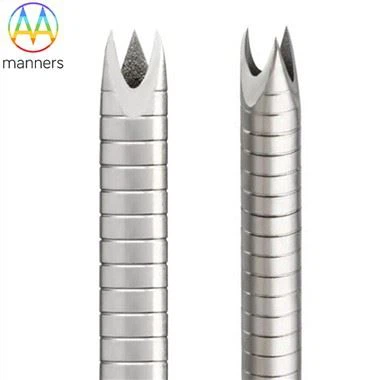
- Ultrasound visibility markers (tip roughening / micro-pitting / spiral etching): Strongly recommended as standard to greatly enhance tip tracking under ultrasound guidance.
- Color-coded gauge rings: Enable quick specification identification, reducing intraoperative confusion.
- Graduated markings (every 1 cm): Scale markings within 5–10 cm from the tip assist in judging insertion depth.
- Hydrophilic coating (internal lumen or external surface): Some premium versions feature internal hydrophilic coating to reduce guidewire friction; external hydrophilic coating reduces tissue resistance.
Manufacturers' Configuration Recommendations:
Primary / teaching hospital interventional departments:22G×200 mm (with visibility marker + markings), 21G×200 mm in proportional mix, accompanied by a 0.018″ guidewire starter kit.
Pediatric / lean adult specialty:23G×150 mm as backup.
Overseas OEM customers:Customizable length, connector (Luer slip vs. Luer lock), packaging (individual paper-plastic pouch / blister box), and multilingual IFU per client drawings.
Guiding customers to order according to "22G for PTC cholangiography vs. 21G–22G for PTCD first-pass vs. extended length for obese patients" not only improves clinical satisfaction but also reduces returns/exchanges caused by specification errors.