Full-Process Analysis Of PTC Needle Manufacturing And Building Manufacturers’ Process Competitiveness
Jul 06, 2026
https://admin1.seo.com.cn/CustomerAdmin/S_News/Create?ru=%2FCustomerAdmin%2FS_News%2F
The PTC needle (Chiba Needle) appears structurally simple-a thin-walled stainless steel tube with a removable stylet and a plastic hub-but its manufacturing process directly determines puncture sharpness, ultrasound visibility, guidewire passage, and user safety. Professional PTC needle manufacturers must establish controlled process windows across five major stages-tube forming, tip grinding, surface treatment, assembly, and sterilization-to ensure consistent batch-to-batch performance. This is the core barrier distinguishing high-end brands from generic low-cost products.
Raw Material Selection and Cutting: Mainstream PTC needle shafts use medical stainless steel SUS304 or SUS316L (corrosion-resistant, excellent biocompatibility); high-end lines use Nitinol (NiTi) shafts for enhanced kink resistance. Tubes are cut to specified lengths (150/200/250 mm, etc.) according to target specifications (e.g., 22G OD 0.7 mm, ID 0.41 mm, thin wall approx. 0.15 mm), with deburring to prevent subsequent scratching of the inner wall.
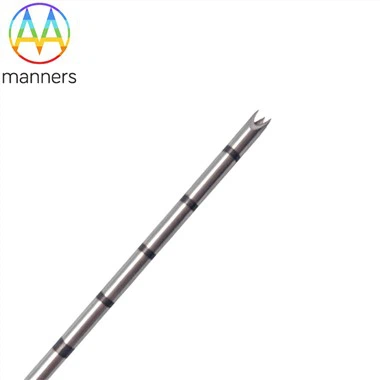
Tube Forming and Sizing: Precision tube-drawing controls OD/ID tolerances (typically ±0.02 mm), ensuring compatibility with matched micro-guidewires. Near the tail end, the tube is crimped or bonded to a Luer-Lock hub (PP/PC/ABS material) with an anti-backflow structure for syringe connection. Some manufacturers laser-etch centimeter markings on the shaft within 5 cm from the tip, and apply roughening/micro-pitting at the terminal few millimeters to create an ultrasound-hyperechoic marker-a key process for enhancing tip visibility under ultrasound guidance.
Tip Grinding and Stylet Matching: The Chiba needle's signature long bevel (typically 30° short bevel or 20° long bevel) is precision-ground on CNC grinders, requiring a burr-free cutting edge, symmetrical bevel, and alignment between the inner stylet and outer needle bevel (so the outer needle can still inject fluid smoothly after stylet removal). Some manufacturers apply a secondary back-cut to reduce puncture resistance. Post-grinding, optical projectors are used for 100% inspection of edge angle and symmetry. The stylet tip is ground to the same angle, fitting seamlessly with the outer needle tip when inserted to prevent tissue embedding in the lumen.
Surface Treatment and Cleaning: External electropolishing reduces the friction coefficient and minimizes tissue drag during insertion. Internal electrochemical polishing ensures lumen smoothness for effortless guidewire sliding and contrast injection. Multi-stage ultrasonic cleaning then removes metal debris and polishing residues, eliminating particulate contamination.
Assembly, QC, and Sterilization: The needle tube is firmly assembled with the hub (adhesives must comply with ISO 10993 biocompatibility), and a protective cap is installed. Quality control covers: full inspection of dimensions (OD/ID/length/marking position), random sampling of tip sharpness (penetration force test through simulated tissue), stylet fit (insertion/withdrawal force), lumen patency (passing wire/air tightness), and appearance (no scratches or rust). Final Ethylene Oxide (EO) sterilization grants a typical sterile shelf life of 3–5 years. The entire process must be documented under an ISO 13485 quality system to ensure traceability.
For PTC needle manufacturers, tip grinding precision + internal lumen smoothness + ultrasound visibility markers constitute the three major process selling points. It is recommended to showcase electron microscopy comparisons in sample catalogs to intuitively convey quality differences. Possessing OEM/ODM capabilities (customizing length, connectors, coatings per customer 2D/3D drawings) is also a significant plus for expanding into international markets.