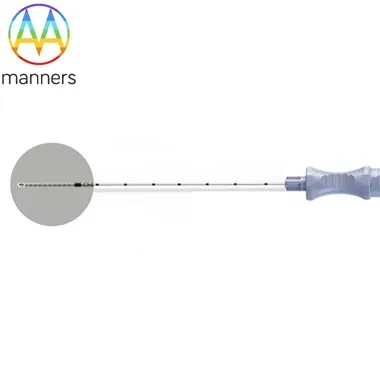
How To Choose The Right Tuohy Epidural Needle Gauge?
Jun 22, 2026
For junior residents new to regional anesthesia, the array of Tuohy needles on the shelf-ranging from 14G to 25G, standard to extra-long-can be bewildering. Selecting the right specification is not merely a technical issue; it is a sign of respect for individual patient anatomy. This guide provides practical advice for practitioners at different stages.
1. Understanding the Logic: Gauge and Length
First, understand the "Gauge" (G) system: the higher the number, the finer the needle diameter. For example, an 18G Tuohy has an OD of ~1.27 mm, while a 25G is only ~0.51 mm. Finer needles cause less trauma but increase injection resistance and catheter passage difficulty.
Length: Standard adult needles are 8 cm (3.5 inches). Extra-long (10–15 cm) needles are required for obese patients or thoracic approaches.
2. The Beginner's Choice: 17G–18G (The "Golden Window")
For inexperienced operators, 17G or 18G is strongly recommended.
- Clear Tactile Feedback: The thicker shaft provides a distinct Loss of Resistance (LOR) upon piercing the ligamentum flavum.
- Catheter Compatibility: Standard 19G/20G epidural catheters pass through easily, reducing failure rates.
- High Fault Tolerance: The rigidity supports minor redirections without buckling. Many teaching hospitals standardize on 18G for trainees until proficiency is achieved.
3. Advanced Selection: 20G–22G (The "Minimally Invasive Pursuit")
After accumulating hundreds of cases, physicians may attempt finer gauges.
- Reduced Trauma: Smaller holes theoretically lower rates of post-operative back pain and epidural hematoma.
- Pediatrics & Ambulatory Surgery: Minimally invasive access improves recovery experience.
- Challenge: The LOR sensation is more subtle, requiring high fingertip sensitivity. Catheter advancement requires more finesse to avoid coiling. Best suited for senior physicians with established muscle memory.
4. Special Considerations for Special Populations
- Obese Patients: 14G or 16G Extra-Long. Standard lengths often fail to reach the epidural space. The thicker diameter provides better control through thick adipose tissue.
- Elderly / Calcified Ligaments: 18G with a sharp tip. Degenerative ligaments are tough; a dull or overly curved tip may slip. Sharpness is prioritized over curvature here.
- Cervical Epidural: 18G or 20G Short-Bevel, Short Length (5–7 cm). Shorter length aids depth control in the narrow cervical canal.
5. From "Using Right" to "Using Well"
Regardless of gauge, follow the "Three-Step Verification":
- Pre-check: Inspect the tip for barbs or hooks.
- Two Layers: Feel for the double pop (Supraspinous Ligament → Ligamentum Flavum).
- Aspiration: Ensure no blood or CSF before catheterization.
- Remember: The best needle is the one that fits the patient's anatomy and your experience level. Regularly review your success and complication data to build personalized preferences.