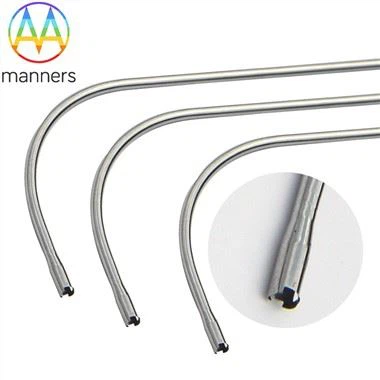
Tip Type Differences And Clinical Application Of Disposable Stainless Steel Spinal Needles
Aug 05, 2026
1. Dual-Tip Product Design
Disposable stainless steel spinal needles support two mainstream clinical tip types: Quincke Point and Pencil Point, covering dual operational needs of efficient rapid puncture and high-standard minimally invasive puncture. The dual-type design breaks the limitation of single structural performance of traditional spinal needles, enabling products to adapt to different clinical operation habits, surgical grades and patient groups. Both tip types are made of high-precision stainless steel through integral grinding, with stable structural performance and consistent batch quality, ensuring reliable clinical application effect of different models.
2. Structural Characteristics and Advantages of Quincke Point
Quincke Point is a classic bevel cutting tip designed for efficient rapid puncture. The sharp and smooth cutting edge can quickly penetrate skin, fascia and spinal dural tissues with low puncture resistance and high operational efficiency, which is suitable for emergency surgery, major spinal anesthesia and routine lumbar puncture for adult patients with normal spinal anatomy. The optimized bevel angle ensures rapid tissue penetration while avoiding excessive cutting damage. This type of needle is favored in conventional general clinical scenarios due to its fast puncture speed and high success rate, meeting the efficient treatment needs of mass routine diagnosis and anesthesia.
3. Minimally Invasive Principle and Advantages of Pencil Point
Pencil Point is an innovative atraumatic blunt tip optimized for modern minimally invasive medicine. Different from the cutting mechanism of Quincke Point, the rounded pencil tip has no sharp edges and adopts physical tissue separation to complete puncture. It stretches and separates dural fibers along natural anatomical gaps without cutting damage, protecting the integrity of spinal tissues. After needle withdrawal, the elastic dural fibers can self-close quickly, effectively reducing cerebrospinal fluid leakage and the incidence of post-lumbar puncture headache. It is especially suitable for high-risk groups such as children, elderly patients and pregnant women, as well as high-standard minimally invasive surgeries.
4. Reasonable Selection Strategy for Clinical Scenarios
In actual clinical operation, Quincke Point disposable stainless steel spinal needles are preferred for routine adult surgeries and emergency scenarios that pursue high efficiency. Pencil Point models are selected for delicate patients, long-time surgery and high-standard minimally invasive treatment to prioritize safety and reduce complications. The flexible matching of dual-tip types makes the product have ultra-wide clinical adaptability, which can cover all mainstream spinal puncture and anesthesia scenarios, solving the performance defects of single-type spinal needles in scenario adaptation.
5. Conclusion
The dual-tip design of Quincke Point and Pencil Point endows disposable stainless steel spinal needles with dual advantages of high efficiency and minimal trauma. Reasonable structural differentiation and scenario matching optimize clinical operation effect and patient safety. This diversified structural design makes disposable stainless steel spinal needles highly competitive and adaptable in the global medical device market.