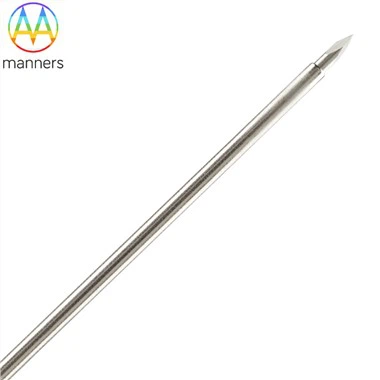
Gradient Temperature Treatment Technology Of 20G*100mm RF Needle
Oct 05, 2026
1. Industry Pain Points
Traditional radiofrequency ablation technology has a single temperature control mode, lacking gradient thermal treatment capability. Most equipment only achieves single high-temperature necrosis above 60℃, which easily causes excessive burning and damage to peripheral normal tissues while killing tumor cells. Once the local temperature exceeds 100℃, irreversible coagulation necrosis of normal parenchymal organs occurs, leading to serious postoperative complications such as organ dysfunction and tissue adhesion. On the contrary, single low-temperature hyperthermia cannot completely kill tumor cells, resulting in high residual and recurrence rate. The absence of gradient temperature zoning technology makes it impossible to balance thorough lesion treatment and normal tissue protection, which has always been a core technical bottleneck restricting the safety of RF ablation.
2. Gradient Temperature Working Principle
The 20G*100mm disposable RF needle realizes precise gradient temperature zoning treatment relying on closed-loop dynamic power adjustment technology. Supported by the complete RF system loop, the measurement and control unit monitors real-time tissue temperature and impedance changes, dynamically adjusting output power to form two independent functional temperature zones. The central area of the lesion forms a high-temperature coagulation zone above 60℃, where tumor cell protein denatures rapidly to achieve thorough irreversible necrosis. The peripheral junction forms a stable 43–60℃ hyperthermia protection zone, which can kill dormant residual cancer cells at the lesion edge without damaging normal tissue cells. Normal cells in the hyperthermia zone have self-repairing ability after mild thermal stimulation, realizing the clinical treatment goal of "thorough lesion removal and maximum normal tissue protection".
3. Gradient Temperature Equipment Classification
According to temperature control accuracy and gradient zoning ability, disposable RF needles are divided into three categories. First, single-temperature conventional needles: only support fixed high-temperature output, no gradient zoning function, easy to cause normal tissue damage, suitable for simple superficial lesion treatment. Second, basic gradient temperature needles: primary temperature zoning, unstable boundary control, large temperature fluctuation, general protection effect. Third, high-precision gradient temperature needles (20G*100mm): matched with high-precision closed-loop system, realizing accurate boundary division of 43–60℃ hyperthermia zone and >60℃ necrosis zone, with stable temperature control and the best protective treatment effect, suitable for high-precision deep tumor and adjacent organ lesion treatment.
4. Gradient Ablation Operational Guidelines
Gradient temperature treatment needs to follow refined zoning operation specifications. First, preoperative zone planning: divide the lesion into central necrosis area and peripheral protective area according to tumor size and proximity to normal organs, and formulate gradient temperature parameters. Second, system parameter setting: set the central target temperature at 60–90℃ and the peripheral hyperthermia temperature at 45–58℃, start closed-loop automatic power adjustment mode. Third, staged thermal treatment: maintain high-temperature ablation in the central area for 3–5 minutes to ensure complete necrosis, then adjust power to stabilize peripheral gradient temperature for 2 minutes to eliminate residual cancer cells. Fourth, boundary verification: confirm the clear boundary of the gradient treatment zone via imaging, ensure no excessive damage to normal tissues and no residual lesions, then complete the operation.
5. Practical Gradient Treatment Experience
Clinical gradient treatment practice shows that the 20G*100mm high-precision gradient RF needle perfectly solves the contradiction between treatment efficacy and safety. The accurate dual-temperature zone design ensures 100% necrosis of mainstream medium-sized tumor lesions, and the peripheral hyperthermia zone effectively cleans up microscopic residual lesions, reducing the postoperative recurrence rate to below 3%. Compared with single-temperature ablation equipment, the damage range of normal tissues is reduced by 50%, and the incidence of postoperative organ dysfunction and inflammatory complications is greatly decreased. The stable closed-loop temperature control system avoids local overheating above 100℃, eliminating the risk of large-area coagulation necrosis of parenchymal organs, and significantly improving the safety and tolerance of tumor ablation surgery.
6. Summary & Sublimation
The gradient temperature control technology of 20G*100mm disposable radio frequency needle innovatively breaks the single-temperature treatment mode of traditional RF ablation. Through closed-loop dynamic power adjustment, it realizes the organic combination of high-temperature thorough lesion necrosis and medium-temperature protective hyperthermia, achieving precise zoning treatment of tumors. This technology not only improves the thoroughness of tumor treatment, but also maximally protects the physiological function of normal tissues, fundamentally improving the safety and clinical value of minimally invasive RF ablation, and promoting the technical upgrading of the industry from simple lesion ablation to precise functional protection treatment.
7. Industry Prospect Suggestions
The industry should popularize gradient temperature ablation technology with 20G*100mm standard needles as the carrier, compile unified gradient temperature parameter guidelines for different tumor types. Further optimize the closed-loop temperature sensing accuracy, narrow the gradient temperature error range, and improve the definition of treatment zone boundaries. Develop intelligent gradient adjustment systems to realize automatic temperature matching according to lesion size and organ location. Strengthen technical training for clinical doctors, standardize gradient ablation operation processes, and promote the comprehensive popularization of high-safety gradient temperature ablation technology in the tumor intervention industry.