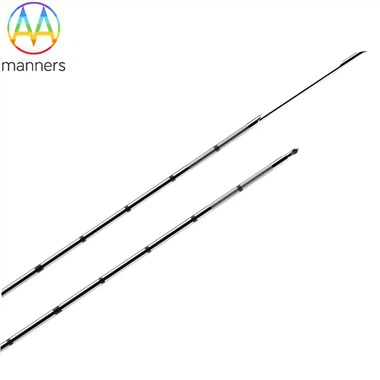
Insulated Vs Non-Insulated RF Needles
Oct 05, 2026
The Pain Point
If there is one myth that quietly injures patients, it is: "The RF only heats at the very tip." In reality, any bare conductive surface submerged in tissue becomes an electrode. On a 22G non-insulated needle inserted 2 mm into a 0.8 mm-thick eyelid, 1.2 mm of shaft is heating the dermis and even superficial fat. The clinical sequelae are now well documented in trainer case files: linear grid burns, transient or permanent fat dimpling along the jaw, post-inflammatory hyperpigmentation (PIH) in Fitzpatrick IV–VI skins, and the dreaded "RF ridge." Most operators blame "energy too high"; the real culprit is often insulation length mismatch. Worse, generic cartridges sometimes mislabel insulation length by ±0.5 mm-a fatal margin at periorbital depths.
Principle - Where the Current Actually Goes
RF current seeks the path of least impedance between active and return electrodes. In bipolar arrays, that path is the tissue bridge between two adjacent tips. In monopolar setups, it fans out toward the dispersive pad. Along a non-insulated shaft, the submerged length acts as a continuous linear electrode-heat falls off gradually with distance from the generator connection, but never to zero. Insulation changes this physics: PTFE (≈0.1–0.3 mm wall), FEP (fluorinated ethylene propylene, more flexible), and parylene-C (vapor-deposited, 10–25 µm, conformal) confine the active zone to a defined exposed length. Typical exposed-tip conventions:
|
Exposed tip |
Target depth |
Indication |
|---|---|---|
|
0.5 mm |
0.5–0.8 mm |
Periorbital, lip lines |
|
1.0 mm |
1.0–1.5 mm |
Cheek texture, pores |
|
2.0 mm |
1.5–2.5 mm |
Jawline, nasolabial base |
|
3–4 mm |
3–4 mm |
Subdermal, pain blocks (16–18G) |
Device Types in Detail
- Fully insulated + micro-tip (0.5–1 mm): The aesthetic safety standard for 23–26G. Epidermis stays cool; heat lands in papillary/upper reticular dermis.
- Partially insulated (2–3 mm exposed): Mid-dermal remodeling; favored for atrophic acne scars where a deeper "anchor" coagulum is wanted.
- Step-insulated (two-zone): A 1 mm bare tip + a second 0.5 mm lateral window for combined tip-and-side heating-used in some fractional scar devices.
- Non-insulated full shaft: Broad thermal cylinder; 16–18G; expert-only for neurolysis/ablation, never for facial wrinkle "spa" use.
- Tapered-insulation: Insulation thickness thins toward the tip, giving a soft energy gradient-useful at jaw–neck transition zones.
Operation Guide - Depth-Insulation Matching Rules
Rule 1: Exposed tip ≤ set depth, never the reverse. If depth = 1.2 mm, use 0.5–1.0 mm exposure. Rule 2: On skin <0.8 mm (lower eyelid, dorsal nose), cap exposure at 0.5 mm and energy ≤4 W bipolar. Rule 3: Overlap <15% on grids; double-firing one point is the classic burn recipe. Rule 4: For Fitzpatrick IV–VI, drop energy 20–30% and extend pulse interval to allow epidermal cooling. Rule 5: After firing, apply non-occlusive cooling gel only-occlusive films trap heat. Log: insulation length, depth, W, pulse (ms), passes.
Real-World Experience
A Bangkok derm clinic audited 60 treatments using identical 25G/6 W settings. Insulated (0.5 mm tip): 2-day erythema, even lift, 0 grid marks in 30 cases. Non-insulated same gauge: 3 grid-mark cases, 1 transient fat dimple at jaw, 2 PIH cases in Fitzpatrick IV patients. The corrective action was not "lower power to 4 W"-it was switching to insulated cartridges and capping depth at 1.0 mm. A Seoul trainer notes: "Students learn power first; I retrain them to think insulation first, power second."
Summary and Sublimation
Insulation is the grammar of RF safety. Just as a punctuation mark decides the meaning of a sentence, the exposed millimeter decides whether energy heals or harms. Bare metal does not "know" where the dermis ends.
Outlook
Next-gen cartridges will embed a temperature-sensitive outer insulation that shifts hue from clear to amber above 42°C surface temp-giving operators a visual stop signal. Generator hubs with RFID will auto-limit depth: scan a 0.5 mm-tip cartridge → generator caps depth at 1.0 mm. By 2028, "insulation length" will be a declared, RFID-locked parameter, not a printed guess on a pouch.