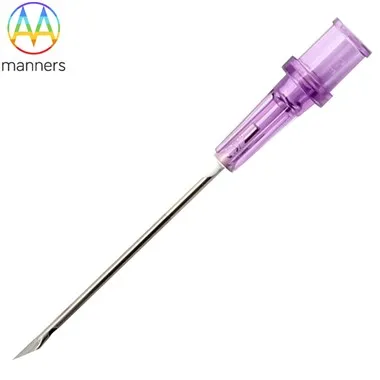
Depth Adaptability Of 20G*100mm Disposable RF Ablation Needle
Oct 05, 2026
1. Industry Pain Points
Depth mismatch is a prominent problem restricting the clinical effect of radiofrequency ablation. Traditional RF needles have single fixed length specifications: short needles (less than 80mm) cannot reach deep visceral lesions such as liver, lung and retroperitoneal tumors, requiring repeated puncture and increasing surgical trauma and bleeding risk; ultra-long needles (more than 120mm) have poor rigidity, easy bending and positioning deviation during puncture, leading to inaccurate lesion targeting and irregular ablation zones. In addition, non-standard length needles cannot match the closed-loop system's depth sensing parameters, resulting in abnormal impedance feedback and unstable temperature control. The lack of medium-length standardized needles suitable for conventional deep lesions leads to low clinical treatment efficiency and high failure rate of deep tumor ablation.
2. Depth Adaptive Working Principle
The 20G*100mm RF needle achieves optimal deep lesion treatment through the perfect combination of standard length specification and closed-loop parameter matching. The 100mm effective working length covers the depth range of most human common deep solid tumors, realizing one-time in-place puncture without repeated adjustment. The high-rigidity stainless steel needle body maintains linear stability during deep tissue penetration, avoiding bending and offset. Combined with the systemic closed-loop control system, the needle can accurately sense impedance and temperature changes of deep dense tumor tissues, automatically adjust RF power output to adapt to the thermal conduction difference of deep tissues. It forms a stable high-temperature coagulation zone above 60℃ in deep lesions and a 43–60℃ protective hyperthermia zone at the edge, realizing efficient and safe precise ablation of deep tumors.
3. Depth Specification Equipment Classification
According to effective working length, disposable RF needles are divided into three depth-adaptive grades. First, superficial short needles (50–80mm): suitable for subcutaneous tumors, superficial lymph nodes and shallow soft tissue lesions, with limited penetration depth, only for shallow tissue treatment. Second, standard medium-length needles (100mm, 20G): the gold standard for deep conventional lesions, balancing rigidity and penetration depth, suitable for abdominal, thoracic and pelvic deep tumors, with the widest clinical adaptation range. Third, ultra-long deep needles (120–150mm): customized for ultra-deep special lesions, with poor operational stability and high positioning difficulty, only for rare special surgical scenarios. The 20G*100mm model is mass-produced with standardized processes, with stable depth adaptability and excellent closed-loop system matching, becoming the mainstream choice for routine deep ablation.
4. Deep Lesion Ablation Operational Guidelines
Deep lesion treatment with 20G*100mm RF needles requires standardized depth positioning and parameter control. First, depth preoperative measurement: use CT/B-ultrasound to measure the vertical depth of the tumor from the body surface, confirm that it matches the 100mm effective length range, and formulate a puncture path. Second, stable deep puncture: hold the needle stably for slow layered penetration, avoid rapid insertion leading to needle body bending, and accurately reach the deep lesion center under real-time imaging guidance. Third, deep closed-loop adjustment: start the deep tissue adaptive mode of the RF system, rely on impedance feedback to adjust power, compensate for the low thermal conduction efficiency of deep tissues, and stabilize the core temperature above 60℃. Fourth, post-ablation inspection: confirm complete deep lesion necrosis via imaging, slowly withdraw the needle layer by layer, and perform hemostasis and anti-infection treatment for deep puncture tracts.
5. Practical Depth Application Experience
Long-term clinical deep ablation practice verifies that the 20G*100mm standard needle solves the depth adaptation dilemma of traditional equipment. Its 100mm effective length perfectly matches the depth characteristics of common liver, lung, renal and pelvic tumors, realizing one-time successful puncture with a success rate of 99%. The high-rigidity needle body avoids positioning deviation during deep tissue penetration, and the closed-loop impedance sensing function accurately identifies the density difference between deep tumor and normal tissues, realizing targeted thermal ablation. Compared with short needles, it eliminates repeated puncture trauma; compared with ultra-long needles, it improves positioning accuracy and ablation regularity. The complete deep spherical coagulation zone formed by the needle significantly improves the cure rate of medium-depth tumors, with fewer postoperative complications and faster patient recovery.
6. Summary & Sublimation
The 20G*100mm disposable radio frequency needle fills the market gap of standardized medium-length deep ablation equipment. With its precise depth adaptation, stable structural rigidity and excellent closed-loop system matching performance, it thoroughly solves the pain points of difficult positioning, unstable ablation and high trauma in deep tumor treatment. It standardizes the depth specification of clinical RF ablation needles, unifies the operation standards of deep lesion minimally invasive treatment, and provides stable and reliable equipment support for the standardized and popularized development of deep tumor RF ablation therapy.
7. Industry Prospect Suggestions
The industry should take 20G*100mm as the core standard length specification to promote the unification of national industry depth standards for RF needles. Optimize the rigidity and toughness balance of 100mm needle body materials to further adapt to complex deep tissue tortuous puncture paths. Develop depth intelligent sensing accessories matching standard needles, improve the real-time depth monitoring ability during operation. Strengthen the clinical popularization of standard deep needles in oncology and interventional departments, reduce the use of non-standard length equipment, and comprehensively improve the standardized treatment level of deep tumor minimally invasive ablation in the industry.