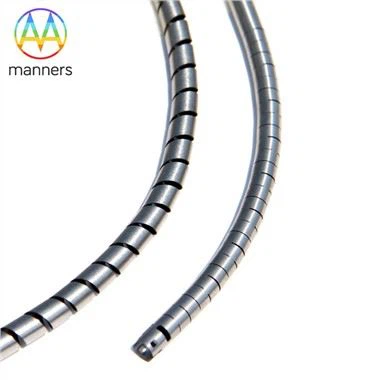
Fusion Of Elastic Mechanics And Micron Art: How Laser-Slot Technology Enables Springback And Torque Transmission In Semi-Rigid Hypotubes
May 01, 2026
In minimally invasive surgical instruments and precision medical devices, there is a constant need for components that can flexibly navigate complex paths, stably transmit rotational torque, and automatically return to a straight state after bending. The slotted semi-rigid laser-cut hypotube is the perfect solution to this demand. Neither as limp as a fully flexible tube nor as inflexible as a rigid tube, it achieves an exquisite balance between the two. This article analyzes in depth how manufacturers use high-precision laser cutting to carve intricate slot patterns into metal tubing, 赋予材料可控弹性,并同时实现看似矛盾的 "弹回" 与扭矩传递特性.
I. Design Philosophy: Finding the Golden Mean Between Rigidity and Flexibility
The core design of a slotted semi-rigid hypotube involves cutting a series of precisely defined transverse or spiral slots into a continuous metal tube (typically stainless steel or nitinol). These slots are not randomly arranged but follow mechanically optimized, structured patterns. The design philosophy hinges on three principles:
Creating localized flexible hinges: Slots create deliberate, thin "hinge regions" in the tube wall. Under transverse loads, stress concentrates at these hinges, allowing the tube to bend predictably around these points.
Preserving global structural continuity: Solid segments between slots-called webs or bridges-maintain the tube's overall integrity. These webs bear and transmit axial push/pull forces and, critically, rotational torque.
Tuning bending stiffness and elastic recovery: By precisely controlling slot width, depth, pitch, and pattern (transverse, spiral, or hybrid), engineers can "program" the tube's spring rate and elastic restoring force-much like designing a spring. The goal: full elastic return to straightness after bending, with no plastic deformation.
II. Laser Cutting: The "Engraving Tool" for Micron-Level Precision
Traditional machining (milling, wire EDM) cannot deliver this design-they introduce stress, burrs, and limited accuracy. High-precision laser micromachining, especially fiber or femtosecond lasers, is the only viable solution.
Non-contact processing eliminates mechanical stress: Laser cutting is non-contact, avoiding compression or tension on the tubing. This eliminates residual stress during manufacturing-critical for long fatigue life.
Micron-level precision and consistency: Requirements like ultra-precise slot width/pitch control and outer diameter tolerance ±0.01 mm are reliably achievable only with lasers. Modern systems use high-accuracy motion platforms and real-time visual compensation, carving thousands of identical slots with micron repeatability across meters of fine tubing.
Freedom for complex patterns: Simple straight transverse slots, intricate spiral slots, staggered patterns, or variable-pitch designs are all easily programmed. Spiral slots excel at maintaining torque efficiency during bending.
Controlled Heat-Affected Zone (HAZ): For heat-sensitive nitinol, ultrafast femtosecond laser "cold machining" minimizes HAZ, preserving the alloy's superelasticity and ensuring exceptional springback performance.
III. Engineering Realization of Core Performance
Elastic Recovery (Springback)This depends on two factors: the material's elastic limit and the slot design. High-yield stainless steel (e.g., 304V) and superelastic nitinol (NiTi) are preferred. Nitinol offers 8% elastic strain (far higher than stainless steel), enabling larger bending angles and reliable recovery. The slot design-optimizing slot depth-to-wall thickness ratio and web width-ensures bending stress stays below the material's yield strength, preventing permanent deformation.
Rotational Torque Transmission (1:1 Fidelity)This is what distinguishes slotted semi-rigid hypotubes from ordinary springs: effective torque transfer even when bent. The solution lies in clever slot geometry. Spiral slots or engineered staggered transverse slots create continuous, angled force paths in the tube wall. When the proximal end rotates, torque travels through uncut webs as shear force. Even bent, these webs remain connected, ensuring torque efficiency. The design objective: maximize the ratio of torsional stiffness to bending flexibility.
Strain Relief FunctionIn medical devices, these tubes act as mechanical shock absorbers between rigid components (e.g., handles) and flexible parts (e.g., catheter shafts). They absorb stress concentrations from relative motion or bending, preventing fatigue failure at fragile joints (welds, adhesions)-dramatically boosting overall device reliability.
IV. Core Process Competencies for Manufacturers
Consistently producing high-performance slotted semi-rigid hypotubes demands mastery of key manufacturing capabilities:
Advanced laser process database: Optimized parameters (power, frequency, speed, assist gas) for stainless steel/nitinol, varying tube diameters/wall thicknesses. Ensures burr-free cuts and minimal HAZ.
Precision motion control + in-line inspection: Maintains stable laser focus position during high-speed cutting. Integrated real-time vision systems monitor slot width/pitch for closed-loop control.
Specialized post-processing: Electropolishing removes micro-burrs and oxide layers from cut edges. This delivers smooth, low-friction surfaces and eliminates stress raisers-critical for passing high-cycle fatigue testing.
Simulation-driven design services: Top manufacturers do not just "print to drawing." Using Finite Element Analysis (FEA), they simulate bending stiffness, torque efficiency, stress distribution, and fatigue life-to optimize slot geometry for peak performance and reliability.
Conclusion
The slotted semi-rigid laser-cut hypotube epitomizes the fusion of elastic mechanics and advanced micromachining. Through precision "subtractive manufacturing," it creates controlled flexibility in metal tubing, elegantly resolving the core medical device paradox: needing to bend through anatomy while retaining rigid functional strength. Manufacturers mastering this technology are, in essence, micron-scale metal spring designers-using lasers as brushes and metal as canvas to craft structures that bend with agility yet transmit force with rigidity. They provide reliable "bones and joints" for countless flexible surgical instruments and precision actuation systems.