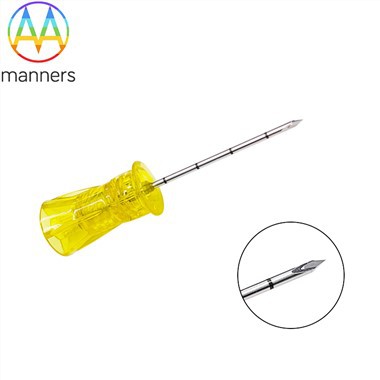
As Class III medical devices,
vacuum-assisted breast biopsy needles carry safety implications that directly impact patient life and health. Manufacturers must implement full lifecycle control covering design, procurement, production, inspection and post-market services under the ISO 13485 and ISO 9001 quality management systems. This article dissects the closed-loop quality control system for VABB needles, spanning raw material certification, in-process inspection, finished product release and adverse event feedback.
1. Raw Material Access: Traceability from Steel Mills to Production Workshops
Every batch of SS316 tubing must be accompanied by material certificates specifying chemical composition (Cr 16–18%, Ni 10–14%, Mo 2–3%) and mechanical properties (tensile strength ≥ 515 MPa, elongation ≥ 40%). Upon delivery, random samples are subjected to hardness testing (HRC 30–40), dimensional measurement (outer diameter tolerance ±0.01 mm) and RoHS hazardous substance analysis. Any materials failing compliance with RoHS Directive 2011/65/EU and its 2015/863 amendment are fully rejected. All records are retained for a minimum of 10 years to guarantee full traceability.
2. In-Process Inspection: Gatekeeper for Every Manufacturing Step
For parts machined on Citizen L12-1M7 lathes, first-article inspection is conducted after every 50 pieces produced. Profile projectors and feeler gauges verify needle tip angles, sample notch width and internal chamfers of cutting cannulas. Post laser marking, barcode scanners confirm mark legibility, while microhardness testers ensure no thermal softening occurs in marked zones.
Following passivation and electropolishing, three samples per batch undergo SEM surface topography examination and ASTM B117 salt spray testing (zero rust formation over 24 hours). After ultrasonic cleaning, liquid particle counters measure particulate concentration in cleaning fluid (no more than 100 particles ≥10 μm per milliliter).
3. Finished Product Inspection and Sterility Release
Finished needles must pass the following testing items:
- Dimensions: Laser micrometers recheck outer diameter and length (drawing deviation ≤ 0.05 mm);
- Puncture force: Universal testing machines measure peak force when the tip penetrates silicone tissue simulant (≤ 2.0 N);
- Vacuum tightness: Connection to negative-pressure equipment verifies no leakage while maintaining –80 kPa for 30 seconds;
- Sterility: Post ethylene oxide (EO) sterilization, biological indicator (BI) incubation and sterility testing are performed to achieve a sterility assurance level (SAL) of 10⁻⁶.
All inspection data is logged into the MES (Manufacturing Execution System) to generate batch records linked to unique serial numbers.
4. Post-Market Surveillance and Continuous Improvement
Manufacturers maintain an adverse event database to collect global complaints including needle tip fracture, insufficient tissue specimens and vacuum system failure. Annual Corrective and Preventive Action (CAPA) reviews are held. For example, if burrs on sample notch edges cause specimen tearing in a batch, root-cause analysis identifies excessive wear on notching cutting tools; tools are replaced immediately and tool change intervals adjusted accordingly. Regular internal audits and management reviews drive the quality management system toward a zero-defect objective.
Conclusion
Behind one miniature vacuum-assisted breast biopsy needle lie dozens of material certificates, hundreds of control checkpoints and thousands of hours of validation data. ISO 13485 is far more than a certification document-it represents an unbroken quality commitment extending from design and manufacturing through clinical application.