From Stainless Steel Tube To Precision Insufflation Needle: Demystifying The Production Of Veress Needles
Jul 11, 2026
https://en.wikipedia.org/wiki/Veress_needle
Though small in size, the Veress needle exemplifies precision medical device manufacturing. A qualified Veress needle undergoes over ten meticulous processes-from material selection and tip grinding to spring assembly, surface treatment, and cleaning/packaging. Precision control at each stage directly impacts clinical safety and reliability. This article delves into the core manufacturing techniques involved.
Raw Material Selection: Mainstream Veress needles utilize medical-grade stainless steel 304 or 316L seamless capillary tubes, typically 2.5mm–5mm OD (12G–18G) with 0.1mm–0.2mm wall thickness. 316L, containing molybdenum, offers superior corrosion resistance compared to 304, making it ideal for repeated exposure to bodily fluids and disinfectants. Tubes undergo eddy current testing, hardness testing (HV 200–250), and chemical composition analysis to ensure compliance with ISO 9626 standards for needle tubing.
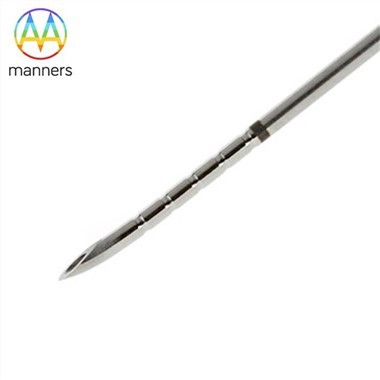
Needle Tip Grinding: This is the most critical process. The Veress tip is conical or beveled, shaped via CNC precision grinding. The grind angle (typically 15°–25°) directly affects penetration force and tissue trauma: smaller angles yield sharper but weaker tips; larger angles increase insertion resistance. Post-grinding, microscopic inspection ensures edge integrity (no chipping/burrs), complemented by sharpness testing (e.g., penetrating silicone tissue simulants). Advanced manufacturers employ laser cutting辅助 (auxiliary) grinding to further refine edge precision.
Spring Obturator Assembly: Unique to Veress needles, the internal blunt obturator is turned from stainless steel rod. The tip must be smoothly rounded to prevent tissue injury upon deployment, while the tail connects to a precision spring. Spring tension is tightly controlled (typically 0.5N–1.5N) to ensure reliable retraction against fascial resistance and swift deployment upon entering the peritoneum. Assembly occurs in cleanroom environments to prevent particulate contamination, followed by functional testing (depress/release cycles) to verify performance.
Surface Treatment: Includes electropolishing and passivation. Electropolishing removes micro-burrs, reduces surface roughness (Ra < 0.2μm), and minimizes tissue adhesion/bacterial attachment. Passivation (citric or nitric acid) forms a dense chromium oxide layer, enhancing corrosion resistance. Post-treatment, lumen patency is verified via flow testing to ensure compliance with insufflator flow dynamics.
Cleaning & Packaging: Ultrasonic cleaning removes residual oils and metallic debris, with final rinses meeting WFI (Water for Injection) standards. Packaging typically employs Tyvek thermoform trays or pouches, ensuring sterile barrier integrity. Sterilization utilizes Ethylene Oxide (EO) or Gamma irradiation, validated by biological indicator challenges to achieve a Sterility Assurance Level (SAL) of 10⁻⁶.
The entire process adheres strictly to ISO 13485 quality management systems. Each batch undergoes comprehensive testing-dimensional, functional, visual, and sterility-with full traceability records retained. This relentless pursuit of precision manufacturing and quality control underpins the Veress needle's exceptional clinical performance.