From Ovarian Puncture To Oocyte Preservation: Fluid Dynamics And Micro-Trauma Control Engineering in OPU Needles
Apr 12, 2026
From "Ovarian Puncture" to "Oocyte Preservation": Fluid Dynamics and Micro-Trauma Control Engineering in OPU Needles
Introduction: The "First Mile" Bottleneck in Rapid Breeding
In the entire chain of cattle rapid breeding via OPU-IVP (Ovum Pick-Up - In VitroProduction), live oocyte retrieval is the starting point that determines all subsequent possibilities. It is also the most critical step, relying heavily on both operator expertise and instrument precision. Here lies a fundamental engineering conflict: the trade-off between oocyte recovery rate and ovarian tissue micro-trauma. The OPU needle must, in a single puncture, efficiently aspirate the contents of multiple follicles (2–8 mm in diameter) using sufficient negative pressure flow, ensuring the integrity of the Cumulus-Oocyte Complexes (COCs). Simultaneously, the sharp needle tip, high flow velocity, or improper path can cause unnecessary cutting and hemorrhage to the ovarian parenchyma, compromising the long-term reproductive health of the donor cow and the viability of repeated OPU cycles. This is a precision engineering challenge performed within an unseen living body, targeting microscopic objectives while balancing "production efficiency" against "animal welfare."
1. Core Conflict: Aspiration Efficiency vs. Tissue Friendliness
The OPU process is essentially transvaginal ultrasound-guided puncture and vacuum aspiration. The physical contradiction concentrates on the flow field and stress field at the needle tip.
High Recovery Demand: Requires precise follicle localization and sufficient shear force to detach the cumulus cell mass, transporting it into the needle cannula via stable laminar flow without retention in the needle tract or connectors.
Low Trauma Requirement: Needle insertion, aspiration, and the puncture path induce mechanical stress and localized ischemia on the ovarian capsule and parenchyma. Trauma triggers inflammatory responses and tissue adhesions, subsequently reducing the number of available follicles and potentially causing animal discomfort, thus undermining the sustainability of the donor as a "living oocyte factory."
2. Calibration Variable 1: Tip Geometry - The "Armor Piercer" of Puncture and the "Flow Collector" of Fluid Dynamics
The needle tip is the interface interacting directly with the tissue; its design is the convergence of fluid mechanics and structural mechanics.
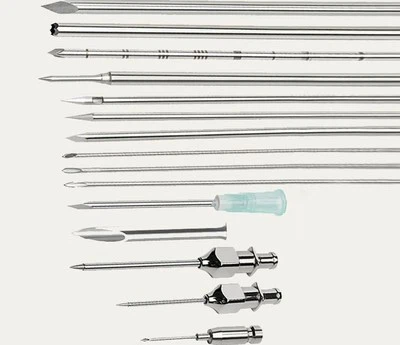
Bevel Angle and Edge Sharpness: Traditional bevel tips (e.g., 18G) offer low puncture resistance, but their sharp edges act more like a "knife" during probe manipulation, easily cutting interfollicular tissues and vessels. We optimize this by employing double-bevel (pencil-point) or protective sheath tips. During puncture, the blunt tip bluntly dissects tissue fibers, reducing laceration; upon reaching the follicle, the sharp side edges cleanly incise the follicular wall, minimizing tearing.
Side Hole Quantity, Size, and Layout: Single-end-hole needles effectively aspirate only the follicle directly aligned with the tip. We design 2–3 symmetrical side holes proximal to the tip. This achieves two functions: 1) Expanded Collection Range: The needle tip does not need to be centered in every small follicle; "area collection" is achieved by moving within a cluster, significantly boosting efficiency. 2) Stable Flow Field: Multi-port intake reduces turbulence and vortices that may occur at the end hole, allowing oocytes to enter the cannula more gently and reducing physical damage risk.
3. Calibration Variable 2: Aspiration System Fluid Control - From "Brute Force Suction" to "Precise Capture"
The aspiration system is the "conveyor belt" for oocytes; its stability is paramount. The core lies in precise negative pressure control and the elimination of pulsation.
Balance of Constant Negative Pressure and Pulse Lavage: Simple vacuum pumps provide constant negative pressure, but this easily leads to occlusion or incomplete recovery when follicular contents are viscous or COCs are loosely attached. We introduce a programmable pulsed aspiration system. Upon detecting a drop in flow rate (indicating potential blockage), the system automatically switches to an instantaneous positive pressure pulse (lavage mode) to clear the needle tract, immediately restoring negative pressure afterward. This mimics a more physiological "sipping" action, increasing the capture rate of tightly adhered COCs.
Line Compliance and Dampeners: Long, soft silicone tubing cushions pressure changes but causes operational response delays. We integrate miniature pulsation dampeners and real-time pressure sensors between the OPU needle and the pump. The dampener smooths micro-fluctuations from the pump source, while the sensor provides closed-loop feedback, allowing the operator to "visually perceive" the pressure state at the tip-enabling "haptic visualization" to avoid oocyte traction damage or incomplete follicular collapse caused by blindly increasing negative pressure.
4. Calibration Variable 3: Needle Body Materials and Surface Engineering - Minimizing Biological Friction and Cell Adhesion
Repeated movement of the needle body within tissue causes frictional damage, while adhesion of oocytes within the needle lumen means direct loss.
Rigidity-Flexibility Gradient Design: The needle body needs sufficient rigidity for precise puncture force transmission, but full-length rigidity increases tissue damage risk. We employ composite tubing with a rigid proximal section and a flexible distal section, or apply an ultra-thin flexible polymer coating over a stainless steel needle. This ensures puncture precision while allowing the distal end to conform to physiological curves during transducer angulation, reducing rigid scraping of the vaginal fornix and ovarian ligaments.
Inner Wall Super-Lubrication: The inner walls of the needle and collection tubing undergo hydrophilization or bio-mimetic phospholipid coating. This allows protein-rich follicular fluid and cell clusters to pass with extremely low frictional resistance, significantly reducing cell adhesion and residue on the tube walls. This ensures recovered cells enter the collection cup maximally, improving the final recovery rate.
5. Validation: Recovery Rate-Trauma Dual-Index Model
How do we quantify the performance of an OPU needle? We establish a validation system combining ex vivoand in vivomodels.
Test 1: Ex VivoOvarian Model Efficiency Test: Fresh abattoir ovaries are fixed in a 37°C saline bath. Under ultrasound guidance, standardized OPU procedures are performed using the test needle versus a control needle. Comparisons are made regarding visible follicle puncture rate, oocyte recovery rate, and the morphological integrity rate of recovered oocytes (homogeneous cytoplasm, intact cumulus cell wrapping). A superior needle should demonstrate a recovery rate increase of >15% over traditional needles, with an integrity rate exceeding 90%.
Test 2: In VivoAnimal Post-Operative Trauma Assessment: Following serial OPU procedures on donor cows, laparoscopic observation or follow-up ultrasound imaging is used to assess the number of bleeding points and adhesion area on the ovarian surface. Concurrently, follicular development dynamics during subsequent natural estrous cycles are monitored. High-performance needles should reduce visible micro-trauma by >50% without impairing long-term ovarian function or repeatability.
Conclusion: Precision, Efficiency, and Sustainable Live Sampling Engineering
A superior OPU needle is far more than a hollow metal tube. It is a micro-live sampling platform integrating precision mechanical design, intelligent fluid control, and advanced biomaterials. Its mission is to stably, gently, and efficiently acquire primitive genetic material from the most valuable bioreactor-the living animal-with minimal intervention.
At Bovine Master, we view the OPU needle as the first bridge connecting elite genetics with industrial propagation. Through deep optimization of tip fluid-structure interaction, intelligent aspiration control, and the biological interface of the needle body, we unify the seemingly contradictory goals of "high-efficiency collection" and "animal welfare" within a precise engineering solution. This not only enhances single OPU output but also safeguards the lifelong reproductive value of donor cows, laying a solid technical foundation for the sustainable development of the cattle rapid breeding industry.