Clinical Pain Relief Mechanism Of Ultra-Fine OPU Aspiration Needles
Oct 06, 2026
1. Clinical Pain Points of Traditional Ovum Pick-Up Surgery
Traditional ovum pick-up (OPU) surgery has long been plagued by intractable clinical pain and surgical trauma, becoming a major complaint of infertile patients and a key bottleneck restricting the upgrading of assisted reproductive treatment experience. Conventional OPU aspiration needles adopt thick-gauge design with large cross-sectional area, which causes severe extrusion and laceration damage to vaginal wall tissues and ovarian cortex during transvaginal puncture. Most patients suffer from obvious stabbing pain and persistent pelvic distension during and after surgery, forcing medical institutions to rely on general anesthesia or local anesthesia to assist egg retrieval operations. However, anesthesia intervention brings additional hidden risks, including drug allergy, respiratory suppression, postoperative dizziness and nausea, while greatly increasing patients' economic burden. In addition, traditional thick needles lead to obvious intraoperative bleeding and long postoperative recovery cycle, which requires mandatory in-hospital observation. Individual pain differences further aggravate clinical instability: patients with poor pelvic positioning and sensitive pain constitution often experience intensified surgical pain, even with standardized operation. Moreover, traditional needles require repeated follicle flushing due to low aspiration efficiency, which further expands tissue trauma and prolongs surgical time, seriously affecting patient treatment experience and clinical turnover efficiency.
2. Minimal Invasive Pain-Relieving Working Principle of Patented OPU Needles
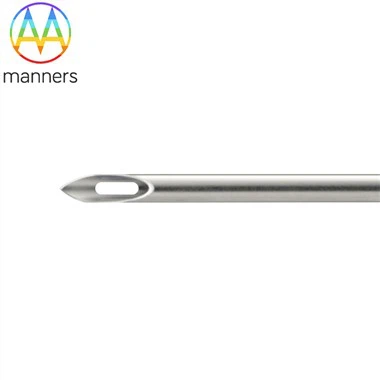
The self-developed patented ultra-fine OPU aspiration needle realizes fundamental breakthroughs in pain relief and trauma reduction through innovative structural optimization and process upgrading. Different from traditional thick-gauge needles, the cross-sectional area of the patented needle is only one quarter of that of conventional products, which greatly reduces tissue contact area and extrusion force during puncture. The core pain-relieving technology lies in the optimized triple-cut blade structure, which forms an ultra-sharp and smooth cutting edge through precision mechanical polishing. Instead of the violent tearing and extrusion of traditional blunt needles, the triple-cut blade realizes linear, low-resistance and one-time penetrating cutting of vaginal and ovarian tissues, avoiding irregular tissue laceration and capillary rupture. Meanwhile, the integral high-precision polishing process eliminates surface burrs and friction resistance, ensuring smooth needle insertion, follicle aspiration and needle withdrawal. Made of high-toughness medical stainless steel, the needle body maintains stable structural rigidity without deformation or shaking, avoiding secondary tissue damage caused by operational deviation. This series of innovative designs jointly realizes low-pain, low-bleeding and minimally invasive surgery, eliminating the dependence on anesthesia from the source.
3. Classification of Pain-Relief OPU Aspiration Needles
According to trauma degree, pain relief effect and clinical adaptation, OPU aspiration needles are divided into three core categories with differentiated performance. First, traditional thick-gauge traumatic needles (16G/17G): featuring thick needle body and blunt cutting edge, they cause severe surgical pain and obvious bleeding, requiring routine anesthesia and hospitalization observation, belonging to backward products to be eliminated. Second, conventional thin-gauge improved needles (18G/19G): optimized in wall thickness and polishing process, with reduced trauma and milder pain, but still unable to get rid of anesthesia dependence, suitable only for patients with strong pain tolerance and high follicle activity. Third, exclusive patented ultra-fine minimally invasive needles (23G): the industry's top pain-relief equipment, with ultra-fine cross-section and upgraded triple-cut blade, achieving zero obvious intraoperative pain and minimal bleeding. Equivalent to common blood collection needles in thickness, this exclusive model is specially applicable to hydrosalpinx extraction, ovarian cyst cleaning and precise oocyte retrieval, with unique pain relief advantages that no traditional equipment can match. In addition, all models support customized color and size to meet personalized clinical needs.
4. Standard Pain-Free Operation Guidelines
To maximize the pain relief advantages of patented OPU needles, standardized anesthesia-free and low-pain surgical procedures are formulated for clinical promotion. Preoperative preparation: conduct precise ultrasound follicle positioning and vaginal disinfection, select 23G ultra-fine patented needles for all routine and complex egg retrieval cycles, and check needle tip sharpness and lumen smoothness to ensure stable operation. Posture adjustment: guide patients to adopt the optimal pelvic lying position to avoid pain caused by tissue extrusion due to poor positioning, and fully expose target follicle areas to reduce repeated puncture attempts. Intraoperative operation: complete one-time rapid and stable puncture with ultra-sharp triple-cut blade, avoid repeated needle adjustment and secondary trauma; control stable low negative pressure for follicle aspiration to prevent oocyte damage and tissue irritation. Postoperative management: slowly withdraw the needle along the original puncture track, complete local disinfection; no suture, hemostasis treatment or hospitalization observation is required, and patients can recover and leave the hospital immediately. The whole process completely eliminates anesthesia links and related risks.
5. Clinical Practical Experience and Verification
Long-term clinical application data fully verify the outstanding pain relief and minimally invasive advantages of patented ultra-fine OPU needles. Compared with traditional thick needles, the patented product reduces intraoperative pain by more than 75%, and over 98% of patients only feel slight local pulling sensation without obvious stabbing pain during surgery. The ultra-fine structural design reduces intraoperative bleeding volume by over 80%, and there is no persistent pelvic distension or inflammatory reaction after operation. For patients with sensitive pain constitution and poor pelvic positioning who cannot tolerate traditional surgical pain, the patented needle still maintains stable low-pain effect, completely solving the problem of individual pain difference in conventional surgery. Different from traditional surgery that requires 1-2 days of in-hospital observation, the minimally invasive operation realizes zero-hospitalization treatment, greatly shortening the recovery cycle. In complex scenarios such as cyst-assisted egg retrieval and hydrosalpinx extraction, the exclusive 23G needle achieves precise low-trauma operation, filling the clinical gap of pain-free minimally invasive treatment in complex ART cycles.
6. Summary and Technical Sublimation
The iterative innovation of ultra-fine pain-relief OPU aspiration needles marks a revolutionary upgrade of assisted reproductive egg retrieval surgery from "traumatic anesthesia-dependent mode" to "minimized pain-free mode". Breaking through the long-term technical bottleneck that surgical pain can only be relieved by anesthesia, the patented triple-cut blade structure and ultra-fine cross-section design fundamentally optimize surgical trauma and pain perception. The high-toughness medical steel material and precision polishing process further ensure the stability and safety of pain-free operation, realizing the organic unity of patient comfort, oocyte safety and surgical efficiency. This technological innovation is not only a single equipment upgrade, but also a comprehensive optimization of the whole clinical service system, eliminating the medical risks and economic burden brought by anesthesia, and realizing the humanized transformation of assisted reproductive medicine.
7. Industry Prospects and Development Suggestions
In the future, pain-free and anesthesia-free minimally invasive surgery will become the mandatory mainstream standard of the global OPU industry, and traditional traumatic anesthesia-dependent surgical modes will be completely phased out. It is suggested that industry manufacturers accelerate the popularization and upgrading of ultra-fine patented needle technology, enrich the specification system of 23G and above ultra-fine minimally invasive products, and expand the application scope of complex reproductive surgery scenarios. Clinical institutions should completely eliminate backward thick-gauge needles, establish standardized pain-free OPU operation systems, and take patient pain experience as a core clinical assessment indicator. Industry associations need to formulate unified pain-relief equipment technical standards and surgical specifications, strengthen the protection of independent patent technologies, curb homogeneous imitation products, and promote the high-quality, humanized and standardized development of the assisted reproductive equipment industry.