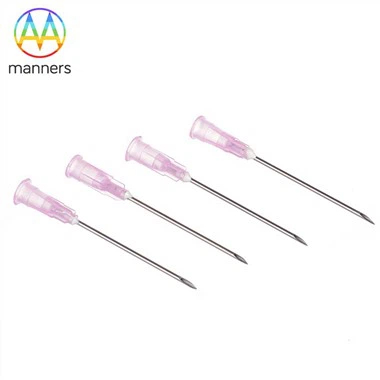
Oocyte Protection Technology And Lumen Polishing Advantages Of OPU Needles
Oct 06, 2026
1. Core Clinical Pain Points of Oocyte Damage
Oocyte mechanical damage and activity reduction caused by unoptimized OPU needle structure are key hidden dangers affecting the success rate of IVF treatment. Most traditional low-end OPU needles adopt rough processing technology without fine lumen polishing, resulting in uneven inner wall and residual burrs. During negative pressure aspiration, follicle fluid and oocytes rub violently against the rough lumen wall, easily causing oocyte rupture, cytoplasmic loss and zona pellucida damage, which directly reduce oocyte fertilization rate and embryo qualification rate. In addition, traditional needles have poor structural uniformity, and unstable negative pressure matching easily leads to excessive shear force on fragile small follicle oocytes, resulting in irreversible cell damage. For low-response patients with limited follicle resources, oocyte damage caused by inferior needles will lead to waste of precious follicle resources and reduced cycle pregnancy rate. Moreover, unpolished needle walls are prone to follicle fluid residue and bacterial adhesion, increasing the risk of follicle contamination and embryo culture failure, forming a major technical obstacle to the improvement of clinical ART treatment effect.
2. High-Precision Polishing Oocyte Protection Principle
High-quality OPU aspiration needles adopt integral mirror polishing technology based on top-grade medical stainless steel, building a full-process safety protection system for oocytes. The core protection principle is to eliminate mechanical friction and shear damage through ultra-smooth lumen structure. After multi-times fine polishing, the inner wall of the needle lumen achieves zero burr, zero roughness and ultra-low friction coefficient, ensuring that oocytes pass through the lumen smoothly and stably under stable negative pressure, without mechanical extrusion and scratch damage. The high-purity medical stainless steel material has excellent biocompatibility, no biological toxicity and chemical irritation, avoiding immune damage and contamination of oocytes and follicle fluid. Meanwhile, the optimized lumen structural design realizes uniform negative pressure transmission, effectively avoiding local excessive pressure leading to oocyte rupture. The matched triple-cut sharp blade reduces tissue trauma and follicle wall rupture deviation, ensuring complete acquisition of intact follicle fluid and maximum retention of oocyte activity and integrity.
3. Classification of OPU Needles by Oocyte Protection Performance
According to lumen polishing precision and oocyte protection capability, OPU needles are divided into three graded product systems. First, unpolished ordinary needles: rough inner wall, prominent burrs, serious oocyte shear damage, low cell intact rate, only suitable for non-clinical experimental teaching, completely unable to meet formal IVF treatment standards. Second, semi-polished conventional needles (16G-19G): basic surface polishing treatment, reduced lumen friction, certain oocyte protection effect, suitable for high-response patients with sufficient mature follicles, with ordinary comprehensive protection performance. Third, full mirror-polished patented ultra-fine needles (23G): industry's highest polishing standard, zero friction lumen, uniform and stable negative pressure transmission, ultra-high oocyte intact rate and activity retention rate. Exclusive to high-precision minimally invasive surgery, this model is specially used for fragile small follicles and precious oocyte collection, with irreplaceable protection advantages for low-response and difficult infertility patients.
4. Standard Oocyte Protection Operation Guidelines
Formulate targeted standardized operation specifications based on the protection performance of different OPU needles to maximize oocyte utilization rate. For semi-polished conventional needles: stabilize negative pressure at 90-110mmHg, adopt slow and uniform aspiration speed, avoid rapid pressure change causing oocyte extrusion damage, and properly reduce flushing times to minimize lumen friction. For full mirror-polished 23G ultra-fine patented needles: adjust optimal low negative pressure (80-90mmHg), utilize ultra-smooth lumen advantage to realize one-time complete aspiration without repeated flushing, fully protect fragile oocyte activity. Preoperatively, strictly inspect lumen smoothness of each needle to eliminate unqualified products with residual burrs. Intraoperatively, avoid long-term lumen exposure and repeated suction and discharge operations to prevent follicle fluid residue and cell damage. Postoperatively, classify and count oocyte integrity to optimize subsequent operation parameters in real time.
5. Practical Clinical Application Experience
Clinical comparative experiments confirm that full mirror-polished patented OPU needles significantly improve oocyte protection effect and IVF success rate. The oocyte intact rate of polished high-quality needles is 20% higher than that of traditional unpolished needles, and the high-quality embryo formation rate increases by 15%. For low-response patients with only a small number of follicles, the ultra-smooth lumen of 23G ultra-fine needles almost eliminates mechanical damage to oocytes, greatly improving the utilization rate of limited follicle resources. Certified by SGS and ISO13485 medical standards, high-grade polished needles have stable biocompatibility, zero intraoperative contamination and zero postoperative adverse reactions. Different from traditional needles that require repeated follicle flushing leading to oocyte loss, patented polished needles realize one-time efficient and safe collection, effectively reducing the waste of precious reproductive resources and significantly improving the clinical pregnancy rate of difficult infertility cycles.
6. Technical Summary and Sublimation
Lumen polishing precision and material quality are the core technical indicators determining the clinical value of OPU aspiration needles. The upgrade from rough unpolished structure to full mirror-polished ultra-smooth structure fundamentally solves the clinical pain point of oocyte mechanical damage caused by traditional equipment. High-quality medical stainless steel ensures biosafety and structural stability, while precision polishing technology realizes full-process protection of oocyte integrity and activity. This technological optimization changes the traditional operation mode of "prioritizing acquisition quantity and ignoring cell quality", realizing the qualitative leap of OPU surgery from "simple collection" to "precision protection". It provides a solid technical guarantee for improving the success rate of assisted reproductive treatment and protecting patients' reproductive rights and interests.
7. Industry Optimization Prospects and Suggestions
In the future, full mirror polishing technology will become the mandatory manufacturing standard for high-end OPU needles, and unpolished inferior products will be completely eliminated from the clinical market. It is suggested that equipment enterprises increase investment in precision polishing technology research and development, improve lumen smoothness and structural uniformity of ultra-fine needles, and form differentiated technical advantages in oocyte protection. Clinical institutions fully popularize full-polished patented minimally invasive needles, establish oocyte quality assessment systems linked to equipment performance, and continuously optimize surgical matching parameters. Industry authorities formulate unified polishing process standards and product grading specifications, take oocyte protection rate as the core evaluation index of product quality, and guide the industry to develop towards refined, precise and high-value clinical service orientation.