Polished Lumen Protects The Oocyte
Oct 06, 2026
Pain Point: The Invisible Oocyte Damage
Patients scrutinize stimulation doses; embryologists lose sleep over a subtler threat-mechanical oocyte injury incurred between the follicular antrum and the collection dish. A COC exposed to turbulent suction, a micro-burr at the lumen–tip transition, or a pressure spike arrives at the lab looking "retrieved" but subtly compromised: cumulus partially stripped, zona irregular, cytoplasmic granulation under polarization microscopy. These injuries rarely present as overtly fractured eggs; they surface 24–48 hours later as failed fertilization, 2PN fragmentation, or day-3 arrest. Retrospective root-cause analysis almost never implicates the needle-unless the lab deliberately audits needle-wall quality alongside pump settings.
Principle of Gentle Fluidics
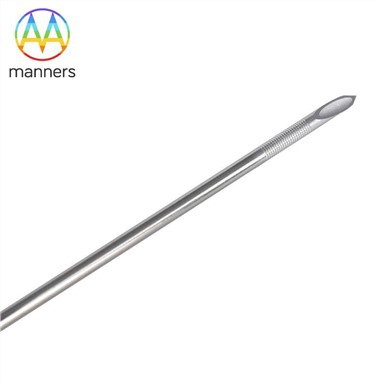
The human oocyte (~100 µm) sits within a compliant cumulus matrix that tolerates laminar, low-shear transport far better than turbulent jet flow. Surface roughness at the lumen wall is the silent antagonist: drawn stainless steel carries micro-pits from the extrusion process (Ra often 0.4–0.8 µm as-drawn). Electropolishing dissolves these micro-peaks, bringing Ra to ≤0.2 µm and creating a passivated, low-adhesion surface. The COC glides rather than catches. Combined with a triple-cut bevel-three laser-honed facets that distribute insertion force-the entry is a clean cleavage of tissue rather than a tearing wedge. Flow continuity is further preserved by smooth-bore luer locks: step-edges at the hub are a known site of flow separation and micro-eddy formation that can momentarily accelerate the COC.
Device Feature Breakdown
- 316L medical stainless: tensile strength ~520 MPa, chloride-resistant, validated for single-use saline/medium exposure.
- Electropolished lumen: Ra ≤0.2 µm; reduces protein/cumulus adhesion; eases cleaning validation even though needles are single-use (matters for extractables testing).
- Triple-cut bevel: bench tests show ~30% lower insertion force vs. single-bevel; smaller thermal lesion.
- Non-kink silicone-blend tubing: shape-memory after 180° fold; avoids flow choke.
- Color-coded hubs (blue/red): prevent aspiration/flush line reversal-a rare but catastrophic error.
- Peel-off sub-label: lot traceability for MEA batch correlation.
Operating Guide for Oocyte-Gentle Handling
Prime both lumina with warm (37°C), de-bubbled medium; a 0.2 mm air pocket can cause a 10–15% pressure jitter.
Use pump ramp mode (0→target pressure over 0.5 s) if available; avoid step-jump suction.
Cap suction at protocol limits: 80–110 mmHg (mild/natural), 120–150 mmHg (standard), ≤180 mmHg (16G donor).
Keep collection vial in heated block; hand to embryologist within 60 s.
Release suction before withdrawal-dragging under vacuum strips cumulus strands.
Never wipe the tip mid-case (micro-scratches the electropolished surface); never rest the needle on the drape.
Single-use only; do not "bridge" two patients even with rinse claims.
Field Wisdom & Audit Data
A veteran embryologist's axiom: "Sudden denudation without hyaluronidase? I blame the pump ramp and the lumen, not the 38-year-old ovary." Three labs running a quarterly "needle-wall audit" compared COC denudation scores before/after switching to electropolished double-lumen stock: severely denuded COC rate dropped from 6.8% to 3.1% (pooled, n≈1,200). One lab correlated pump ramp-on vs. ramp-off and found fragmentation at 2PN stage fell ~4 percentage points. None of these gains are visible in the OPU room-they appear only in the day-3 grading sheet.
Regulatory Context
Under ISO 13485 and EU MDR, lumen surface finish is a design characteristic subject to validation; extractables/leachables testing (ISO 10993-18) applies even for single-use devices. Forward-looking procurement specs now request "MEA-tested lumen" or "low-protein-adsorption coating" as acceptance criteria, mirroring the way culture dishes are already qualified.
Cost-of-Quality Perspective
A single denuded/arrested embryo represents lost stimulation cost, lab time, and a deferred transfer. Even a 3-percentage-point reduction in denudation across 500 cycles/year translates to ~15 saved COCs and fewer cancelled transfers-a quiet ROI that never shows on the needle invoice.
Summary
Oocyte quality is not only written in the follicle; it is shaped in the needle lumen. Polishing is not finish-it is function.
Outlook
By 2030, premium OPU needles will carry MEA certification, low-fouling coatings (phosphorylcholine mimics), and "gentle-flow" pump pairing certificates. The needle will be validated not merely for sterility and sharpness, but for embryo-compatible fluidics.