Analyzing The Technological Barriers Of The Core Components Of The Disposable Piercing Device
Jun 07, 2026
https://www.lookmedchina.com/resources/disposable-laparoscopic-trocar.html
Key words: Manufacturer of disposable puncture devices
To the patient, the disposable puncture device is merely a simple "tube"; in the hands of a surgeon, it is the "key" to establishing a life passage; but from our perspective - as the professional manufacturer of disposable puncture devices - it is an "industrial art piece" composed of multiple precise processes. Its outstanding performance is not accidental but stems from a profound understanding and ultimate overcoming of a series of technical barriers in the manufacturing of its core components. This article will deeply analyze the manufacturing secrets of the two core components - stainless steel tubes and polymer parts.
I. Stainless Steel Pipe Fittings: The Transformation from "Raw Material" to "Mirror Finish"
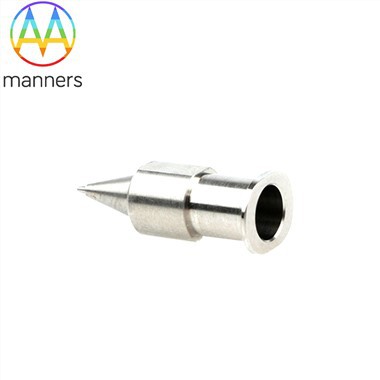
The main body of the puncture tool's barrel is usually made of 316L or 304 stainless steel tubing. The starting point of its manufacturing process is the "bright annealing" raw material, which ensures that the base material is free of impurities and has uniform crystal phases. The core processing involves "using turning instead of grinding" in the precise numerical control turning. High-end manufacturers use numerically controlled turning machines of brands such as Citizen from Japan. This type of machine can complete all the processing of the outer circle, inner hole, step, thread, and complex grooves in one clamping, ensuring extremely high coaxiality (≤0.01mm). This is crucial for the fit between the puncture tool and the seal, as well as the smoothness of the instrument passing through.
The more challenging part is the deburring process. The holes at both ends of the piercing tool will produce micrometer-sized burrs after processing. Any sharp edges or metal residues larger than 0.01mm may fall off during the operation and become "micro-particles" that endanger the patient, or scratch the sealing ring and cause air leakage. The leading manufacturing solution is to integrate an online deburring station on the CNC lathe. Special tools are used to round the corners and clean the holes after processing, achieving "processing completion in one step" and eliminating secondary pollution.
Finally, electrolytic polishing is the finishing touch. It is not merely a simple cleaning process; rather, it is an electrochemical "reverse electroplating" procedure that can uniformly remove a few micrometers of the metal layer from the surface, preferentially dissolving the microscopic protrusions, thereby achieving a mirror-like smooth surface. This not only greatly enhances the visual effect, but more importantly, significantly reduces the risk of bacterial adhesion and biofilm formation, and removes any impurities that may have been embedded on the surface during processing, achieving the ultimate clean that combines functionality and safety.
II. Polymer Components: Balancing Optical Transparency and Structural Strength
The tips of the puncture devices (especially the visual blunt dissection heads) and the handles, etc. are mostly made of engineering plastics such as polycarbonate (PC). The core process is precision injection molding. The difficulty lies in the integration of "optical performance" and "structural strength." Take the transparent tip as an example. The material (such as Makrolon 2458) requires high purity, and the mold runner design must be absolutely balanced to ensure that the melt is uniformly cooled during filling, avoiding flow lines, shrinkage marks, or bubbles. Any internal defects will be magnified under the strong light during the operation, interfering with the doctor's judgment of the tissue layers.
The mold itself must be made of high-hardness steel, and the surface of the cavity needs to reach the level of mirror-polished (even optical-polished). The control of injection molding process parameters such as temperature, pressure, and speed must be extremely precise to eliminate internal stress and prevent the product from cracking or deforming later. For an integrated handle with complex moving parts (such as safety guard spring mechanisms), it involves the combination of multiple materials co-injection, slider core ejection, and ultrasonic welding, among other advanced processes, to ensure smooth operation and reliable self-locking.
As a leading manufacturer of disposable puncture devices, we are well aware that combining a stainless steel tube and a plastic part into a reliable surgical instrument requires a deep integration of materials science, mechanical processing, mold engineering, electrochemistry, and automated testing technologies. Each breakthrough in the process barriers directly translates into safer punctures in clinical settings, clearer vision, and more stable operations. This is precisely the true value of high-end manufacturing.