Why Single-Use Matters For The Medical Stainless Steel Spinal Needle
Nov 23, 2026
1. The Problem: Reuse Looks Cheap and Costs More
In units under budget pressure, the argument for reprocessing sounds reasonable. The device is stainless steel, it is expensive per unit, it is used for a few seconds, and the hospital already owns an autoclave. Why discard it?
The answer emerges in the operating room rather than in the finance office. A needle that has passed through ligament and dura once has already been subjected to bending and to contact with saline, blood, and protein. Cleaning restores appearance, not geometry. Repeated autoclave cycles at 134 degrees Celsius accelerate surface oxidation and can soften the temper of fine cannulae. The tip, ground to a microscopic edge, loses sharpness after handling and mechanical cleaning, and a blunted tip behaves as a different instrument - it requires more force, drags tissue, and produces a larger, more irregular dural defect.
Then there is the less visible problem. Residual protein in a lumen of a few hundred micrometers is difficult to remove and impossible to verify by eye. Prion protein resists standard sterilization. A device that looks clean is not the same as a device that is clean.
The patient's experience tracks these differences. A sharp needle is felt as pressure followed by a brief, well-localised sensation. A blunt one is felt as a push that seems to go on too long, sometimes with a dull ache referred into the leg, and the patient often moves in response. That movement is the beginning of most difficult punctures, and it is entirely avoidable when the instrument is correct.
2. The Engineering Reality of Reprocessing
Medical-grade stainless steel is a durable material, and that durability is exactly what makes reprocessing plausible. But durability under load is not the same as durability of a cutting edge. The bevel of a Quincke point or the cone of a pencil point is formed by precision grinding; the angle and the surface finish determine how the device parts tissue. Mechanical cleaning brushes the lumen and can round the apex. Chemical disinfection may leave a film that increases friction.
The assembly adds further constraints. A spinal needle consists of shaft, stylet, and hub, joined so that the stylet runs freely without play. Repeated disassembly and reassembly introduces wear at the hub junction, which is where leaks and false negative flashbacks originate. A Medical Stainless Steel Spinal Needle that leaks at the hub will present as a failed puncture even when the tip sits correctly in the subarachnoid space, and the operator will redirect - creating a second dural puncture for no reason.
There is a regulatory dimension as well. Devices labeled for single use have not been validated for reprocessing, and their instructions for use do not describe cleaning cycles. Choosing to reuse them transfers an unquantified risk to the patient and to the institution.
3. Product Forms and Specifications
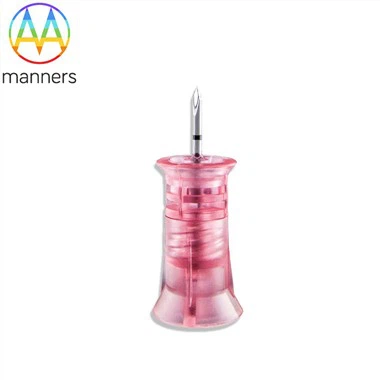
Fully single-use devices are supplied sterile, in individual blister packs, with a protective sheath over the shaft. They are available across the gauge range from 16G to 27G, in cutting and conical tip types, in a standard 90mm length or custom lengths for obesity and higher approaches, and with hub colors that follow the familiar sequence: 16G white, 17G light purple, 18G pink, 19G light gray, 20G yellow, 21G green, 22G black, 23G dark blue, 24G purple, 25G orange, 26G brown, 27G gray.
Reusable variants exist mainly for diagnostic and veterinary applications, where the device is resterilized between patients under a validated protocol, with documented inspection and a defined maximum number of cycles. Where such a program exists, it requires a sharpening assessment at every cycle, a lumen patency check, and a record that allows recall. Few hospitals have the infrastructure to sustain that level of control for a device this fine.
The practical distinction for an anesthesia department is simple: a single-use device arrives with a known history, namely none.
4. Practice: What Single-Use Discipline Requires
The first requirement is storage discipline. Keep trays sealed until the patient is in the room, and open them in a controlled sequence so that the needle is the last item exposed. A device that has sat open on a trolley during a long case has been exposed to airborne contamination and to accidental contact.
The second is inspection at the moment of use. Check the packaging integrity and the expiry date, confirm gauge and tip type against the planned technique, remove the sheath without touching the shaft, and verify that the stylet moves freely. If anything is abnormal - a bent shaft, a burr felt through the sheath, a damaged hub - discard the device and open another. That decision is trivial when the device is single-use and expensive when the device is the only one available.
The third is disposal. Used devices belong in sharps containers, filled no more than three-quarters, closed and replaced according to schedule. Recapping is not permitted. Needlestick injuries from spinal needles are uncommon but severe when they occur, and most of them happen during disposal rather than during the procedure.
Training should therefore cover the whole sequence rather than the puncture alone. New staff are often taught how to place a needle and left to infer how to open, inspect, and discard it. Making those steps explicit - a short checklist on the tray, a demonstration during induction, an annual refresher - costs an hour a year and prevents the errors that appear in incident reports.
The fourth is documentation: gauge, tip, length, level, attempts, and any paresthesia, recorded as part of the anesthetic record.
5. Experience from Departments That Have Made the Change
Anesthesia teams that move from reprocessed or reused stock to single-use devices describe three phases. In the first weeks, clinicians notice the tip. Punctures that previously required steady pressure now pass with a single controlled advance, and the dura gives a cleaner release. In the following months, the headache consultation rate falls modestly, an effect that is easy to miss unless the data are collected deliberately.
The third phase is financial, and it rarely supports the original assumption. Once the cost of reprocessing is counted properly - labour, sterilization loads, packaging, inspection time, and the occasional discarded batch that fails inspection - the difference per case narrows considerably. Add the cost of a single extended admission for a severe postural headache, and the direction of the comparison often reverses.
The most durable lesson from these programs concerns culture rather than money. A department that treats the needle as a single-use instrument also tends to inspect it properly, to limit attempts, and to document honestly, because the device is no longer perceived as a scarce resource to be conserved.
One further observation is worth recording. Departments that adopt single-use stock often discover that their previous failure rate was concentrated in a small number of extremely blunt devices, retained in circulation because they were the only ones left in the drawer at the end of a shift. Removing the incentive to stretch supply removes the behavior that produced those devices in the first place.
6. Summary
Single-use status is a safety specification, not a marketing claim. On a medical stainless steel spinal needle, the properties that matter clinically - tip sharpness, lumen cleanliness, hub integrity - degrade with handling and cannot be restored by cleaning. Procurement should therefore specify sterile single-use devices across the full 16G to 27G range, with accurate color coding, a 90mm standard length, and custom options for patients whose anatomy requires more.
7. Outlook
Two trends are converging. Regulation of reprocessed single-use devices is tightening in most markets, requiring validation data that few third-party reprocessors can supply for fine-bore instruments. And manufacturers are improving recyclability of packaging and hub materials, which removes the environmental argument often used to justify reuse. The likely outcome is a clearer separation: single-use for neuraxial access, and validated reusable instruments confined to applications where inspection and cycle limits can genuinely be enforced.