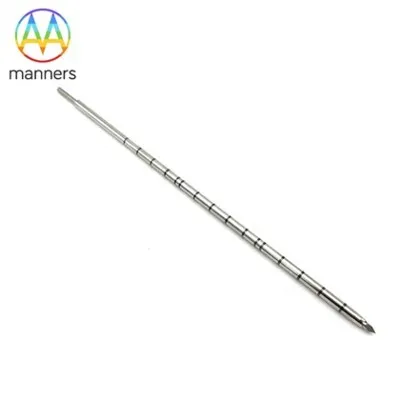
Veress Needles Manufacturing: Solving Core Safety Pain Points In Laparoscopic Insufflation
Aug 16, 2026
https://en.wikipedia.org/wiki/Veress_needle
Industry Pain Points
Minimally invasive laparoscopic surgery has become the mainstream of modern abdominal and gynecological surgical treatment, yet blind peritoneal entry remains one of the most high-risk links in the entire operation. For decades, clinical institutions worldwide have been plagued by three core pain points in traditional insufflation operations. First, ordinary puncture tools lack anti-puncture protection mechanisms, and excessive insertion force often causes accidental damage to abdominal visceral organs and major blood vessels, leading to intraoperative bleeding, organ perforation and other severe complications. Second, low-precision medical puncture needles have unstable gas transmission lumen, which easily causes uneven CO₂ insufflation, subcutaneous emphysema and pneumoperitoneum failure, disrupting the surgical visual field and prolonging operation time. Third, non-standard manufactured needles have poor biocompatibility and incomplete sterilization tolerance, resulting in postoperative infection risks and short service life of reusable instruments. In addition, many small-scale medical device manufacturers produce Veress needles with inconsistent dimensional accuracy, unqualified spring stability and irregular cannula shaping, which further amplifies clinical operational risks and cannot meet the standardized surgical requirements of tertiary hospitals and international medical institutions. These industry bottlenecks urgently demand high-quality, standardized Veress needles manufactured by professional medical device suppliers to optimize clinical safety and operational efficiency.
Working Principle of Standard Veress Needles
The core safety advantage of professionally manufactured Veress needles lies in its unique spring-loaded retractable blunt stylet mechanism, which is the fundamental principle to solve clinical puncture risks. A complete Veress needle consists of two core structures: an outer sharp cannula and an inner movable blunt stylet, with a high-precision built-in spring control system. During abdominal wall penetration, the fascia and muscle tissue of the abdominal wall form continuous resistance. Under external pushing force, the blunt inner stylet is squeezed and retracts into the outer cannula, exposing the sharp cannula tip to smoothly penetrate skin, subcutaneous tissue and abdominal fascia layers with minimal tissue trauma. The moment the needle tip breaks through the abdominal wall and enters the peritoneal cavity, the tissue resistance disappears instantly. The high-stability spring configured by professional manufacturers instantly pushes the blunt stylet forward to cover the sharp cannula tip completely. This mechanical switching effectively avoids secondary puncture and scratch damage to intra-abdominal organs and blood vessels. Meanwhile, the reserved hollow lumen in the needle body provides a stable channel for CO₂ gas transmission, realizing controllable and uniform pneumoperitoneum establishment, which lays a safe operating space for subsequent laparoscopic instrument insertion and surgical operation.
Classification and Characteristics of Manufacturer-Supplied Veress Needles
Professional Veress needle manufacturers classify products according to material specifications, structural dimensions and usage scenarios to meet differentiated clinical needs. In terms of materials, mainstream products are divided into 304 medical stainless steel and 316 medical stainless steel models. 304 stainless steel Veress needles have excellent corrosion resistance and sterilization adaptability, low cost and high cost performance, suitable for conventional routine laparoscopic surgeries and primary medical institutions. 316 stainless steel Veress needles have higher biocompatibility, stronger oxidation resistance and pressure resistance, tolerating high-frequency high-temperature sterilization, and are widely used in complex surgeries and high-standard international medical institutions. In terms of size classification, manufacturers standardize product lengths from 80mm to 150mm and outer diameters from 2.5mm to 5mm. Short-specification 80–100mm needles are suitable for thin patients and gynecological minimally invasive surgeries, while long-specification 120–150mm needles adapt to obese patients and deep abdominal cavity operations. According to usage types, products are divided into disposable and reusable Veress needles. Disposable models are independently packaged, sterile and cross-infection free, while reusable models adopt integrated precision welding process, with durable spring performance and long service life.
Standard Operational Guidelines for Clinical Use
To maximize the safety performance of manufacturer-standard Veress needles, clinical operations must follow standardized procedural guidelines. First, preoperative inspection: check the needle body for deformation, spring retraction flexibility and lumen patency, confirm complete sterile packaging and valid certification. Second, patient positioning: take supine position, select the conventional umbilical puncture site, disinfect and lay towels strictly. Third, slow puncture operation: hold the needle handle steadily, maintain a 45-degree oblique insertion angle, slowly push the needle body, and sense tissue resistance changes in real time. Fourth, resistance judgment and verification: stop pushing immediately when feeling sudden resistance disappearance, perform aspiration test with no blood and intestinal fluid overflow as the qualified standard. Fifth, pneumoperitoneum establishment: connect CO₂ insufflator, control initial pressure at 12–15mmHg, conduct low-flow slow insufflation to ensure uniform abdominal cavity expansion. Sixth, postoperative withdrawal: slowly extract the needle body after completing insufflation, avoid rapid pulling to prevent tissue tearing, and dispose or clean and sterilize the needle according to product attributes.
Practical Clinical Experience Summary
Years of clinical application experience of professional medical institutions shows that standardized manufacturer Veress needles can reduce laparoscopic puncture complication rates by more than 90% compared with ordinary puncture tools. In actual operations, the key to safe use lies in the combination of equipment performance and surgical technique. First, it is necessary to select matching specifications according to patient physical characteristics: obese patients must use 120mm or longer long needles to avoid insufficient puncture depth, while pediatric minimally invasive surgeries prioritize small-diameter thin-body needles to reduce tissue damage. Second, avoid blind forced puncture; the spring buffer mechanism of high-quality Veress needles relies on resistance changes, and forced pushing will cause mechanical failure and over-penetration. Third, for patients with a history of abdominal surgery and intestinal adhesion, choose improved Veress needles with enhanced spring stability, and adjust the insertion angle appropriately to avoid adhesion tissue damage. Fourth, regular maintenance of reusable needles is required: clean the lumen residual gas and tissue debris after each use, detect spring elasticity regularly, and eliminate failed equipment in time. Clinical practice proves that certified manufacturer products with ISO13485 medical certification have more stable performance and lower failure rate in long-term repeated use.
Summary and In-depth Sublimation
As the core basic instrument of minimally invasive laparoscopic surgery, Veress needles undertake the key task of establishing safe peritoneal access, and their product quality directly determines the safety baseline of minimally invasive surgery. The evolution of Veress needle manufacturing technology is essentially the process of clinical surgical safety upgrading. From traditional unprotected puncture tools to modern spring safety Veress needles, from non-standard manual processing to standardized precision manufacturing, every technical iteration and process optimization is centered on reducing surgical trauma and protecting patient safety. High-quality Veress needles are not only a single medical instrument, but also an important carrier of minimally invasive medical concepts, reflecting the industry's pursuit of precision, safety and minimally invasive treatment. Standardized manufacturing and standardized clinical use complement each other, forming a complete safety guarantee system for laparoscopic initial puncture.
Industry Development Prospects and Suggestions
With the continuous popularization of global minimally invasive surgery, the market demand for high-precision Veress needles continues to grow, and the industry presents three major development trends. First, intelligent upgrading: manufacturers are developing new Veress needles with built-in pressure sensing function, which can real-time monitor intra-abdominal pressure and avoid excessive insufflation. Second, material optimization: high-performance alloy composite materials will gradually be applied to needle body manufacturing to further improve biocompatibility and durability. Third, customized production: personalized size and structural customization according to special surgical scenarios and patient groups will become an industry new trend. It is suggested that medical institutions prioritize cooperating with formal manufacturers with ISO9001 and ISO13485 certification to purchase standardized products; strengthen surgeon's standardized operation training to reduce human error; and promote the popularization of high-performance improved Veress needles to further improve the overall safety level of minimally invasive surgery industry. Manufacturers should continue to optimize precision processing technology, improve product consistency, and launch more differentiated products to meet the diversified needs of global clinical markets.