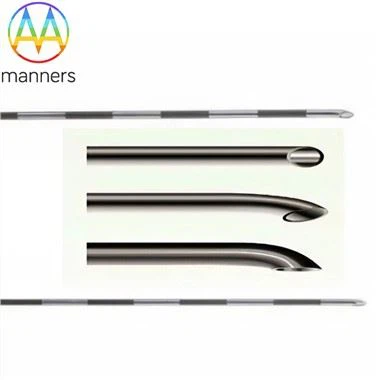
Material Performance And Precision Processing Of Ultra-Sharp Trocar Needles
Sep 30, 2026
1. Industry Material and Process Pain Points
The medical trocar needle industry has long faced material quality instability and backward processing technology pain points. Many low-end products adopt inferior ordinary stainless steel materials, which have poor corrosion resistance and low hardness, and are prone to tip passivation, needle body bending and surface rust after disinfection and use, seriously affecting puncture accuracy and clinical safety. In terms of processing technology, most traditional products only adopt simple rough polishing, with residual burrs and uneven surface on the needle body, which easily scratch normal tissues during operation and increase intraoperative trauma and bleeding. The lack of fine electropolishing process leads to poor biocompatibility of products, easy tissue irritation and postoperative inflammatory reaction. In addition, the industry has a single processing mode, lacking personalized customization capacity, unable to meet the differentiated precision needs of complex clinical operations, and serious product homogenization restricts technological progress of the industry.
2. Core Performance Principle of High-Grade Stainless Steel Materials
11 Gauge 4 Inch Length Ultra-Sharp Trocar Tip Needles select medical-grade 304 and 316 stainless steel as core raw materials, with excellent comprehensive performance superior to ordinary alloy materials. 316 medical stainless steel has ultra-high corrosion resistance, oxidation resistance and biocompatibility, which can resist repeated high-temperature disinfection and chemical sterilization without rust and deformation, and will not produce allergic or rejection reactions in contact with human tissues for a long time. 304 stainless steel provides stable structural hardness and mechanical toughness, ensuring that the ultra-sharp tip maintains long-term cutting sharpness and the needle body is not easy to bend under pressure. The scientific material matching scheme makes the product have both ultra-high puncture precision and durable service life. Combined with professional ultra-sharp trocar tip forming technology, the product realizes low-resistance and low-trauma precise puncture, perfectly adapting to various minimally invasive surgical and biopsy scenarios.
3. Process Classification and Product Advantages
According to processing precision and technical standards, ultra-sharp trocar needles are divided into standard polished type and high-precision electropolished customized type. The standard polished products adopt fine mechanical polishing technology, with smooth needle body and qualified sharpness, stable performance and high cost performance, suitable for routine basic clinical puncture operations in primary medical institutions. The high-precision electropolished products adopt secondary medical electropolishing technology on the basis of fine polishing, completely remove micro burrs and surface impurities, achieve mirror-level smoothness, and further improve biocompatibility and puncture fluency. This series supports full-size customization according to 2D/3D drawings and samples, covering all gauge specifications from 8G to 20G, and is suitable for high-precision complex minimally invasive surgery in tertiary hospitals and professional medical institutions. All products have stable injection and puncture performance, and support standard and customized packaging services.
4. Precision Processing and Clinical Operation Guidelines
Production processing guidelines: Strictly screen 304/316 medical stainless steel raw materials to ensure that the material hardness, corrosion resistance and biocompatibility meet medical industry standards. Complete integrated forming of needle body and ultra-sharp trocar tip through precision cutting and grinding. Adopt layered fine polishing and medical electropolishing processes to eliminate surface defects and ensure no burrs on the whole needle body. Conduct strict dimensional inspection and sharpness testing to ensure that the 11G gauge and 4-inch length specifications are accurate and consistent. Clinical operation guidelines: Select standard polished or high-precision electropolished products according to surgical precision requirements. Avoid violent extrusion and friction of the needle body before use to prevent tip damage. During puncture, operate gently and stably to give full play to the advantages of smooth needle body and ultra-sharp tip, reduce tissue friction and trauma, and ensure one-time successful puncture.
5. Practical Application Experience of Process Optimization
Production practice and clinical application fully prove that high-quality stainless steel materials and precision processing technology greatly improve the comprehensive performance of trocar needles. Compared with ordinary rough-processed products, electropolished ultra-sharp trocar needles have smoother surface, almost no tissue friction resistance during puncture, significantly reduced intraoperative trauma and bleeding volume, and lower postoperative inflammatory reaction and infection rate. The high-hardness stainless steel material ensures that the tip remains sharp after multiple disinfections, avoiding the problem of puncture failure caused by tip passivation. The standardized 11G 4-inch size design has strong scene adaptability, while the customized process can meet the personalized needs of special operations. Relying on the enterprise's national high-tech enterprise qualification and ISO13485 certification, the product's processing quality and clinical safety are strictly guaranteed, and the market and clinical recognition continue to improve.
6. Summary and Sublimation
The high-quality material formula and precision polishing processing technology of 11G 4-inch ultra-sharp trocar tip needles solve the industry pain points of poor material stability, rough processing and low precision of traditional puncture instruments. The combination of medical-grade stainless steel and electropolishing technology endows the products with ultra-high sharpness, smoothness and biocompatibility, realizing low-trauma and high-precision clinical puncture operation. It breaks the homogenization dilemma of low-end trocar needle products, improves the overall quality standard of the industry's minimally invasive puncture instruments, and provides reliable technical and quality support for clinical precise minimally invasive treatment.
7. Industry Process Upgrading Suggestions
It is suggested that the industry comprehensively promote the application of medical electropolishing technology for trocar needle processing, eliminate rough mechanical polishing processes, and improve the overall precision of products. Enterprises should increase R&D investment in new medical alloy materials, further improve the durability and biocompatibility of trocar needles. Standardize the dimensional precision and sharpness testing standards of 11G 4-inch mainstream products, and unify industry processing specifications. Strengthen the personalized customized processing capacity of products to meet the diversified precision needs of high-end clinical surgery, and promote the high-quality and standardized upgrading of the trocar needle manufacturing industry.