Ultrasound Visualization Upgrade Of Radioactive Particle Localization Needle Manufacturers
Aug 07, 2026
1. Industry Pain Points Traditional common puncture needles have smooth and uniform needle tip structure, which presents weak echo and blurred imaging under ultrasound guidance. During seed implantation surgery, surgeons cannot clearly identify the real-time position and depth of the needle tip, resulting in "blind puncture" to a certain extent. For small tumors, deep visceral tumors and edge lesions, slight position deviation will cause seeds to be implanted into normal tissues or tumor marginal areas, leading to insufficient local radiation dose and poor treatment effect. Repeated fluoroscopy and positioning not only prolong the operation time but also increase radiation exposure for both doctors and patients, becoming a major bottleneck restricting the precision of minimally invasive brachytherapy.
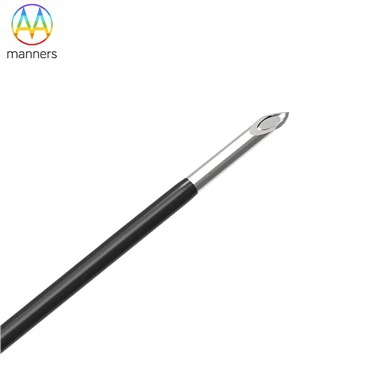
2. Working Principle Leading radioactive particle localization needle manufacturers adopt professional echo-enhanced technology for needle tip optimization. Through special micro-texture processing and structural transformation on the needle tip surface, the ultrasonic echo reflection effect is significantly enhanced, so that the needle tip can present high-bright and clear imaging under conventional ultrasound equipment. Cooperated with high-precision electropolishing technology, the needle tip maintains ultra-sharp puncture performance while realizing visual positioning. The centimeter-scale depth scale on the needle body and the foil hub orientation marker form a dual positioning system of "ultrasonic vision + scale calibration", which realizes real-time accurate judgment of needle insertion depth and bevel direction, completely solving the problem of intraoperative positioning deviation.
3. Product Classification According to visualization performance and structural design, manufacturer products are divided into three types. The first is standard echo-enhanced needles, suitable for conventional superficial and medium-depth tumor surgery, with basic ultrasonic visualization function and cost-effective advantages. The second is high-definition echo-enhanced precision needles, adopting intensive micro-echo structure, with clearer imaging effect, specially used for small lesions and high-precision tumor implantation surgery. The third is dual-mark positioning needles, equipped with round and square hubs with foil markers, which can identify the bevel tip orientation in real time, matching high-precision directional seed implantation. All specifications from 8G to 20G support echo enhancement customization to meet differentiated scenario needs.
4. Practical Operation Standards Before operation, select corresponding visualization-grade needles according to lesion size and depth. For routine large-area tumors, standard echo-enhanced needles are applicable; for micro-lesions and deep tumors, high-definition echo models are recommended. During intraoperative ultrasound monitoring, adjust the imaging angle to focus on the needle tip echo bright spot, and cooperate with the centimeter scale on the needle body to accurately control the puncture depth. Judge the bevel direction through the foil hub marker to ensure consistent seed implantation direction. After reaching the target position, perform slow seed deployment under real-time ultrasound visualization to avoid position offset.
5. Industry Application ExperienceClinical practical data verifies that echo-enhanced radioactive particle localization needles manufactured by professional manufacturers improve the needle tip recognition rate by more than 90% under ultrasound, completely eliminating blind puncture risks. The dual positioning design of scale and marker effectively avoids directional deviation, improving the one-time accurate implantation rate of seeds. For difficult minimally invasive surgeries such as brain tumors and cervical tumors, high-definition echo needles greatly shorten the operation time and reduce unnecessary fluoroscopy times. The stable echo structure will not fail due to sterilization and repeated use, with reliable and durable performance.
https://apgar.dk/wp-content/uploads/2019/06/10292014-RSLN-IFU-Rev-D.pdf
6. Summary Weak ultrasonic visualization of traditional needles is the key factor leading to inaccurate seed implantation and high surgical radiation exposure. Radioactive particle localization needle manufacturers effectively solve clinical positioning pain points through needle tip echo enhancement, electropolishing sharpening and dual-structure marking design. Classified visualized products cover conventional and high-precision surgical scenarios. Standardized visualization operation specifications significantly improve surgical accuracy, reduce operation risks and radiation dose, which is the core guarantee for standardized development of modern brachytherapy.
7. Future Prospect In the future, with the popularization of intelligent ultrasonic navigation systems, manufacturers will develop multi-dimensional echo-enhanced intelligent localization needles, realizing automatic needle tip positioning and depth identification. Combined with individualized customization of lesion imaging characteristics, the visualization adaptability of needles will be further improved, promoting brachytherapy surgery to develop towards full-process intelligence, high precision and low radiation.