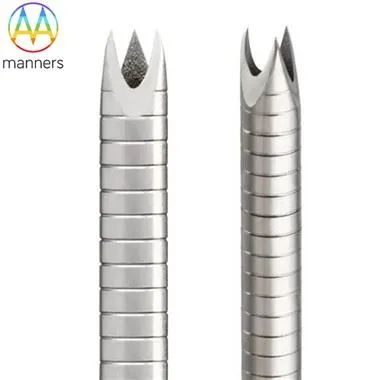
Lubrication Optimization Solution Of Radioactive Particle Localization Needle Manufacturers
Aug 07, 2026
1. Industry Pain Points In traditional brachytherapy seed implantation surgery, ordinary puncture needles lack professional lubrication protection structures. The rigid needle body produces high friction resistance when penetrating human soft tissues. Surgeons need to apply extra thrust during operation, which easily causes traction and laceration of muscles, blood vessels and fascia, leading to intraoperative bleeding, postoperative edema and persistent pain. Rough inner and outer needle walls are prone to adhere to human tissues; repeated adjustment of puncture position will expand the wound area and increase the risk of surgical infection. Uneven resistance also leads to biased puncture feedback, making it difficult for junior surgeons to accurately control the insertion angle and depth. This further causes deviation of radioactive seed placement, uneven radiation dose distribution in tumor target areas, and ultimately reduces the curative effect of brachytherapy, which is the key device-induced reason for high complication rates in primary hospital seed implantation operations.
2. Working Principle Professional radioactive particle localization needle manufacturers solve the above pain points through medical material modification and advanced surface coating technology. The product adopts high-quality medical stainless steel as the base material to ensure overall structural strength, rigidity and deformation resistance during puncture. The outer surface is coated with uniform medical silicon coating with excellent biocompatibility and ultra-low friction coefficient. The silicon coating forms a flexible lubricating isolation layer between the needle body and human tissues, which effectively reduces contact friction during insertion and extraction. Meanwhile, the inner diameter of the needle tube is precisely polished to form a smooth mirror surface, eliminating internal friction resistance during seed deployment. The overall structural optimization realizes low-resistance puncture and barrier-free seed delivery, balancing surgical fluency and human tissue safety.
3. Product Classification In terms of lubrication and application scenarios, mainstream products provided by radioactive particle localization needle manufacturers are divided into two categories. The first is standard silicon-coated localization needles, covering conventional specifications from 8G to 20G, suitable for most routine tumor seed implantation surgeries, with universal low-resistance puncture performance. The second is enhanced full-polish lubrication needles, which adopt dual polishing technology for both inner and outer walls, equipped with thickened uniform silicon coating. This type is specially customized for complex tissue scenarios such as sclerotic tumors and deep visceral tumors, with stronger anti-adhesion and low-resistance capabilities. In addition, manufacturers support customized coating thickness and surface smoothness according to clinical surgical needs to match personalized operation scenarios.
4. Practical Operation Standards In clinical practice, surgeons need to select matching lubrication-grade needles according to tumor tissue hardness and depth. For superficial soft tissue tumors, conventional 13G–16G silicon-coated needles are preferred to reduce minor tissue trauma. For hard and deep tumors, enhanced fully polished needles are adopted to avoid needle body jamming and tissue tearing. Before operation, check the integrity of the silicon coating to ensure no peeling or damage. During puncture, maintain a stable insertion speed relying on the low-resistance performance of the needle body, avoid forced propulsion. After seed deployment, slowly extract the needle body to prevent residual tissue adhesion and secondary damage, ensuring standardized and safe whole-process operation.
5. Industry Application Experience Long-term clinical feedback from cooperative medical institutions shows that high-quality silicon-coated radioactive particle localization needles can reduce intraoperative puncture resistance by more than 40%, effectively lowering the incidence of bleeding and edema complications. Many senior interventional surgeons summarize that polished inner walls completely solve the common industry problem of seed jamming and offset. Regular products from formal manufacturers have uniform coating thickness and strong adhesion, which will not fall off after high-temperature sterilization and repeated use, avoiding foreign body residue risks. Customized lubrication schemes for special lesions greatly improve the success rate of one-time puncture and reduce repeated positioning operations.
6. Summary High friction resistance and tissue damage caused by unoptimized needle body structure are core pain points restricting the safety of traditional seed implantation surgery. Professional radioactive particle localization needle manufacturers rely on medical silicon coating technology and inner wall polishing technology to fundamentally optimize the puncture and delivery performance of the needles. With standardized and enhanced classified products, they cover routine and complex clinical scenarios. Standardized operation procedures combined with high-quality equipment can significantly reduce surgical trauma and complications, which is an essential technical upgrade for minimally invasive brachytherapy.
7. Future Prospect With the continuous upgrading of minimally invasive tumor treatment concepts, clinical requirements for surgical trauma control and operational refinement are becoming stricter. Future radioactive particle localization needle manufacturers will further upgrade nano-silicon coating and ultra-mirror polishing technology to achieve zero-resistance and zero-damage puncture. Intelligent differentiated coating customization for different tumor tissues will become a new development trend, helping further improve the precision and safety of clinical brachytherapy seed implantation surgery.
https://apgar.dk/wp-content/uploads/2019/06/10292014-RSLN-IFU-Rev-D.pdf