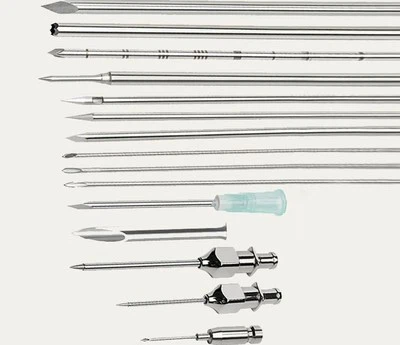
Toward The Future Of Precision Interventional Diagnosis – The Convergent Innovation Of Contrast-Enhanced Ultrasound, Artificial Intelligence, And The Soft Tissue Biopsy Needle
Apr 28, 2026
Toward the Future of Precision Interventional Diagnosis – The Convergent Innovation of Contrast-Enhanced Ultrasound, Artificial Intelligence, and the Soft Tissue Biopsy Needle
Abstract: This article looks forward to the future development directions of contrast-enhanced ultrasound (CEUS)-guided "soft tissue biopsy needle" technology. Building upon current research confirming its significant value, future trends will focus on multi-modal image fusion, artificial intelligence (AI)-assisted decision-making, intelligent innovation in biopsy needle devices, and quantitative analysis. It explores how AI can assist in identifying optimal biopsy targets; how image fusion technologies enable 3D precision navigation; and how future "smart biopsy needles" can provide real-time tissue property feedback. These innovations will collectively propel interventional diagnosis of soft tissue tumors into a new era of greater automation, standardization, and precision.
Main Text:
Current research has firmly established the central role of contrast-enhanced ultrasound (CEUS) guidance in enhancing the diagnostic efficacy of the "soft tissue biopsy needle." However, this is not the endpoint but a signpost for a new starting point. Standing on the foundation of a 91.1% diagnostic success rate, we look to the future where CEUS-guided biopsy technology will deeply integrate with artificial intelligence, advanced imaging, and smart devices, moving towards an era of "full-dimensional perception, intelligent decision-making, and robotic execution" in precision interventional diagnosis.
Artificial Intelligence (AI) Empowered Automatic Optimal Target Identification and Risk Prediction. Currently, the interpretation of CEUS images and target selection remain highly dependent on the interventional physician's experience. Future AI systems, trained via deep learning on tens of thousands of CEUS images paired with corresponding pathological outcomes, could automatically perform:
Viable Region Segmentation: Automatically and in real-time, outline areas of different enhancement intensities within the tumor, quantitatively calculate parameters like volume and perfusion for each, and directly mark the "optimal biopsy target" and "necrotic areas to avoid."
Quantitative Analysis of Perfusion Features: Precisely quantify enhancement patterns (e.g., time-to-peak, washout rate, area under the curve). These parameters may correlate with tumor grade, subtype, or even genetic features. AI could suggest, "The perfusion characteristics of this region highly match a certain high-grade sarcoma; sampling here is recommended."
Intelligent穿刺Path Planning: Integrated with 3D reconstruction, AI could plan the optimal safe穿刺 path avoiding critical vessels, nerves, and bony structures, and simulate needle advancement.
This would upgrade target selection from "qualitative experiential judgment" to "quantitative data-driven" decision-making, further improving first-pass success rates and potentially enabling preliminary non-invasive grading based on imaging features.
Multi-Modal Image Fusion and 3D Real-Time Navigation. Future interventional ultrasound systems could integrate CEUS, conventional US, and even pre-procedural MRI/CT.
CEUS-MRI Fusion: Combining the real-time blood flow information from CEUS with the excellent soft-tissue resolution and large-field anatomical context of MRI. The biopsy needle is operated under real-time US guidance, but its path and target can be confirmed with greater spatial accuracy in a navigation interface fused with MRI images, especially useful for deep-seated, complex anatomical tumors.
3D CEUS and穿刺Navigation: Achieving 3D CEUS imaging to construct a立体 model of the tumor and its vasculature. Biopsy needles equipped with electromagnetic or optical tracking sensors could have their position and orientation displayed in real-time within the 3D model, enabling true立体 spatial navigation, ensuring precise targeting even for irregularly shaped tumors.
Intelligent Innovation of the "Soft Tissue Biopsy Needle" Itself. Future biopsy needles will not merely be mechanical tools for tissue acquisition but smart probes integrated with various sensing functions:
Real-Time Tissue Impedance/Spectroscopic Sensing: The needle tip could integrate micro-sensors providing real-time feedback on tissue impedance or optical spectral signals. Compared against databases, it could提示 "needle tip currently in necrotic tissue" or "entered high cellular density tumor region," providing real-time in vivo feedback to the operator.
Micro-Sample On-Site Rapid Analysis (FNA) Assistance: Combined with Rapid On-Site Evaluation (ROSE), future developments might include biopsy kits integrated with微型 microscopic imaging units, allowing preliminary imaging analysis of极小 samples simultaneously with core acquisition, instantly confirming sample adequacy and cell type, and enabling on-the-spot additional passes if needed.
Robotic-Assisted穿刺Systems: Guided by high-precision imaging navigation (e.g., 3D models fused with CEUS), a robotic arm could stably and precisely manipulate the biopsy needle along a pre-planned path to the target, eliminating hand tremor and respiratory motion effects, achieving sub-millimeter穿刺 accuracy.
Correlation Studies Between Quantitative CEUS and Biopsy Pathology. Current research primarily uses qualitative CEUS. An important future direction is large-sample correlative studies between quantitative CEUS-derived hemodynamic parameters (e.g., blood flow velocity, volume) obtained via time-intensity curve analysis and the molecular pathology and genomic analysis results from biopsy-obtained tissue. Exploring whether specific perfusion patterns correlate with specific gene mutations, immune microenvironments, or therapeutic targets could allow the "imaging" performed before the "biopsy" to provide more predictive biological information while the biopsy obtains tissue for definitive diagnosis.
Implications for Industry and R&D: This future vision requires deep cross-disciplinary integration between ultrasound equipment manufacturers, biopsy needle device companies, AI software developers, and robotics firms. The future "Precision Interventional Diagnosis Platform" will be an integrated ecosystem: AI-enhanced Ultrasound Systems (with multi-modal fusion and quantitative analysis capabilities) + Intelligent Sensing Biopsy Needles + Robotic Stabilization Platforms + Digital Pathology Workflows. For clinicians, this necessitates adapting from the role of "operator" to "human-machine collaborative decision-maker."
In summary, CEUS guidance has opened the door to precision intervention for soft tissue tumor biopsy. The convergence of artificial intelligence, image fusion, and intelligent devices will open this door wider, leading us into a new era of more precise diagnosis, safer operation, and more intelligent workflows. In this process, the "soft tissue biopsy needle" will evolve from a passive execution tool into an active, integrated component of an intelligent diagnostic terminal that combines sensing and action.