Gauge Selection Mastery — Matching Needle Size To Medication Reality
Nov 03, 2026
The Pain Point
Choose a needle gauge too small, and viscous medications crawl through the filter; too large, and fine doses become impossible to measure accurately. Many practitioners select needle gauges by habit rather than by analysis, leading to clogged filters, foaming solutions, and dosing errors. The frustration is amplified with filter needles, where the membrane adds resistance on top of the cannula's natural flow limitation. In busy compounding environments, a clogged filter means a discarded preparation, a delayed dose, and a frustrated operator - and when this happens repeatedly, staff begin to blame the device rather than the selection logic. The problem is compounded by the sheer variety of medications in a modern formulary: aqueous solutions, viscous emulsions, reconstituted powders, biologics, and contrast agents all behave differently, and a gauge that works perfectly for one may fail completely for another. Without a systematic approach, gauge selection becomes guesswork, and guesswork produces waste, delays, and occasional clinical errors when a dose is prepared in a compromised way.
The Principle Behind the Solution
Flow rate through a needle follows Poiseuille's law: it increases with the fourth power of the internal radius. A one-gauge difference - say from 19G to 18G - raises flow capacity by roughly 30 to 40 percent. The filter membrane adds a fixed pressure drop, meaning the system's total resistance is the sum of cannula resistance and membrane resistance. Understanding this relationship lets you select a gauge that balances three variables: medication viscosity, required flow rate, and dosing accuracy. Viscosity dictates the minimum internal diameter needed to move the fluid at an acceptable speed. Flow rate requirements come from the clinical context: a 500 mL parenteral nutrition bag needs to be prepared in minutes, while a 1 mL pediatric dose must be measured with precision. Dosing accuracy constrains the maximum diameter, because a large-bore needle makes fine volume control difficult, especially with small syringes. The selection task is therefore an optimization problem: find the gauge that satisfies all three constraints simultaneously. The filter's micron rating adds another dimension - a 5-micron membrane flows faster than a 0.22-micron membrane of the same area - so filter choice and gauge choice must be made together.
Classifying Filter Needle Equipment
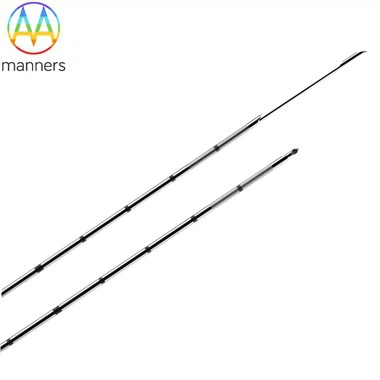
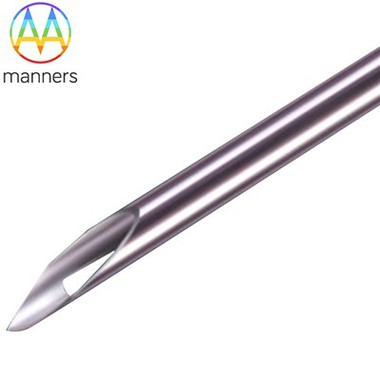
The blunt filter needle family covers gauges from 14G to 27G, each serving a distinct role. The 14G–16G range handles thick preparations: parenteral nutrition, lipid emulsions, and viscous contrast agents, where the large internal diameter is essential for acceptable flow. The 17G–19G sweet spot is the clinical standard for most IV medications - the 18G x 1.5-inch 5-micron blunt filter needle is the most widely specified configuration in European hospital pharmacies, offering a balance of flow, control, and compatibility with standard vial stoppers. The 20G–22G range suits standard aqueous solutions where flow is not an issue and precision is more important; these gauges are also preferred for glass ampoule aspiration, where gentler flow reduces splash and glass fragment disturbance. The 23G–27G range addresses pediatric, ophthalmic, and micro-dose applications requiring precision over speed. Length also matters: the standard 1.5-inch cannula reaches the bottom of most vials, while longer cannulas serve tall ampoules and shorter versions suit low-profile containers. The device classification is completed by connection type - Luer lock for security, Luer slip for speed - and by packaging format, from individual sterile pouches to bulk trays.
Practical Operating Guide
Build a simple selection checklist that any operator can apply in under thirty seconds. First, identify the medication's viscosity: if it pours like water, any gauge from 18G to 22G works; if it pours like oil or honey, choose 18G or larger. Second, define the volume and time budget: a 500 mL transfer with a 22G needle will test your patience and clog the filter, so use 18G or 16G for large volumes; small volumes under 5 mL can use 20G–22G for better control. Third, consider the container: small multidose vials tolerate larger gauges well because the filter protects the medication and the blunt tip preserves the stopper; glass ampoules benefit from 20G–22G to control flow and reduce splash and fragment disturbance. Fourth, factor in the filter rating: if you are using a 0.22-micron sterilizing filter, compensate for its slower flow by choosing a larger gauge cannula. Document your selections in a ward-level reference chart organized by drug category, and update it whenever the formulary changes or a new preparation is introduced. Train staff on the checklist through scenario-based exercises - present a medication, ask for the gauge choice, and explain the reasoning. Finally, track clog rates by gauge and drug: if a particular combination occludes repeatedly, the data will reveal whether the gauge is too small, the reconstitution is inadequate, or the drug batch is abnormal.
Real-World Experience
A compounding center for parenteral nutrition documented that switching from 20G to 18G blunt filter needles for lipid emulsions cut average preparation time by 40 percent and reduced filter replacement frequency by half. For chemotherapy diluents, however, they kept 20G - the slower flow improved accuracy in small-volume dosing. The center's final protocol specifies gauge by drug category, not by habit, and pharmacists report dramatically fewer clogged-filter incidents. A second example comes from a pediatric hospital that initially used 18G for everything. After a review, they adopted 22G for small-volume antibiotic doses and saw measurable improvement in dosing precision, with fewer syringe overdraw corrections. The same hospital standardized on 16G for parenteral nutrition and eliminated the chronic filter-clogging complaints that had plagued the neonatal unit. These experiences illustrate the core lesson: there is no universal gauge, only the correct gauge for a given drug, volume, and container.
A third example from an Australian hospital pharmacy illustrates the cost dimension of gauge selection. The pharmacy tracked its annual consumption of blunt filter needles by gauge and found that standardizing on 18G for most adult medications, with 20G reserved for pediatric doses and 22G for micro-doses, reduced inventory variety from seven gauges to four. The simplification cut procurement complexity, reduced selection errors at the point of use, and allowed volume discounts on the remaining gauges. Crucially, clinical outcomes did not change - the fewer gauges were not a compromise but a rationalization. The pharmacy's experience shows that gauge selection mastery is not about using every available size but about matching the right size to the right job and then standardizing that match across the institution. Standardization, paradoxically, is the highest form of flexibility, because it frees staff from decision-making under pressure and lets the system's structure carry the expertise. The remaining four gauges cover the entire formulary with confidence, and the documentation supporting each choice gives both pharmacists and inspectors a clear, defensible rationale for every needle in the inventory.
Summary and Elevation
Gauge selection is not a trivial detail; it is the difference between a preparation workflow that fights the physics of fluid flow and one that works with it. A CE-marked blunt filter needle gives you the certified performance, but it is the operator's knowledge of viscosity, flow, and volume that turns that certification into reliable daily practice. Mastery of gauge selection transforms compounding from a repetitive task into a professional skill - one that reduces waste, protects patients, and earns the trust of the clinical team.
Future Outlook
Smart syringe pumps with embedded flow sensors will eventually communicate with filter needles equipped with RFID tags, automatically adjusting pump rates to the needle's known resistance profile. Electronic medication records will embed gauge recommendations at the point of ordering, so the right needle is selected before the preparation begins. Until then, mastering gauge selection remains a core pharmacy skill - one that separates competent preparation from excellent preparation, and one that costs nothing to learn but saves a great deal in waste, time, and patient risk.