Tip Configurations Across Clinical Scenarios
Nov 17, 2026
One Catalogue, Many Clinical Demands
A procurement officer looking at a needle catalogue sees a list of similar stainless steel tubes with differently shaped ends. A clinician looking at the same list sees a set of clinical problems. The closed point that protects a tract, the backcut bevel that captures elastic tissue, the trocar that opens a tough capsule, the Whitacre geometry associated with atraumatic access, and the lancet that punctures cleanly are not variations on a theme; they are answers to different questions asked by different specialties in different anatomical settings.
Confusion arises when a single tip form is asked to serve every purpose, which is common when a department standardises on whatever is already stocked. The result is predictable: adequate results in the indications it suits, repeated frustration in the ones it does not. This article maps configurations to clinical scenarios so that selection becomes an explicit clinical judgement rather than an inherited habit.
How Each Tip Form Behaves in Tissue
The closed point needle carries a rounded, non-cutting distal end with a side aperture. It advances without opening a channel that communicates directly with the lesion, which reduces the theoretical risk of seeding along the tract and allows the operator to sample within a lesion after passing through intervening tissue. Its limitation is that tissue must be drawn into the aperture, so suction and fluid dynamics matter more than cutting sharpness.
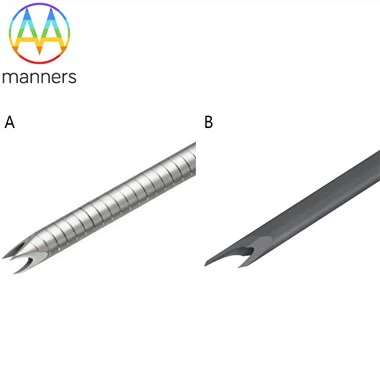
The backcut bevel sharpens the heel of the bevel rather than the tip, so that tissue which recoils away from a conventional bevel is caught by the trailing edge. This is valuable in elastic tissue such as breast and soft tissue lesions. The trocar geometry uses a pyramidal cutting point that penetrates firm capsules and peritoneum before the sampling element engages, useful in transabdominal approaches. Whitacre and pencil point designs are associated with access procedures where a non-cutting or gently tapered entry reduces trauma. Lancet geometry punctures with a sharp, clean edge and is chosen where a small, well-defined entry is required. Crown configurations, including the crown end needle family in its various core cut forms, score a circular channel and retrieve a coherent specimen, which suits solid lesions requiring architecture.
Scenario Mapping for Daily Practice
Mapping configurations onto scenarios clarifies the choice. For sampling a solid lesion where grading and architecture determine management, a crown core cut design is the natural first choice, with Franseen tips as an alternative in dense fibrous lesions. For lesions adjacent to a tract that should remain uncontaminated, a closed point configuration offers a mechanical safeguard, with the caveat that specimen volume is generally lower.
For soft, elastic tissue that deflects a plain bevel, a backcut geometry improves capture. For transperitoneal access to a deep target, a trocar tip establishes the route and can be followed by a sampling needle. For fluid collection, drainage, or access where traumatic entry matters, Whitacre style tips reduce the risk associated with sharp puncture. For procedures requiring a small, precise entry, lancet geometry provides it.
A single manufacturer producing Crown End Needles across these forms, in stainless steel from 0.25 mm to 30 mm, allows a department to build a matched set rather than an accumulation of unrelated products, with one documentation trail and one qualification record.
Selecting Within a Clinical Workflow
Effective selection follows the workflow rather than the catalogue order. First define the diagnostic or therapeutic objective: tissue architecture, cellular sample, fluid drainage, or access. Next define the route: transcutaneous, transabdominal, transorgan, or endoscopic, since each imposes different stiffness and length requirements. Then identify anatomical hazards: vessels, pleura, bowel, or a tract that must not be contaminated.
Only then choose tip geometry, and verify that the required gauge and length exist in that geometry. Confirm compatibility with the guidance modality, since some alloys and tip forms produce artefact that obscures the tip on imaging. Plan specimen handling for the selected technique before the procedure begins, and record the configuration used in the procedure note so that outcomes can be correlated with device choice over time. A short internal form covering these five decisions prevents the most common error, which is defaulting to a familiar needle in an unfamiliar anatomical setting.
Observations from Clinical Practice
Clinicians experienced with a broad needle inventory describe several recurring insights. The first is that closed point configurations are often underused in situations where tract contamination is a genuine concern, and overused where specimen volume is critical; the geometry trades yield for safety, and that trade must be made deliberately. The second is that backcut bevels are frequently discovered late, after several unsuccessful attempts with a plain bevel inelastic tissue.
The third is that trocar tips are sometimes selected for lesions that a fine needle would reach without difficulty, adding unnecessary trauma. The fourth is that the apparent difference between tip forms is often smaller than the difference between a sharp needle and a dull one; condition dominates geometry, and a worn crown behaves worse than a fresh simple bevel. Together these observations argue for stock discipline and rotation, not merely catalogue breadth.
The Discipline of Matching
The underlying principle is that every tip form encodes a set of trade-offs: yield against safety, penetration against trauma, capture against simplicity. No configuration is universally superior, and a department that treats selection as a routine administrative step forfeits the value of the inventory it has purchased.
When the trade-offs are understood, the catalogue becomes a decision tool. A clinician can state, in advance and in writing, which geometry will be used in which scenario and why, and can then measure whether the outcome matched the expectation. That discipline, supported by ISO 13485 documented manufacturing and stable tolerances, is what converts a shelf of similar tubes into a coherent clinical capability.
Consolidating Around Fewer, Better-Specified Devices
The direction of travel in most departments is toward fewer stock items with tighter specifications. Rather than holding a dozen loosely defined needles, teams are consolidating around a small number of qualified configurations, each supported by drawings, each validated with free samples before adoption, each traceable to a manufacturing lot. The benefit is not only inventory simplicity but measurability: when the device is constant, technique improvement becomes visible.
Suppliers able to support this consolidation will be those who manufacture the full Crown End Needles range, accept customisation against 2D or 3D drawings or supplied samples, maintain ISO 13485 process control, and deliver in standard carton packaging with predictable lead times, so that a consolidated specification does not become a single point of failure.
Consolidation also brings a training benefit that is easy to overlook. A smaller inventory with clearly defined roles is easier to teach, and an operator who understands why a closed point differs from a trocar tip is less likely to reach for the wrong device under time pressure. Written indications for each geometry, kept alongside the stock, prevent the most expensive error in this field, which is not choosing an imperfect needle but choosing one unsuitable for the anatomy in front of the operator. Review such a list annually against actual usage and retire configurations that are never selected.
Seasoned practitioners add a further caution: familiarity with one geometry can create false confidence in another. Crown tips and trocar tips feel similar during insertion yet behave very differently once tissue is engaged, so any change of device deserves supervised use until the operator can predict how that tip will respond under load. Treating each form as its own instrument, rather than as a variation of a generic needle, is the habit that separates a well-managed inventory from a well-used one.