Small-Gauge Customization And Hub Assembly
Nov 17, 2026
The Gap Between a Drawing and a Working Needle
A specification sheet lists a diameter, a length, a material, and a tip geometry. A usable medical device requires considerably more: a cannula that is straight within tolerance over its full working length, a tip ground concentrically, a hub bonded without adhesive encroaching on the lumen, a protective sheath that survives transport, and a sterile barrier that holds until the moment of opening. When any of these is neglected, a needle that looks correct on paper fails in the hand.
Customisation makes the problem harder. A department asks for a non-standard length, a specific hub colour for gauge identification, a particular tip form in a small diameter, and a packaging configuration that fits its storage. Each request is individually reasonable and collectively demanding, especially at the fine end of the range where a few micrometres of wall variation changes behaviour. This article examines what small-gauge customisation involves and where quality is most often lost between the drawing and the finished device.
What Small-Diameter Manufacturing Requires
As diameter falls, every tolerance becomes proportionally more significant. At 0.25 mm outer diameter, wall thickness variation of a few micrometres alters both stiffness and internal volume; concentricity error of similar magnitude produces a tip that wobbles rather than rotates about its axis. Tube drawing establishes the base geometry, but the finished needle depends on subsequent operations: straightening, cutting to length, tip grinding, deburring, cleaning, passivation, and inspection.
Each step interacts with the others. Grinding a crown into a thin wall can collapse the tube if support is inadequate. Deburring that removes an internal burr can round the cutting edge if overdone. Cleaning that removes grinding residue must also preserve the internal surface finish, because a roughened lumen will strip specimens or retain fluid. Hub assembly adds a further constraint: the bond must be strong enough to resist withdrawal force yet must not intrude into the lumen, and the transition between hub and cannula must not create a stress riser that shortens fatigue life.
Configurations Available for Custom Builds
The practical question for a buyer is how much of this a supplier can control, and in what range. A capable manufacturer will offer stainless steel cannulae from 0.25 mm to 30 mm outer diameter, with thin and heavy wall options, in injection and puncture configurations, and will accept customisation against 2D or 3D drawings or against a supplied physical sample. The latter matters because many clinical requirements are easier to express by example than by dimension.
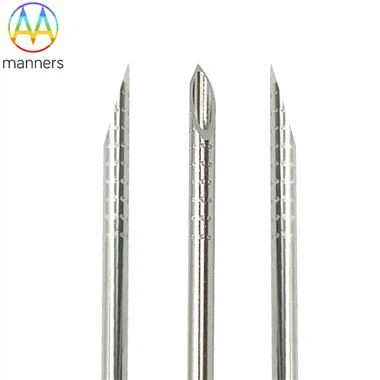
Tip forms should include the full functional range: crown and core cut geometries for tissue sampling, Franseen, Menghini, closed point, backcut bevel, trocar, Whitacre, and lancet, so that a single specification source covers aspiration, biopsy, access, and puncture needs. Hub options, needle lengths, sheath styles, and labelling should be selectable, and ISO 13485 process control should apply to the custom workflow exactly as it does to catalogue items.
A Practical Path from Request to Release
A custom needle project proceeds best in defined stages. Begin with a requirements document that states clinical purpose, target tissue, gauge, length, tip form, hub type, packaging, and labelling, plus the guidance modality if imaging compatibility matters. Convert that into a drawing with tolerances on diameter, wall, length, straightness, tip geometry, and hub bond. Where dimensions are hard to express, supply a physical sample and specify which features are critical.
Require a pre-production sample lot and evaluate it functionally, not only dimensionally: check straightness by rolling, inspect tip concentricity under magnification, verify lumen patency and cleanliness, and test hub pull strength. Only then approve the first production run. During production, request inspection records that reference the drawing, and confirm that changes to material, process, or subcontractor trigger notification. Finally, agree packaging and labelling, since a custom device with generic labelling creates handling errors in a busy store.
Where Custom Projects Usually Go Wrong
Failures in custom needle projects cluster around a few well-known points. The most common is an under-specified drawing that leaves straightness, internal cleanliness, or hub bond strength unstated; the supplier meets the drawing and the clinician finds the device unusable. The second is a tip geometry specified by name without dimensional definition, so that a crown requested verbally is delivered with a different point count or height than intended.
The third is scale mismatch: a design validated as a single hand-made sample is transferred to production without confirming that the grinding and assembly processes hold the same tolerance at volume. The fourth is packaging, where needles arrive bent because the sheath or carton was not designed for the length. Experienced buyers address all four by defining critical characteristics explicitly, requesting samples for functional evaluation, and inspecting the first production lot rather than trusting the sample that preceded it.
Customisation as Controlled Consistency
The value of customisation is not novelty but fit. A department that specifies its own gauge, length, tip, and hub obtains a device matched to its protocol, and with it a stable baseline against which outcomes can be judged. That value collapses if the custom specification is not reproducible, because variability reintroduces exactly the uncertainty that customisation was meant to remove.
The organisations that benefit most treat customisation as a quality activity: drawings controlled under document management, samples evaluated against stated criteria, production records retained, and changes notified. ISO 13485 certification provides the framework, but the discipline of treating a needle specification as a controlled document is what makes the framework meaningful.
What Buyers Should Expect Next
Custom manufacturing is moving toward shorter iteration cycles and tighter documentation. Digital drawing exchange, faster sample turnaround, and clearer tolerance conventions will make it practical to refine a needle design over a few months rather than a year. At the same time, expectations around traceability and change control are rising, and suppliers who cannot document their processes will be excluded regardless of price.
For buyers of Crown End Needles, the practical checklist is straightforward: a diameter range covering 0.25 mm to 30 mm, stainless steel construction, both thin and heavy wall availability, the full range of tip forms for injection and puncture, customisation from 2D or 3D drawings or physical samples, free samples for functional evaluation, standard carton packaging, and ISO 13485 certification that applies to the custom workflow. Those who can demonstrate all of it consistently are the partners worth locking into a specification.
It is worth stating plainly what separates a competent custom supplier from a merely willing one. The willing supplier accepts the drawing and returns parts that meet the stated dimensions. The competent supplier asks which characteristics are critical, explains how the process controls them, and flags where the requested tolerances are unrealistic for the chosen wall. That conversation usually shortens the project, because most custom needle problems are decided at the drawing stage rather than on the grinder.
Equally, a buyer should be able to describe the intended use well enough for the manufacturer to challenge it. If a request specifies a crown tip in a very fine gauge for a soft, friable target, a good manufacturing partner will point out that such a geometry may retrieve little and suggest alternatives rather than silently producing a device that disappoints. That exchange is the real value of customisation: not the ability to order any combination, but access to a partner who understands how combinations behave.
A closing observation applies to every custom project, whatever the gauge. The specification you approve becomes the reference for years, and it will outlive the individuals who wrote it. Store it with the drawing, the approved sample, and the inspection criteria in one place, and treat any request to deviate as a change that must be reviewed rather than accommodated informally. A well-controlled specification for Crown End Needles is therefore not paperwork but the mechanism that preserves the fit between device and protocol long after the original project team has moved on.