The Technological Evolution Of EBUS-TBNA Needle Manufacturers: The Precision Revolution From Blind Needle Aspiration To Real-Time
Apr 27, 2026
The Technological Evolution of EBUS-TBNA Needle Manufacturers: The Precision Revolution from Blind Needle Aspiration to Real-Time Ultrasound Guidance
In the field of respiratory interventional diagnostics, the R&D journey of EBUS-TBNA needle manufacturers mirrors a clear evolutionary path: transitioning from relying on experience for "blind puncture" to depending on imaging for "precision navigation." As the core tool on this path, the EBUS-TBNA (Endobronchial Ultrasound-Guided Transbronchial Needle Aspiration) needle has, with each iteration, profoundly altered the diagnostic landscape for lung cancer and mediastinal diseases.
Phase 1: The Era of Conventional TBNA - Exploring in the Dark
Before the widespread adoption of EBUS technology, transbronchial needle aspiration relied primarily on conventional TBNA needles. Although these needles featured a hollow design, their operation depended entirely on the physician's deep memory of bronchial anatomy and "hand feel." Under the rough localization of X-ray fluoroscopy, doctors would puncture through the bronchial wall based on experience to perform "blind aspiration" on lymph nodes near the carina or hilum. The limitations of this method were obvious: success rates were highly dependent on the operator's experience, the hit rate for small or atypically located lymph nodes was low, and there were significant risks of complications such as hemorrhage and pneumothorax. At this stage, needle manufacturers focused mainly on the rigidity, sharpness, and basic cytological sampling efficiency of the needle body.
Phase 2: The Birth of EBUS-TBNA - A Paradigm Shift Driven by Visualization
With the miniaturization of ultrasound probes and their integration with bronchoscopes, real-time endoluminal ultrasound technology became a reality. This gave rise to the first generation of dedicated EBUS-TBNA needles. The core challenge for EBUS-TBNA needle manufacturers was: How to make a slender metal needle clearly visible on an ultrasound image?
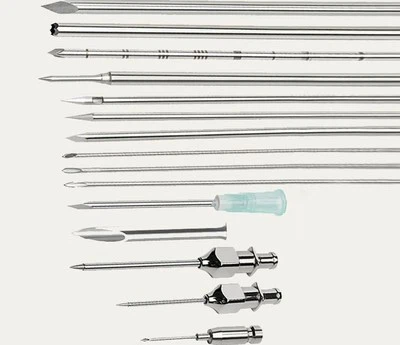
Early solutions involved adding echo-enhancing markers to specific parts of the needle tip or shaft-for instance, using laser etching to create micro-pits or textures that produced strong echo points on ultrasound. This design allowed physicians to see the needle tip's position and trajectory in real-time on the screen, achieving a revolutionary leap from "blind puncture" to "visual puncture." Manufacturers also began optimizing the flexibility of the needle body, enabling it to pass smoothly through the curved working channel of the bronchoscope while maintaining sufficient pushing force to penetrate the bronchial wall and lymph node capsule.
Phase 3: The Race for Needle Tip Refinement - Enhancing Sample Quality and Safety
Once visualization became standard, the competitive focus of EBUS-TBNA needle manufacturers shifted to needle tip design, aiming to obtain larger and more intact tissue samples rather than just cytological smears. This drove histological sampling capability to the forefront as a key metric.
Bevel Design & Cutting Efficiency: Traditional beveled puncture needles were continuously optimized. Sharper angles and smoother cutting surfaces were introduced to reduce tissue crushing and cellular deformation.
Side Ports & Sample Capture: Some manufacturers introduced needles with side ports. Once the tip penetrated the target, moving the needle back and forth allowed the side port to "scrape" more tissue strips, significantly increasing the sample volume available for histopathological analysis (rather than just cytology).
Stylet & Anti-Contamination Design: Retractable stylets became a standard configuration. During the puncture process, the stylet extends first to keep the lumen patent and prevent blockage by mucosal tissue from the bronchial wall. Upon reaching the target, the stylet is retracted to expose the sharp needle tip for sampling. This greatly improves the success rate of the first puncture and the quality of the sample.
Phase 4: Deep Empowerment by Materials Science and Manufacturing Processes
Currently, leading EBUS-TBNA needle manufacturers have elevated the competitive dimension to the level of materials and precision manufacturing.
High-End Material Applications: The use of superelastic Nitinol alloys or special stainless steels gives the needle body the necessary stiffness while possessing exceptional flexibility and bending fatigue resistance. This allows it to withstand multiple bends within the bronchoscope in complex airways without deforming or breaking.
Precision Machining: The use of advanced equipment like 5-axis laser cutting machines ensures extreme precision and consistency in needle tip geometry, making the cutting performance of every needle highly reliable. The inner and outer walls of the needle body undergo electropolishing to achieve a mirror-like finish, drastically reducing tissue residue and insertion resistance.
Full-Process Quality Control: From raw material certification (providing material certificates for all substances) to final sterilization, a full-chain quality control system covering design, production, and inspection has been built under the framework of the ISO 13485 medical device quality management system to ensure product safety and efficacy.
Future Outlook: Intelligence and Functional Integration
Technological evolution has not ceased. The next generation of EBUS-TBNA needles may integrate smarter elements, such as tip pressure sensing to provide feedback on tissue hardness for distinguishing tumors from normal tissue. They may also combine with functions like radiofrequency ablation to achieve "diagnosis-therapy integration." The race for EBUS-TBNA needle manufacturers is advancing from "visibility" to higher dimensions of "accurate measurement" and "treatability."
Conclusion
In summary, the technological evolution history of EBUS-TBNA needle manufacturers is a history of continuous innovation centered on the core goal of "precise, safe, and efficient acquisition of high-quality samples." Every step forward makes the thin needle in the hands of respiratory intervention physicians sharper, smarter, and more reliable.