The Technological Evolution Of Breast Biopsy Needles
Jun 13, 2026
https://www.mayoclinic.org/tests-procedures/breast-biopsy/about/pac-20384812
Breast biopsy, the "gold standard" for diagnosing breast cancer, owes its core capabilities to the evolution of the biopsy needle. This history serves as a microcosm of the broader advancement of minimally invasive surgical techniques. From relying on tactile feel and experience with crude aspiration to today's precision strikes under image guidance, each iteration of the biopsy needle has profoundly reshaped the diagnosis and treatment landscape of breast disease.
I. The Incipient Stage: Large-Bore Aspiration and the "Blind Era"
In the mid-20th century, the diagnosis of breast masses relied heavily on open surgical biopsy. Early attempts at percutaneous biopsy involved the use of simple 14G or 16G large-bore needles for manual aspiration. This "blind" approach depended entirely on the physician's anatomical knowledge and palpation skills, proving somewhat effective only for superficial, palpable masses. For deep-seated or non-palpable micro-lesions, it was akin to finding a needle in a haystack. The needles of this era were typically made of crude ordinary stainless steel, yielding fragmented cell clusters rather than intact tissue. Consequently, analysis was limited to cytology, rendering it impossible to assess tumor invasiveness. Biopsy during this period was more of a "hit-or-miss" diagnostic gamble, often resulting in a high false-negative rate.
II. The Revolutionary Period: Spring-Driven Automatic Biopsy Guns
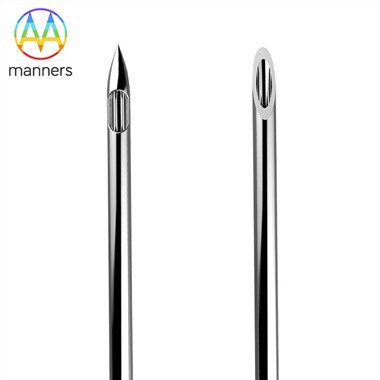
A true revolution occurred between the late 1980s and 1990s. With the maturation of imaging technologies-particularly high-frequency ultrasound and stereotactic mammography-biopsy entered the "visualization" phase. Complementing this shift was the debut of the spring-loaded automatic biopsy gun. Equipped with a high-speed spring mechanism, these devices could fire the inner stylet instantly upon triggering, followed immediately by the forward sliding of the outer cannula to precisely "cut" out a small cylinder of tissue. This design dramatically improved sampling success rates, providing tissue volumes sufficient for comprehensive histopathological evaluation, including hormone receptor testing. During this time, needle materials also began to optimize, with medical-grade stainless steel becoming the mainstream standard, ensuring the rigidity required for sharp cutting and stable tract maintenance.
III. The Golden Age: Vacuum Assistance and Larger Sample Volumes
If the automatic biopsy gun solved the problem of "whether we can get a sample," then the Vacuum-Assisted Breast Biopsy (VABB) systems emerging in the early 21st century addressed "how well we get it." These devices utilize negative pressure to draw target tissue into the sampling notch, followed by continuous cutting with a rotating blade. A single insertion can harvest multiple, large-volume contiguous tissue specimens. Its core advantages include:
- Large Sample Volume: Utilizing large-caliber needles (typically 9G–7G), the tissue yield is two to three times that of traditional core needles, significantly mitigating the risk of missed diagnoses due to insufficient sampling.
- Precise Localization: The system allows for the placement of metallic clips post-sampling to mark the biopsy site, providing exact coordinates for subsequent surgery or radiotherapy.
- Minimally Invasive Therapy: For small benign tumors, VABB can achieve complete excision, serving a dual function of both diagnosis and treatment.
Needle architecture became more complex, featuring dual-lumen or multi-lumen structures for saline delivery, blood evacuation, and tissue aspiration. Regarding materials, beyond stainless steel, some high-end models began incorporating titanium alloys. Their lightweight and non-ferromagnetic properties helped reduce compatibility issues with Magnetic Resonance Imaging (MRI).
IV. Future Trends: Intelligence and Personalization
Today, breast biopsy needles are evolving toward greater intelligence and safety. Examples include needles equipped with real-time pressure sensors that alert physicians when the tip approaches vital structures like blood vessels or the chest wall, and robotic-assisted systems capable of sub-millimeter trajectory planning. Furthermore, needle tip geometries and cutting modes are being optimized for specific lesion characteristics (e.g., cystic, solid, or calcified). Cutting-edge advancements in materials science, such as the application of bioabsorbable polymer coatings, are being explored to further reduce the risk of needle-track seeding metastasis.
From a rudimentary steel rod to a sophisticated multifunctional system, the evolution of the breast biopsy needle has not only elevated diagnostic accuracy but also spared countless women from the trauma of unnecessary open surgery. This tiny needle embodies modern medicine's relentless pursuit of "precision, minimal invasion, and efficiency."