The Technical Route Debate
Jul 05, 2026
An In-Depth Comparison Between Physical Surface Treatments (Etching/Sandblasting/Dimpling) and Polymer Microbubble-Coated Echogenic Needles
https://www.nature.com/articles/s41598-024-72620-8
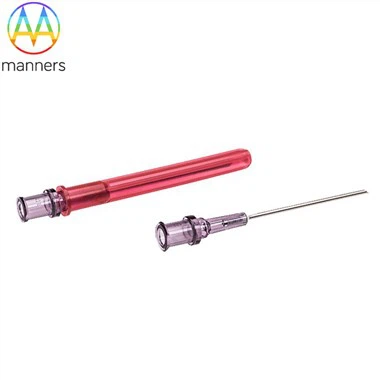
Currently, echogenic needles on the market primarily fall into two major technical schools: mechanical/chemical surface modification and functional polymer echo coatings. Both have distinct pros and cons, often sparking discussion during clinical selection.
I. Surface Microstructure Treatment (Micro-etching / Sandblasting / Dimpling / Laser Texturing)
Through controlled sandblasting, laser micro-engraving, or electrochemical etching of 304/316 stainless steel needle tubes, uniform micro-dimple arrays or spiral micro-grooves are formed near the needle tip (typically the front 15–30 mm). Advantages: ① No additional coating-eliminates risks of coating peeling, swelling, or blood/body fluid displacement of microbubbles; echo performance remains stable and repeatable even after multiple punctures and (for some products) autoclaving. ② Does not affect inner diameter or patency, nor increase surface friction. ③ Relatively controllable manufacturing cost, suitable for large-scale standardized production.
Limitations: ① Visual enhancement is mainly concentrated in treated sections; untreated mid-shaft segments may still darken. ② Excessive roughness may increase tissue drag sensation. ③ Etching depth and distribution require precise control-too shallow yields weak effects, too deep compromises tube strength or causes stress concentration.
II. Polymer Microbubble/Microparticle Coating (Echogenic Polymer Coating)
A medical polymer (PU/silicone) containing closed microbubbles or glass/ceramic microspheres is coated onto the needle shaft, typically 10–30 μm thick. Advantages: ① Can be applied to the full shaft or even entire length, achieving bright hyperechoic visualization from tip to subcutaneous throughout. ② Gradient echo design is achievable by adjusting microsphere size, concentration, and distribution. ③ Can be combined with hydrophilic lubricious layers to reduce puncture resistance.
Limitations: ① Coating durability challenges-repeated punctures cause wear, and immersion displaces gas within microbubbles, reducing echo. ② Requires additional primer to ensure metal-polymer bonding; longer process chain. ③ Possible minor coating debris shedding (mostly biologically inert). ④ Typically restricted to single use; not reusable after high-temperature autoclaving.
III. Clinical Perspective Trade-offs
For short-duration single-needle procedures like nerve blocks, both types perform well; some physicians prefer etched types for their immunity to bodily fluids. For deep biopsies or longer-dwell drainage catheter placements, fully-visual coated types are more popular. Recently, some manufacturers have launched "composite enhancement" products-micro-etched substrate + localized microbubble coating overlay-balancing durability and full-length visibility. Procurement decisions should comprehensively consider the department's mainstream procedure types, single/multiple puncture habits, and cost tolerance.