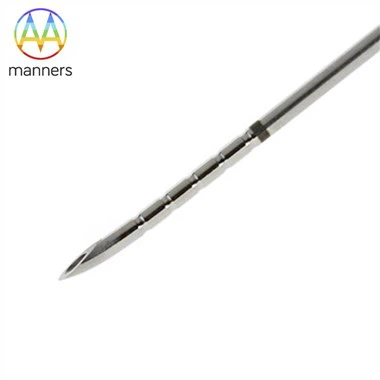
The Role Of The Veress Needle in Medical Education And Training
Jun 17, 2026
For a medical student or resident aspiring to become a surgeon, mastering laparoscopic technique marks a significant milestone in their career. Learning to perform safe access using the Veress needle is often their first exposure to minimally invasive surgery-a foundational skill fraught with challenge.
I. Bridging Theory and Practice: Understanding Anatomy and "Tactile Feel"
The operation of the Veress needle seems simple, yet it embodies rich anatomical and physical principles. In the classroom, trainees must first understand the layered structure of the abdominal wall (skin, subcutaneous fat, fascia, muscle, peritoneum) and the distribution of underlying organs corresponding to different entry sites (such as the umbilicus or left subcostal region).
However, the true challenge lies in practice. The "tactile feel" during insertion-specifically the perception of the two distinct "pops"-cannot be learned from textbooks or videos alone. It demands extensive simulation training and hands-on clinical instruction. Trainees must practice repeatedly on simulators (such as porcine models or silicone trainers) to appreciate the resistance encountered when piercing the fascia and the sensation of "loss of resistance" upon entering the peritoneal cavity. The spring-feedback mechanism of the Veress needle is the critical tool that translates this abstract "feel" into a concrete, repeatable experience.
II. Core Modules of Standardized Training Curricula
Today, many national and regional medical societies have established standardized laparoscopic training curricula, with Veress needle usage as a core module. Training content typically includes:
- Theoretical Knowledge Assessment: Mastering the Veress needle's structure, working principles, indications, and contraindications.
- Box Trainer Exercises: Practicing precise blind access within a closed trainer, often using an internal camera to verify needle tip positioning.
- Animal Laboratory Experience: Performing live tissue punctures on animals (typically swine) to experience realistic tissue resistance and bleeding risks.
- Complication Management Drills: Simulating emergencies such as failed insufflation, subcutaneous emphysema, or accidental vascular injury to train the trainee's judgment and crisis management skills.
III. Training Innovation Enabled by New Technology
With the advancement of Virtual Reality (VR) and Augmented Reality (AR), Veress needle training is undergoing a transformation. Next-generation VR laparoscopic simulators can highly replicate the visual, auditory, and haptic feedback of the insertion process, allowing trainees to practice in a zero-risk virtual environment until muscle memory is formed.
Furthermore, some advanced Veress needles now incorporate educational features. For instance, smart Veress needles equipped with pressure sensors can display the force curve of the insertion process in real-time on a screen, helping trainees intuitively understand what constitutes "correct force" and a "proper pop."
Conclusion
The Veress needle is not merely a surgical instrument; it is an excellent pedagogical tool. Through its unique design, it carries the legacy of knowledge transfer from open to minimally invasive surgery and, through continuous innovation, cultivates generations of skilled minimally invasive surgeons. For every aspiring surgeon, conquering this small Veress needle signifies opening the door to the world of minimally invasive surgery.