The Operator's Map: From Blind Tuning To Controlled Process
Oct 15, 2026
The Pain Point The difference between a good dispensing line and a great one is rarely the equipment-it is the operator's understanding. On a mediocre line, the operator responds to a bad dot by turning knobs at random: a bit more pressure, a nudge to the gap, a different needle-and hopes. On a great line, the operator reads the symptom, identifies the cause, and changes exactly the parameter that controls it. The pain is that most lines operate in the first mode, blind-tuned and reactive, because the process is treated as a mystery rather than a model. The result is a line that is always being adjusted and never truly stable, and a quality problem that is blamed on the material or the machine when it is really a knowledge problem.
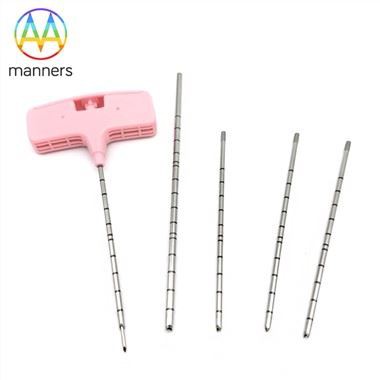
How It Works The coating process for patch glue is a system of parameters with known relationships. Temperature and viscosity govern flow and wet strength. Pressure and piston stroke govern volume. The needle gap and the bore govern dot diameter and height. Speed, dwell, and height govern placement and wetting. Each parameter has a defined effect, and each effect is predictable given the others are held constant. The high precision dispensing stainless steel needle is the fixed reference in this system: its bore and taper are known and consistent, so every adjustable parameter acts against a stable reference. When the operator understands the map-which parameter bends which outcome, and how they interact-tuning becomes deliberate. A shrinking dot is diagnosed as a viscosity rise and the temperature is fixed; a smear is diagnosed as a geometry error and the gap is fixed. The process stops being a guess and becomes a controlled system.
Device Classification The operator's map is built on the classification of the parameter space. Material parameters-temperature, viscosity-are the first category, governing the fluid itself. Delivery parameters-pressure, stroke-govern volume. Geometry parameters-the gap and the bore-govern dot shape. Motion parameters-speed, dwell, height-govern placement and wetting. The needle family spans the geometry category, classified by bore and taper, with the material and finish ensuring clean delivery. The operator's job is to hold this map: to know which category each knob belongs to, which effect it controls, and how the needle's fixed geometry constrains it. The map is the instrument; the classification is its structure.
Practical Guide Build and use the map deliberately. For your material and needle, establish the parameter relationships empirically: how each variable moves the dot, holding others constant. Record the effects-temperature's effect on viscosity and dot size, pressure's on volume, the gap's on diameter and height, dwell's on wetting. Then diagnose by symptom: a shrinking dot means viscosity rose, fix temperature; a smear means geometry is wrong, fix the gap; an under-filled joint means volume is short, fix stroke or pressure. Change one parameter at a time, verify the effect, and record it. Re-verify after any change to the needle or material. The discipline is to tune with a model, not by trial-each knob turned because the map says it is the right one, with the high precision needle as the stable center.
Field Experience Operators with a map tune with confidence. A chip-fix line diagnosed a shrinking dot as a temperature-driven viscosity rise and fixed the heat, where a guesser would have raised the pressure and worsened it. A component placement line corrected a smear by adjusting the gap, once the map showed geometry was the cause rather than volume. A medical assembly used the map to set dwell for proper wetting, matching the process to the material. The common lesson is that understanding is the control. When the operator holds a model of the parameters, the line is tuned deliberately, and the quality problem stops being a mystery.
Reflection The operator's map is a lesson in the nature of expertise. A high precision needle and a sophisticated machine are worth little in the hands of an operator who cannot read the process. The skilled operator's power comes from the model-understanding which parameter bends which outcome, and how the needle's fixed geometry anchors it all. This is the mature practice of precision: not blind adjustment but informed control, not reaction but diagnosis. The map is what turns a machine into a process and an operator into an engineer.
Outlook As dispensing automates, the operator's map will be encoded in software. Expect process recipes that set every parameter as a coordinated set, with the needle's geometry as the fixed reference, and closed-loop systems that sense drift and adjust the matching parameter automatically. Expect operator training to focus on the model-the parameter map-as much as the machine. For buyers, the forward-looking advice is to invest in understanding as much as equipment, because a well-mapped process on a high precision needle is worth more than automation without knowledge. In the controlled line, the operator's map is the true instrument of precision.