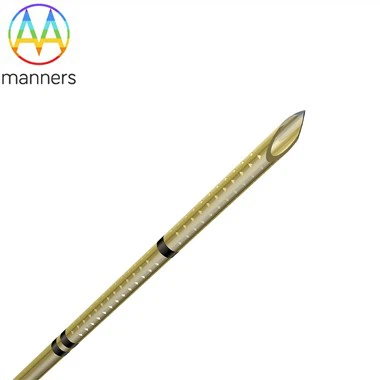
The Evolution Of Materials: How Smart Polymers Are Reshaping The Oocyte Retrieval Paradigm
Apr 24, 2026
The Evolution of Materials: How Smart Polymers Are Reshaping the Oocyte Retrieval Paradigm
Keywords: Composite-coated OPU needles + Achieving exceptional puncture smoothness and oocyte integrity protection
In the core procedure of Assisted Reproductive Technology (ART)-Transvaginal Ultrasound-Guided Oocyte Pick-Up (OPU)-the evolutionary history of puncture needle materials is a chronicle of the relentless pursuit of biocompatibility, mechanical properties, and clinical outcomes at the microscopic scale. From the resilience of first-generation stainless steel needles, to the lightweight innovation of titanium alloys, and onto the infection control revolution of disposable polymer needles, each material iteration has been more than a simple substitution. Rather, it represents a systematic engineering response to the ultimate challenge: "precisely retrieving extremely fragile cells from fragile tissues."
The Enduring Reign and Inherent Limitations of Stainless Steel Needles Defined Early Standards.
Medical-grade 316L stainless steel, with its excellent strength (tensile strength >500 MPa), rigidity (elastic modulus 200 GPa), and mature sterilization tolerance, became the cornerstone of reusable OPU needles. Its high stiffness ensured minimal needle shaft deflection when penetrating the vaginal wall and ovarian parenchyma, providing operators with authentic mechanical feedback. However, its limitations have become increasingly apparent in an era demanding superior pregnancy outcomes. Firstly, the high elastic modulus results in excessive hardness; when traversing ovarian stroma, the needle may "push" follicles aside rather than piercing them directly. This is particularly problematic for follicles located on the posterior aspect of the ovary, often requiring greater pushing force and thereby increasing the risk of hemorrhage. Secondly, microscopic corrosion from repeated autoclaving creates nanoscale pits on the inner lumen walls, fostering biofilms. Even with strict sterilization protocols, the risk of residual endotoxins persists. Finally, while surface-etched textures can enhance ultrasound visibility through echo characteristics, "comet tail" artifacts remain, interfering with precise needle tip localization.
The Lightweight Innovation and Biocompatibility Breakthrough of Titanium Alloys Responded to Clinical Pain Points.
TC4 titanium alloy (Ti-6Al-4V) ushered OPU needles into a "lightweight, high-precision" era. Its core advantages lie in: 1) Higher specific strength, allowing for thinner needle walls while maintaining equivalent penetration force-a key breakthrough enabling increased inner diameter without changing the outer diameter. For instance, for a 17G needle, the inner diameter of a titanium alloy needle (~1.14 mm) exceeds that of a stainless steel counterpart (~1.07 mm). This reduces fluid resistance during follicular fluid and cumulus-oocyte complex (COC) transit by 18%, theoretically minimizing mechanical stress on the oocyte-cumulus cell connections. 2) Exceptional biocompatibility: the spontaneously formed dense titanium oxide layer results in a near-zero corrosion rate, eliminating the potential impact of metal ion leaching on the follicular fluid microenvironment. 3) Superior acoustic impedance matching: the smaller impedance difference between titanium alloy and human tissue yields clearer ultrasound images, improving needle tip recognition by approximately 30%. However, its high cost (3–5 times that of comparable stainless steel needles) and more complex manufacturing processes have limited its widespread adoption.
The Disposable Revolution of Medical Polymer Needles Originates from Dual Drivers: Infection Control and Operational Standardization.
High-performance polymers like Polyetheretherketone (PEEK) and Polycarbonate (PC) derive their core value not from surpassing metals in mechanical properties, but from delivering "absolute zero cross-contamination risk" and "absolute operational consistency." Disposable polymer needles are sterile out of the factory, free from sterilization residues, completely eliminating the theoretical risk of inter-patient transmission of viruses (e.g., Hepatitis B, HIV) and bacteria (e.g., Chlamydia) via the needle tract-a factor critical to the highly sensitive embryology laboratory environment. In terms of mechanical design, polymers can be molded into structures with graduated hardness: a rigid proximal shaft ensures controllability, while a flexible distal segment allows slight bending along the puncture path, reducing laceration of superficial ovarian vessels. The latest generation of multi-layer co-extruded polymer needles features an ultra-smooth inner layer of fluoropolymer (friction coefficient <0.1), a carbon fiber-reinforced PEEK middle layer for support, and a hydrophilic outer coating to reduce tissue drag. This achieves a 40% reduction in puncture force compared to traditional needles and an average decrease of 1.5 points in postoperative patient abdominal pain VAS scores.
Surface Coating Technology is the "Soul Empowerment" of the Material.
Whether the substrate is metal or polymer, surface modification dictates the final interaction with tissue. Diamond-Like Carbon (DLC) coatings increase the surface hardness of stainless steel needles to nearly diamond levels, reducing the friction coefficient to below 0.05. This makes puncture feel like a "hot knife through butter," significantly mitigating the risk of tissue debris clogging the lumen due to friction. Heparin-bonded coatings form a molecular barrier on the needle surface, which not only reduces thrombus formation but, crucially, decreases the adsorption of vasoactive substances in patients with Ovarian Hyperstimulation Syndrome (OHSS) post-retrieval, which is vital for high-risk patients. Smart responsive coatings represent the frontier: temperature-responsive polymers become extremely hydrophilic and lubricious at body temperature but revert at room temperature for easier handling; pH-responsive coatings release anti-inflammatory drugs within the slightly acidic follicular fluid to alleviate local inflammatory reactions.
Future Materials Will Evolve Toward "Structural Intelligence."
Shape Memory Alloys (SMAs) and polymer composite needles under development remain straight at room temperature for easy penetration. Upon reaching the ovarian surface, a micro-current heats the tip, allowing it to pre-programmatically bend 10–30 degrees. This enables precise penetration of target follicles while navigating around vessels, achieving minimally invasive "one-needle, multiple-puncture" retrieval. Biodegradable polymer needles are even more disruptive: constructed from Poly(lactic-co-glycolic acid) (PLGA), the needle tip separates and remains in the puncture tract after retrieval. It slowly releases hemostatic and anti-adhesion drugs before completely degrading within 2–3 weeks. Theoretically, this could reduce post-OPU bleeding and adhesion risks to near zero.
The Underlying Logic of Material Selection is Shifting from "Device Properties" to "Oocyte Outcome Properties."
Studies confirm that optimizing materials and coatings to minimize the mechanical and chemical stress experienced by oocytes during retrieval leads to statistically significant improvements in subsequent fertilization rates, cleavage rates, and high-quality embryo rates. In the future, no single material will dominate all scenarios. Instead, customized material solutions will emerge based on patient ovarian conditions (e.g., tough ovarian texture in PCOS patients vs. rich vasculature in poor responders) and treatment protocols (natural cycle, mild stimulation, conventional stimulation). This marks a profound shift for OPU needles-from standardized tools to personalized medical components.