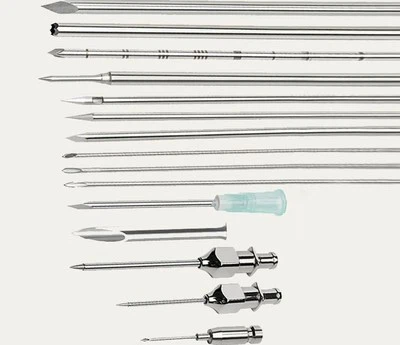
The Art Of Tube-within-a-Tube At The Micron Level: How Citizen Lathes Sculpt Arthroscopic Shaver Systems
Apr 12, 2026
The Art of "Tube-within-a-Tube" at the Micron Level: How Citizen Lathes Sculpt Arthroscopic Shaver Systems
Introduction: The Overlooked Crisis of "Concentricity"
In arthroscopic shaver systems, the clearance between the outer sleeve and the inner rotating tube is typically less than 0.05 mm. This gives rise to a classic manufacturing dilemma: if the inner tube is even slightly eccentric, high-speed rotation will induce severe chatter. This not only disrupts the surgical rhythm but also risks vibrating and damaging soft tissue. How does Manners Technology utilize the Japanese Citizen Cincom L12-1M7 Sliding Headstock Lathe to turn this "mission impossible" into a tangible reality?
I. Historical Tracing: The Counterattack of Swiss-Type Lathes in the Medical Field
In the 1980s, with the rapid advancement of endoscopy, demand for long, thin-walled metal tubes surged. Traditional "Bar Feed" lathes suffered from severe "Tool Deflection" caused by centrifugal force during the rotation of long workpieces. The Swiss-type Sliding Headstock Lathe emerged as a revolutionary solution. Its groundbreaking principle lies in the spindle gripping the workpiece stationary while the turret rotates and feeds around it. This design completely eliminates flexural deformation during long-axis machining, establishing itself as the gold standard for precision medical device manufacturing.
II. Principle Analysis: The Physical Advantage of Stationary Workpieces
How does the Citizen machine achieve tolerances of +/-0.01 mm?
In shaver blade manufacturing, the inner tube must be hollowed out to form a suction channel. On conventional lathes, when the Length-to-Diameter (L/D) ratio exceeds 4, the workpiece bends under cutting forces. However, on a Citizen machine, the workpiece remains static while only the tools rotate, eliminating both centrifugal force and gravitational sag. Coupled with Laser Machining technology, this allows for the precise cutting of 15–30 μm wide slits in extremely thin-walled tubes without inducing thermal deformation, ensuring the dynamic balance of the inner tube at high speeds.
III. Standardization: ISO 1101 Geometric Tolerancing and Laser Welding
Precision manufacturing cannot exist without the constraints of standards.
ISO 1101 (Geometric Tolerancing): Strictly defines requirements for Concentricity and Runout. For shaver systems, the concentricity between the inner and outer tubes must be controlled within 0.02 mm; otherwise, it leads to sticking or seal failure.
AWS D17.1 (Laser Welding Standard): When joining dissimilar materials (e.g., a stainless steel shaft to a Ni-Ti head), laser welding provides an atomic-level metallurgical bond. The Heat-Affected Zone (HAZ) is minimal, preventing the hardness drop associated with annealing.
IV. Application Scenarios: Stable Output Under High Cadence
Meniscectomy: Surgery requires rotation at thousands of RPM. Inner tubes machined by Citizen machines possess extreme straightness and roundness, ensuring no radial runout during high-speed rotation. This transmits an extremely stable "feel" to the surgeon, preventing inconsistent cutting depths due to vibration.
Minimally Invasive Spine Surgery: In narrow intervertebral foramina, shaver blades must be extremely slender. The precision-manufactured "tube-within-a-tube" structure guarantees sufficient wall thickness strength even at very small diameters (e.g., 2.7 mm), preventing collapse.
Conclusion
Micron-level manufacturing precision is the physical foundation upon which modern minimally invasive surgery is built. From the nanometer-level turning of Citizen lathes to the micro-slot cutting of lasers, every shaver blade stands as a testament to the limits of mechanical precision.