The Art Of Precision Source Placement in Particle Implantation
Jun 15, 2026
The anatomy of the head and neck is complex, with critical vasculature, nerves, and functional organs in close proximity. Permanent radioactive seed implantation (e.g., Iodine-125) using the 18G technical specification oral brachytherapy needle is an ideal method for delivering high-dose targeted irradiation while sparing normal tissues. This article focuses on the operational workflow and technical essentials of this needle in head and neck cancer brachytherapy.
Pre-Operative Planning and Template Guidance
1. Image-Based Planning:
Prior to the procedure, physicians utilize CT/MRI images and a 3D Treatment Planning System (TPS) to delineate the target volume (GTV/CTV) and Organs At Risk (OARs). The plan specifies the required seed activity, quantity, and the precise depth, angle, and inter-seed spacing for each needle. The outer diameter of the 18G needle serves as a fundamental parameter for calculating needle trajectories and dose distribution within the TPS.
2. Template Guidance System:
To enhance implantation accuracy, especially for regions like the tongue and floor of mouth, a grid-based template is often employed. The 18G needles are inserted through predefined channels in the template, ensuring parallelism and consistent spacing between multiple needles. The use of a template significantly reduces the subjective error of free-hand insertion, aligning the actual dose distribution more closely with the planned values.
Intra-Operative Procedure
1. Anesthesia and Immobilization:
The procedure is performed under local or general anesthesia. The patient's head must be securely immobilized using a head frame or vacuum cushion to maintain positional stability. The physician must reconfirm the alignment of the template coordinates with the pre-operative plan.
2. Insertion and Depth Control:
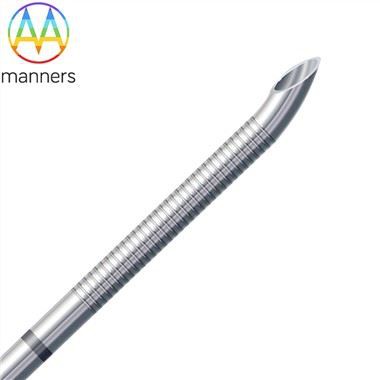
Holding the needle loaded in an implantation gun, the physician aligns with the template channel and advances the needle smoothly and steadily to the predetermined depth. The depth markings etched on the shaft serve as the primary reference for insertion depth. For firmer tumors, slight rotation of the needle may be required to facilitate penetration. Violent force must be avoided to prevent needle breakage or deviation from the intended trajectory.
3. Seed Deployment:
Once the needle tip reaches the distal margin of the target volume, the needle shaft is held stationary while the stylet is retracted or the trigger of the implantation gun is activated, deploying seeds sequentially at the prescribed intervals. Ultrasonography can be used to monitor seed deposition in real-time. If a suboptimal seed position is observed, the deployment strategy for subsequent seeds should be adjusted immediately.
4. Needle Withdrawal and Hemostasis:
After all seeds are deployed, the 18G needle is withdrawn slowly and gently with slight rotation. Rapid withdrawal should be avoided to prevent seed migration or suction effects. Immediate manual pressure with gauze is applied to the puncture site for several minutes to ensure hemostasis. For procedures involving multiple puncture sites, this process is completed sequentially.
Common Challenges and Mitigation Strategies
1. Avoiding Bone and Vasculature:
The head and neck region contains hard structures such as the mandible and skull base. Pre-operative planning must define safe trajectories that avoid bone. If resistance is encountered during insertion, do not force the needle forward. Re-evaluate the trajectory and adjust the angle accordingly.
2. Tissue Displacement:
Soft tumor tissue may shift during needle insertion. Utilizing the sharpness of the tip, stable technique, and real-time imaging is essential to ensure the needle tip remains within the target volume despite tissue movement.
3. Seed Migration:
In rare cases, seeds may migrate via blood or lymphatic vessels to the lungs or other sites. The key to prevention lies in the precise, controlled deployment using the 18G needle, ensuring seeds are firmly embedded within the tissue matrix.
Conclusion
Operating the 18G technical specification oral brachytherapy needle represents a high degree of unity between theoretical planning and practical skill. From the precise positioning of the pre-operative template, to the millimeter-level control of intra-operative depth, and the stable execution of seed deployment, every step tests the physician's technique and experience. Mastering this needle is the gateway to precise and effective head and neck brachytherapy.