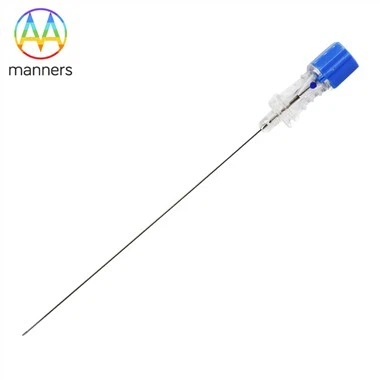
Tactical Applications Of Brachytherapy Needles Across Different Cancer Battlefields
Jun 15, 2026
Brachytherapy needles are not a universal master key, but rather a sophisticated arsenal. On different cancer battlefields, physicians flexibly select distinct tactical "needling" techniques based on the enemy's disposition (tumor location, morphology, size) and our weaponry (radionuclide type, dose rate) to achieve optimal eradication.
I. Prostate Cancer: The "Seed Sower" in a War of Position
Prostate cancer represents one of the most mature fields for brachytherapy. The tactic here is "permanent seed implantation." Under transrectal ultrasound guidance, physicians use slender 17G or 18G implantation needles to distribute dozens or even hundreds of rice-grain-sized radioactive seeds (such as Iodine-125 or Palladium-103) evenly throughout the prostate, much like sowing seeds.
- Tactical Essentials: Needle arrangement strictly follows the pre-operative plan. Typically utilizing template guidance, needle spacing is precise to 5–10 mm. The needle tip must avoid the urethra and rectal wall to ensure the seed distribution creates an ideal dose coverage curve.
- Needle Characteristics: These needles often feature depth markings to aid physicians in controlling implantation depth. Some are equipped with specialized "stylet" mechanisms that eject seeds sequentially at preset intervals, enabling automated and standardized implantation.
II. Cervical Cancer: The "Three-Dimensional Offensive" of Intracavitary and Interstitial Brachytherapy
For locally advanced cervical cancer, the classic tactic is combined intracavitary and interstitial implantation. First, a specialized uterine tandem and vaginal ovoids are placed into the uterus and vaginal fornices (intracavitary component). Subsequently, based on the extent of tumor invasion, multiple 18G or 20G fine needles are inserted through the perineal skin to penetrate the parametrial tissues (interstitial component).
- Tactical Essentials: This constructs a three-dimensional radiation network. The intracavitary component covers the central tumor region, while the interstitial needles deliver supplemental dose to "satellite lesions" extending laterally or anteriorly. The number and position of needles require real-time adjustment based on intra-operative MRI or CT imaging.
- Needle Characteristics: These needles are frequently used in conjunction with "applicators." The needle hubs feature fixation devices to securely attach them to templates, preventing displacement. The shafts are typically flexible to adapt to the complex anatomical contours within the pelvis.
III. Breast Cancer: The "Precise Finishing Blow" Post-Lumpectomy
Accelerated partial breast irradiation (APBI) is a highly effective modality following lumpectomy for early-stage breast cancer. The tactic involves "multi-catheter interstitial implantation." Under ultrasound or CT guidance, physicians arrange 4–12 flexible plastic catheters or metal needles equidistantly around the surgical cavity.
- Tactical Essentials: The needle paths are meticulously designed to ensure the catheter ends form a spherical or ellipsoidal conformation enveloping the tumor bed. The objective is to irradiate only the 1–2 cm margin surrounding the cavity, maximizing the preservation of skin, ribs, and lung tissue.
- Needle Characteristics: This scenario commonly employs "trocar" needles with removable stylets. The stiff metal trocar is inserted to the target depth, after which the stylet is withdrawn, leaving behind a flexible plastic catheter as the channel for subsequent high-dose-rate (HDR) brachytherapy. This design balances the rigidity needed for insertion with the comfort required for catheter retention.
IV. Personalized Tactics for Other Cancers
- Head and Neck Tumors: Due to complex anatomy and proximity to vital organs, "free-hand implantation under ultrasound/MRI guidance" is often employed. Physicians manually manipulate single fine needles (19G–21G), precisely guiding them into deep-seated locations like the tongue base or tonsillar fossa under real-time imaging.
- Skin Cancer: The tactic is the simplest, typically involving specialized "surface applicators" or direct shallow interstitial implantation using short needles, where the length only needs to penetrate the dermal layer.
Summary
From the "seed sowing" approach in prostate cancer to the "three-dimensional offensive" in cervical cancer, and the "precise finishing blow" in breast cancer, every insertion of a brachytherapy needle represents a meticulously planned tactical maneuver. It is precisely this high degree of flexibility and specificity that enables brachytherapy to eradicate local disease while maximally preserving organ function and the patient's quality of life.