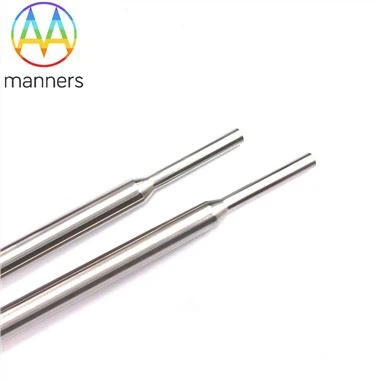
Stainless Steel And Safety: The Metallurgy Of Bleeding Needles
Oct 17, 2026
When the Metal Betrays the Hand
Every practitioner has experienced it: a needle that bends on insertion, a point that dulls after a single use, a surface that discolours after sterilization. The pain point is invisible because it lives in the material. Clients do not see the metal's grain structure; they feel only its consequences-a dragging puncture, a ragged wound, an unexplained irritation. Practitioners blame themselves, their technique, or bad luck, when the real culprit is metallurgy. A bleeding needle hollow is only as good as the steel from which it is drawn, and not all stainless steel is created equal. Understanding the metal is not a materials-science indulgence; it is the foundation of clinical safety and client confidence.
The Science Inside the Steel
High-grade stainless steel earns its name through a precise alloy chemistry. Chromium, typically above twelve percent, forms a microscopic oxide layer on the surface that is the metal's first defence against corrosion. Nickel and molybdenum contribute strength, hardness, and resistance to pitting. The manufacturing process matters as much as the recipe: the steel must be drawn, ground, and polished under controlled conditions to produce a needle that is straight, smooth, and dimensionally accurate. The bevel-the cutting edge that does the actual work-must be ground to a precise angle, because an angle too steep will drag through tissue, and an angle too shallow will dull rapidly. Heat treatment then sets the hardness, balancing the needle's need to be sharp against its need to resist bending. Surface finishing, often the final pass, removes microscopic burrs that can snag tissue and creates the smooth, mirror-like finish that distinguishes a premium needle from a cheap imitation. Every step in this chain is a point of failure and a point of excellence, and the client feels the difference without ever knowing the cause.
Classifying Needles by Material Grade
The market offers a hierarchy of material quality, and the classification is worth understanding. Economy needles may be drawn from lower-grade stainless steel, with looser tolerances, softer hardness, and less consistent surface finishing; they are usable, but they punish both practitioner and client with premature dulling and unpredictable performance. Standard medical-grade stainless steel is the workhorse of the industry: certified composition, consistent geometry, and reliable performance across a wide range of procedures. Premium grades-often using alloys developed for aerospace or surgical applications-offer superior edge retention, corrosion resistance, and biocompatibility, at a correspondingly higher price. Titanium is emerging as a premium alternative, offering biocompatibility for clients with nickel sensitivity, though its softness demands careful handling. The classification matters clinically because the material determines the puncture experience: a premium needle feels effortless because its edge is precise and its surface is smooth, while an economy needle announces itself with drag and resistance. For a practice whose reputation rests on comfort, the material grade is a strategic decision, not a cost line.
Practical Metallurgy-Based Procurement
Build your procurement policy on material evidence rather than price alone. Request material certificates from every supplier and verify that the alloy grade matches the claim-a certificate of conformity is your only protection against mislabelled metal. Test new batches on a sample basis: check hardness indirectly through edge performance, check surface quality under magnification, and confirm dimensional accuracy with calibrated gauges. Establish a relationship with a manufacturer that can produce custom sizes and lengths from your 2D/3D drawings or samples, because dimensional control is where premium manufacturing proves its value. Store needles properly-dry, at controlled temperature, away from corrosive chemicals-because even premium steel will corrode if abused. And maintain a rotation system that uses older stock first, ensuring that no needle sits long enough for moisture or contamination to compromise its surface.
What the Clinics Learned
Practices that upgraded their needle material report immediate, measurable changes. One body-piercing studio that switched from unbranded economy needles to certified medical-grade stainless steel saw its complication rate drop and its client pain scores fall, with no change in technique. A medical practice that adopted premium bevel-ground needles found that phlebotomy success rates improved and patient complaints about "the needle" virtually disappeared. Practitioners consistently report that the premium needle feels different in the hand: smoother entry, cleaner exit, less resistance-the difference between cutting and tearing. The field data is unambiguous: material quality is not invisible. It is felt by every client, remembered by every patient, and reflected in every review.
The Metal That Carries Trust
The stainless steel of a bleeding needle hollow carries more than blood-it carries trust. Every puncture is an act of confidence, and the metal must honour that confidence with predictable, gentle performance. The practitioner who understands the metallurgy can explain to a nervous client why this needle is different, and that explanation is itself a form of care. The metal is the silent partner in every procedure, and the practice that chooses its partner wisely builds a reputation that no marketing can match.
The Future of Needle Materials
Materials science is pushing the boundaries of what a needle can be. Bioactive coatings that reduce inflammation at the puncture site are in development. Nitinol alloys, with their shape-memory properties, are being explored for needles that flex with tissue rather than against it. Nanostructured surfaces, engineered at the microscopic level, promise even lower friction and faster healing. Digital manufacturing will make custom geometries economical, allowing practitioners to specify not just size and length but point geometry and surface finish to a precision that hand grinding could never achieve. The future belongs to practices that embrace these advances-and to the clients who will feel their benefits as the gentlest of touches.