HDR Brachytherapy Needles For Liver Tumor Treatment
Nov 28, 2026
Liver tumours sit inside an organ that moves with every breath and bleeds readily when crossed. A needle that performs well in a fixed target may still disappoint in hepatic work, because the shaft must hold a planned depth in soft, mobile tissue and then be withdrawn without dragging a seed column off position. Clinicians who treat liver lesions therefore judge tooling by different criteria from those used in prostate work. This article sets out those criteria in manufacturing terms, from gauge selection to tip geometry and marking.
Why Liver Targets Challenge Needle Handling
The first difficulty is anchoring. Hepatic parenchyma offers less resistance than prostate tissue, so a cannula can advance further than intended under the same hand pressure. The operator compensates by advancing in smaller increments and checking depth more often, which lengthens the case and increases the number of imaging confirmations.
The second difficulty is respiratory movement. A target can travel several millimetres between inspiration and expiration, and a needle left unheld will follow that motion rather than resist it. Both problems point to the same specification priorities: controllable insertion, clear depth reference, and a shaft stiff enough to hold a line once placed.
This is why a liver programme should not simply inherit a lung specification. The instruments look similar and share a manufacturing route, yet the priorities differ enough that a copy of an existing drawing usually misses one of the two risks. Starting from the anatomy, and building the specification around it, avoids that inheritance problem and gives the supplier a clear basis for adjusting tip and shaft.
How Liver Tissue and Motion Shape the Specification
Soft tissue changes the relationship between gauge and control. A finer cannula reduces trauma and bleeding but bends more readily when it meets a capsule or a vessel wall; a heavier gauge holds a straighter line but creates a larger tract. In liver work the usual compromise is a mid-range gauge for the main body of the implant, with finer options reserved for superficial or peripheral lesions where the path is short.
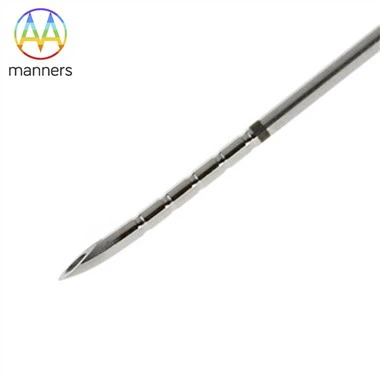
Motion adds a requirement that is often overlooked in the drawing: a marking reference that remains readable while the field is being adjusted. Depth marks laser marked at fixed intervals allow the operator to see immediately whether a cannula has advanced or slipped, without measuring against a template that is itself moving. A clear reference converts a vague sense of position into an observation.
Surface finish enters the conversation through bleeding as well. A polished shaft crosses tissue with less drag, which reduces the mechanical insult along the track and shortens the time the instrument spends inside the organ. That is a small effect on any single pass and a larger one across a multi-channel implant, where total track length adds up quickly.
Breathing control is worth rehearsing as a step linked to the specification. If the planned positions assume a particular phase, insertion should be timed to it, and the working length must allow the operator to complete the last channel without rushing. A shorter instrument sometimes helps more than a longer one, because it removes the need to hold position while the remaining shaft is managed.
Lung and Liver Needle Sets Compared
The table compares the two applications at the points where a buyer must choose differently. Both use the same manufacturing processes, but the priorities differ.
|
Requirement |
Lung application |
Liver application |
|
Dominant risk |
Air entry at the pleural crossing |
Bleeding and target motion |
|
Preferred gauge bias |
Finer, fewer passes |
Mid-range, holds a line |
|
Tip geometry |
Short taper, clean pleural entry |
Controlled taper, resists deflection |
|
Depth reference |
Marks readable in a moving field |
Marks readable at each increment |
|
Shaft stiffness |
Balance against tract size |
Bias toward stability |
|
Common failure |
Tract too large, prolonged air leak |
Depth drift after placement |
The differences are matters of emphasis rather than of different products. A supplier who understands which column applies to a given order can adjust tip grinding and shaft selection without changing the rest of the build.
One row deserves attention in both columns: the fit between cannula and delivery tube. A hub that mates loosely introduces backlash, and backlash in a mobile organ translates into a dwell position that differs from the plan. Verifying the interface on a sample, with the accessory actually in use, is a routine step that prevents a systematic error.
A Practical Setup for Liver Implants
The sequence that works starts with imaging compatibility rather than with the needle itself. Whatever modality the team uses to confirm placement should be tested against a sample tip, because a finish that scatters signal will make every depth check slower and less certain. Once the tip reads clearly, the rest of the setup follows.
The second step is to fix the depth reference before the first pass. Marking intervals should correspond to the increments the operator actually uses, not to a round number chosen in the drawing office. A mark every increment is worth more than a dense scale that cannot be read in a moving field.
The third step is a withdrawal routine that protects the seed column. A slow, steady withdrawal with the hub supported reduces the chance that the column is dragged outward, and it also reduces the chance that a fine cannula is bent at the point of removal, which is where much of the visible damage in returned samples originates.
Time management belongs in the same protocol. Hepatic cases often involve imaging confirmation at several points, and each confirmation consumes suite time. A cannula with readable marks and predictable resistance reduces the number of confirmations needed, which is a benefit measured in minutes per case rather than in dose.
Observations from Liver Case Reviews
Reviews of hepatic cases tend to return to depth stability. The plan is acceptable, the insertion is acceptable, and the delivered distribution is slightly out of position because a cannula moved between confirmation and treatment. When the cause is examined, it is usually the absence of a reliable holding method rather than a defect in the metal.
A second theme is the cost of repeated passes. Each additional pass through hepatic tissue increases bleeding risk and consumes time in an imaging suite. Needles that allow a controlled advance with clear feedback reduce the number of corrective passes, and that effect on case time is often larger than any difference in unit price.
Tissue heterogeneity is another recurring factor. A path that crosses a vessel wall or a fibrous band may deflect even a well-made instrument, and the deflection is invisible without imaging. Needles that track predictably in such conditions, and that give the operator tactile warning before a deflection becomes large, are valued more highly than a lower unit price.
Summary of Specifications for Liver Work
For hepatic implants, the specification sheet should state gauge with a stiffness note, working length, tip angle and grind, surface finish, marking interval, hub interface and packaging. Straightness over the working length deserves explicit attention, because a shaft that bows in soft tissue will not hold the planned depth even if it passed inspection at the factory.
Two further items reduce clinical friction: an imaging compatibility statement for the tip and, where the team uses a holding device, confirmation that the hub geometry mates with it. Both are cheap to specify and both remove a step from a procedure that already has too many.
The summary should also record what the clinic will not accept. Stating that a bow beyond a defined limit is a reject rather than a preference gives an inspector a rule to apply and gives a supplier a clear boundary. Boundaries of that kind prevent the slow drift in quality that appears when acceptance is left entirely to judgement.
The order for HDR Brachytherapy Needles used in liver work should state working length from hub face to tip, because a millimetre of ambiguity in that dimension shifts every planned dwell position along the channel. It should also state the delivery interface, since a mismatch with the afterloader accessory surfaces as backlash rather than as an obvious defect.
Where Liver Brachytherapy Tooling Is Heading
Interest in hepatic work is growing as imaging improves and as focal treatment becomes more attractive for patients who cannot undergo resection. That growth is pushing suppliers toward clearer depth references, more consistent tip geometry and better stiffness control within a single gauge family.
The likely next step is closer alignment between needle specification and the holding devices used in the room. As those devices become standard, hub geometry and marking will move from optional detail to core drawing content, and buyers who specify them early will avoid a costly redesign later.
One further change is likely: instruments designed around a specific imaging modality rather than around a general claim. A tip optimised for one probe may serve poorly on another, and suppliers who state that limitation honestly will be trusted more than those who claim universal compatibility.
Conclusion
Liver work rewards control rather than speed. A cannula that advances predictably, holds its depth in soft tissue, and can be withdrawn without disturbing the seed column is worth more than a lower unit price, because it protects both the plan and the patient. Writing those characteristics into the order is the buyer's contribution to a difficult procedure.