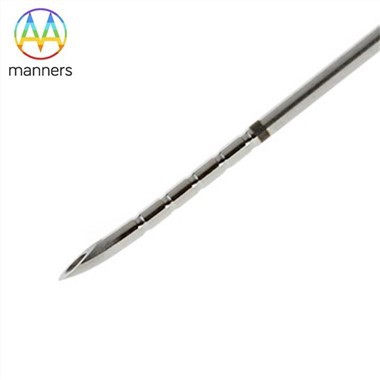
Cost Control With HDR Brachytherapy Needles
Nov 28, 2026
Needle cost is usually discussed at the point of purchase, when two quotations are placed side by side. That comparison captures a fraction of the real expense. The larger part appears later, as repeat passes, wasted units, delayed cases and rejected lots, and none of those items sits on the invoice. Effective cost control therefore begins with the specification rather than with the negotiation, and it is best done by the people who understand how the instrument behaves in the room.
Why Cost Conversations Start in the Wrong Place
Two suppliers can quote different prices for what looks like the same needle. The difference is often not margin but scope: one quotation includes a measured first article report, a controlled surface finish and packing sized to a case; the other assumes nominal dimensions and a generic box. Comparing the totals is misleading because the two products will consume different amounts of clinical time.
The useful question is not which needle is cheaper but which specification the procedure actually requires. A tolerance that is tighter than the process can hold reliably generates rejects, and rejects are paid for across the whole lot rather than on the units that failed. Rationalising a drawing often lowers cost without touching the price of any individual line.
A related confusion is treating price as a property of the product rather than of the order. The same drawing can be quoted differently depending on quantity, lead time and how complete the technical package is. A buyer who provides a full specification, including finish and packing, usually receives a lower and more stable quotation than one who asks for a price against a catalogue name.
How Tolerances, Gauges and Packaging Drive Price
Tolerance is the largest single driver. A bore held to a tight band requires more inspection, more rework and more rejected tube than an open band, and those costs appear in the unit price whether or not the buyer notices. Where a clinical need genuinely requires the tight band, it should be paid for; where the band was inherited from an older drawing, relaxing it is free money.
Gauge works through material and process. A heavier gauge consumes more stock and takes longer to grind, and its straightness is easier to hold, which partly offsets the cost. Packing works through volume and handling: a pouch designed for a case rather than a pallet reduces both material and the risk of leftover units expiring on a shelf.
Straightness is a good example of a hidden driver. A band that demands near-perfect straightness forces additional fixturing and slows grinding, and the cost appears as a premium nobody questions. Where a slightly wider band serves the procedure, widening it is one of the few changes that reduces cost without touching clinical performance.
Cost Elements Compared Across Specification Choices
The table shows where cost is created, and which choices can usually be revisited without clinical consequence.
|
Cost element |
Created by |
Revisitable |
Typical effect |
|
Bore tolerance |
Inspection and rework rate |
Often yes, with clinical review |
High |
|
Straightness band |
Fixturing and grinding time |
Sometimes, depends on route |
Moderate |
|
Surface finish |
Additional process step |
No, affects performance |
Moderate |
|
Custom length |
Setup per drawing |
Sometimes, via a standard family |
High on small orders |
|
Packaging format |
Material and sterilisation route |
Yes, with storage constraints |
Low per unit, high at scale |
|
First article report |
Inspection labour |
No, prevents larger losses |
Low |
The custom length row is where the largest avoidable expense sits for many programmes. A bespoke length per case multiplies setup costs, while a family of three lengths with clear marking covers most clinical needs. Standardising the family, and reserving custom parts for genuine outliers, usually reduces spend more than any price negotiation.
Quantity interacts with all of this. Setup cost is fixed per drawing, so the per-unit penalty for a small order is large, and that penalty is what pushes clinics toward stock lengths that do not quite fit. Aggregating demand across departments, or committing to a family of three lengths in one order, spreads setup across units the programme will actually use.
A Practical Cost Review Before Reordering
The review starts with a count. For one month, record units consumed per case, units opened but not used, and cases that required a corrective pass. Those three numbers describe the true consumption pattern, and they are available without any new system.
The second step is to compare that pattern with what the drawing assumes. If the consumption count regularly exceeds the box content, the packing is wrong. If corrective passes are common in one gauge and rare in another, the specification for the first gauge is probably mismatched to the anatomy being treated.
The third step is to ask the supplier what drives their price. A supplier who can name the inspection step, the process and the material behind a cost is usually also able to propose a cheaper compliant alternative; a supplier who cannot is unlikely to help reduce anything except their own margin.
The review should also cover who holds the stock. Capital tied up in a carton that takes a year to consume is a real cost, and a consignment or small-lot arrangement may be cheaper overall even at a higher unit price. The comparison should include storage, expiry and the administrative cost of reordering, not only the invoice line.
What Buyers Learn After a Year of Tracking
The most common finding is that case time is a larger cost than the instrument. A needle that requires one fewer corrective pass per case saves more than a small reduction in unit price, particularly where imaging suite time is constrained. Programmes that begin tracking usually shift their attention from price per unit to passes per case.
The second finding is that packaging quietly controls waste. When units are opened in pairs against a box of ten, the remainder either expires or is carried to another case with compromised sterility. Matching box content to case consumption removes that loss without changing the product itself.
A third finding concerns complaints. Units returned as damaged are often damaged by handling rather than by manufacture, and the cost of those returns is carried in the next price. A short training note on opening and withdrawal, issued with the first delivery, reduces returns and eventually reduces the price that covers them, which is an unusual saving because it costs the buyer nothing but attention.
Summary of Levers That Lower Cost Without Risk
Four levers account for most of the available saving. Relax tolerances that carry no clinical meaning, standardise lengths into a small family, size packaging to real case counts, and specify surface finish deliberately so it is not over-specified by default. Each of these is a drawing decision and each can be implemented at the next order.
Two levers should be treated with caution. Reducing inspection on dimensions that affect the seed path shifts cost into the procedure, and shortening a finishing step to save a process hour usually returns as a handling problem. Savings in those areas are borrowed, not earned.
The summary should be reviewed whenever the case mix changes. A programme that once treated large volumes and now treats fewer, more focal cases has different cost drivers, and a drawing that suited the earlier pattern may now be over-specified. Reviewing it at that moment is easier than defending it later. Buyers who revisit their HDR Brachytherapy Needles specification annually usually find one clause that no longer earns its cost.
One more lever is worth naming: the number of distinct parts in the catalogue. Every additional length carries its own drawing, its own inspection plan and its own minimum order, and those costs are paid whether or not the length is used. Consolidating to what the case mix genuinely requires is a decision that can be made once and held.
Where Cost Pressure Is Heading
Pressure is moving toward transparency. Clinics are increasingly asking suppliers to state which inspection steps apply to which dimensions, so that two quotations can be compared on a like-for-like basis rather than on a headline figure. That request tends to favour suppliers who already measure what they make.
A second trend is consolidation of the specification family. As more units share a common hub and marking scheme, setup costs fall across the whole order. The result is a lower total cost for the same clinical performance, achieved without a single reduction in quality.
Transparency may extend to process. A supplier able to state which finishing step adds which cost gives a buyer a real choice, rather than a binary between a cheap part and an expensive one. Those choices are where sustainable savings are found, because they can be made once and held for years.
Suppliers should be invited to challenge the drawing. A manufacturing engineer who reads a specification often sees a dimension tighter than the process needs, and raising it costs the buyer nothing. A quotation that arrives with two questions attached is usually a sign of a supplier worth keeping.
Conclusion
Controlling cost with a brachytherapy needle programme is mostly a matter of writing a sensible drawing. Tolerances, lengths, finishes and packing each carry a cost that can be understood and, where appropriate, reduced. The savings that survive are the ones made before the order, not the ones negotiated after it.