Solve Hard Tissue Puncture Resistance And Traumatic Injury
Aug 07, 2026
1. Industry Pain Points Traditional brachytherapy needles adopt blunt or ordinary bevel tips, relying on extrusion force to penetrate skin and fascia during cancer seed implantation. This squeezing penetration easily causes subcutaneous tissue stretching, vascular rupture, intraoperative bleeding and postoperative soft tissue edema. For sclerotic tumor peripheral tissues and thick connective tissue layers commonly seen in recurrent cancer, ordinary needles suffer from difficult penetration, repeated insertion and large wound area. Moreover, unstable squeezing force leads to shaking needle trajectory and angular deviation, resulting in inaccurate initial channel positioning. Uncontrolled puncture trauma increases patient pain and complication rates, while repeated adjustments prolong operation time and raise unnecessary radiation exposure, becoming a major clinical bottleneck of conventional interstitial brachytherapy.
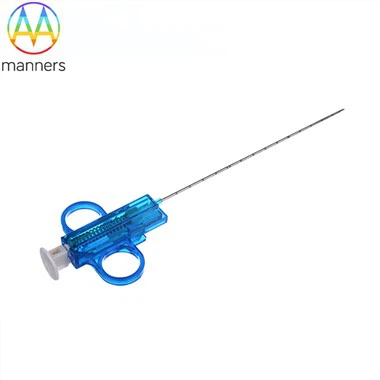
2. Working Principle Mick-type brachytherapy needles for cancer treatment are equipped with an independent sharp trocar-point obturator, adopting cutting-type penetration principle instead of traditional extrusion penetration. The high-precision ground trocar tip features centralized stress concentration and ultra-high cutting performance, which can quickly cut through skin, fascia and dense soft tissues with minimal lateral tissue compression. Manufactured from premium medical stainless steel, the obturator maintains high rigidity during insertion to avoid bending and shaking. After establishing a complete puncture channel, the obturator can be smoothly withdrawn, retaining a regular and unobstructed cannula lumen. This structural design realizes low-resistance, low-trauma and high-stability channel establishment, laying a foundation for subsequent accurate seed deployment.
3. Product Classification According to trocar sharpness and rigidity configuration, brachytherapy needles are divided into standard trocar models and heavy-duty reinforced trocar models. Standard trocar needles cover 13G to 20G fine and medium specifications, with balanced sharpness and flexibility, suitable for routine superficial and medium-depth soft tissue tumor implantation such as breast cancer and superficial lymph node tumors. Heavy-duty reinforced trocar needles apply to 8G, 11G and 14G thick specifications, adopting secondary precision grinding and thickened tube wall design, with stronger rigidity and cutting ability, specially for sclerotic tumors, pelvic tumors and dense visceral tissue penetration scenarios.
4. Practical Operation Standards Clinicians select trocar grades based on preoperative tissue hardness assessment. For soft tissue tumors, adopt standard trocar needles for rapid low-trauma penetration. For hard and sclerotic lesions, choose heavy-duty trocar needles to avoid insertion difficulty and needle body deformation. Keep the needle axis stable during puncture, complete one-time cutting penetration without repeated shaking and forced compression. After reaching the preset tumor depth under image guidance, steadily withdraw the trocar obturator and retain the echogenic cannula to ensure complete and smooth seed delivery channels.
5. Industry Application Experience Long-term clinical application proves that trocar obturator equipped Mick-type needles effectively reduce intraoperative puncture resistance by over 50%, greatly decreasing soft tissue squeeze injury and bleeding complications. Cutting penetration avoids large-area tissue stretching, significantly relieving postoperative pain and shortening patient recovery cycle. The integrated grinding process ensures long-term stable sharpness without passivation after repeated high-temperature sterilization. High rigidity effectively controls trajectory deviation, improving the one-time puncture success rate and overall surgical efficiency of cancer brachytherapy.
6. Summary Extrusion trauma and unstable penetration of traditional brachytherapy needles restrict the safety and precision of cancer interstitial radiotherapy. The unique sharp trocar obturator design of Mick-type brachytherapy needles realizes structural innovation from squeeze penetration to cutting penetration. Graded trocar configurations adapt to different tissue density scenarios, effectively solving clinical trauma and positioning pain points. As the core penetration structure of modern minimally invasive brachytherapy, it comprehensively improves surgical stability and patient clinical experience.
7. Future Prospect Future brachytherapy needle research will focus on gradient trocar sharpness and anti-blunting nano-coating technology to adapt to multi-layer heterogeneous human tissues. Intelligent variable-tip trocar structures will automatically adjust cutting sharpness according to tissue resistance, further achieving ultra-low-trauma intelligent penetration. Continuous structural optimization will promote brachytherapy surgery to develop towards higher safety, higher precision and faster postoperative recovery.