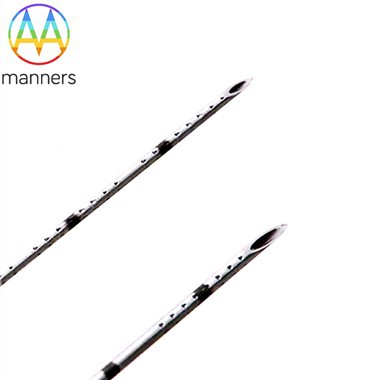
Echogenic Ground-Beveled Cannula Tip — Solve Ultrasound Blind Puncture And Position Deviation
Aug 07, 2026
1. Industry Pain Points Common brachytherapy cannula tips have smooth single-plane structures with weak ultrasonic echo reflection. In ultrasound-guided cancer seed implantation, the needle tip presents low contrast, fuzzy boundary and unrecognizable real-time position, resulting in widespread blind puncture problems. For small-volume tumors, irregular marginal lesions and deep interstitial tumors, invisible needle tips easily cause insufficient lesion coverage or excessive penetration into normal vital tissues. Repeated fluoroscopy and corrective puncture not only prolong operation duration and increase medical staff radiation exposure, but also lead to disordered seed distribution and unbalanced radiation dose, seriously affecting tumor local control rate and increasing cancer recurrence risk.
2. Working Principle Mick-type brachytherapy needles adopt professional echogenic ground-beveled cannula tip technology to solve visualization defects. Through asymmetric multi-angle precision grinding and micro-texture echo enhancement treatment, the cannula tip forms omnidirectional ultrasonic reflection surfaces, significantly improving echo signal intensity and real-time imaging clarity under conventional ultrasound equipment. The ground-beveled structure retains excellent cutting and penetration performance while realizing high-bright visual positioning. It integrates low-trauma skin penetration and real-time ultrasonic navigation, enabling surgeons to dynamically track needle tip depth, angle and position throughout the operation, completely eliminating blind puncture dead zones.
3. Product Classification Based on echo enhancement level and bevel precision, products are divided into standard echogenic bevel needles and high-definition precision echogenic needles. Standard models adopt basic bevel grinding and echo treatment, with stable imaging performance and cost advantages, suitable for large target area tumor routine implantation. High-definition precision models apply intensive micro-texture processing and ultra-fine bevel grinding, featuring higher imaging resolution and positioning accuracy, specially used for micro-lesion, deep tumor and high-precision conformal radiotherapy surgery.
4. Practical Operation Standards Match echogenic needle grades with lesion characteristics before surgery. Superficial large tumors adopt standard echogenic bevel needles; deep tiny lesions and high-precision dose treatment select high-definition echogenic models. During ultrasound guidance, focus the probe on the cannula tip bright echo spot, dynamically adjust puncture angle and correct trajectory deviation in real time. Utilize asymmetric bevel structural characteristics to control seed release direction, ensuring uniform and conformal seed arrangement inside tumor tissues.
5. Industry Application Experience Clinical data shows that echogenic ground-beveled tips improve intraoperative needle tip recognition accuracy to over 98%, realizing full-process visible puncture. The integrated grinding and echo structure will not attenuate or fail after repeated sterilization and clinical use, maintaining long-term stable imaging performance. Real-time visual navigation effectively reduces repeated puncture times and intraoperative fluoroscopy dose, standardizing seed implantation trajectory and dose distribution. It has become a standard core configuration for high-quality cancer brachytherapy worldwide.
6. Summary Ultrasound invisibility and positioning deviation are core precision bottlenecks of traditional brachytherapy instruments. Mick-type brachytherapy needles combine precision bevel grinding and echo enhancement technology to achieve dual advantages of low-trauma penetration and real-time visual positioning. Differentiated graded products cover routine and high-precision difficult surgeries, effectively solving blind puncture pain points, greatly improving the accuracy and standardization of cancer interstitial brachytherapy.
7. Future Prospect Future echogenic cannula technology will develop towards multi-modal imaging adaptation, compatible with ultrasound, CT and MRI synchronous navigation. Intelligent adaptive bevel structures will adjust echo intensity automatically according to tissue depth, realizing millimeter-level intelligent positioning. The iterative upgrading of visualization technology will further promote brachytherapy to intelligent, digital and zero-deviation precise cancer treatment.