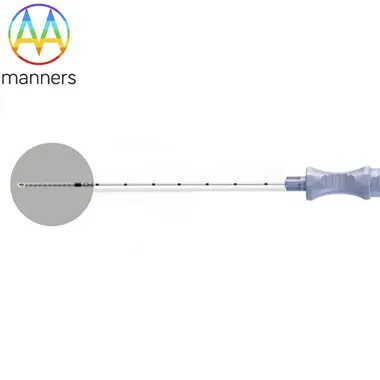
Sample Approval Before Orders From A Disposable Stainless Steel Spinal Needles Manufacturer
Nov 25, 2026
Why Sample Approval Decides the Order
In most purchasing systems the sample is treated as a courtesy: the factory sends a few units, the clinical team looks at them, and the order proceeds on the assumption that production will match. This assumption is the single most expensive habit in needle procurement, because the sample and the production run are made under different conditions. The sample is often turned by hand or drawn from a pilot batch with extra attention. The production run is made on a schedule, by a line that has other orders behind it.
The gap matters because a spinal needle is judged by feel. An operator performing anesthesia at the third or fourth lumbar interspace advances through skin, fat, ligament, and dura, and reads the resistance change by hand. A bevel ground two degrees off, a stylet that seats a fraction short, or a cannula wall that thins slightly toward the tip will all pass a visual inspection and all change that reading. When the change is small the operator adapts without noticing, which is worse, because the adaptation is never reported.
Sample approval is therefore not a formality but the point at which the specification is either locked or lost.
What a Sample Can and Cannot Prove
A sample can prove that the factory has understood the gauge, the length, the tip geometry, the colour, and the packaging format. It can prove that the stylet seats, that the hub is cleanly moulded, and that the unit is presented as a single sterile item.
A sample cannot prove consistency, because consistency is a property of a process rather than of an object. One good needle says nothing about the thousandth. It also cannot prove that the hub colour will match the approved pigment three batches later, that the tip grind will hold its angle when the wheel is dressed less often, or that the packaging will survive a humid store room.
Buyers who understand this distinction use the sample differently. They approve the sample as a reference, and they ask a separate set of questions about how the reference will be maintained.
Where a service uses several gauges, approve one unit of each rather than one representative unit. A sample approved at 25G says nothing about how the 18G will be ground, and the wider bore is where a marginal bevel shows first. Laying a full 16G to 27G set on a table and checking the colour sequence at the same time is a five-minute exercise that catches two classes of error at once: a gauge whose tip geometry is wrong for its size, and a hub whose colour sits outside the agreed map. A Disposable Stainless Steel Spinal Needles Manufacturer able to supply such a set from current stock is demonstrating range capability and sample capability in the same breath, and the two are not the same thing.
Set an expiry for the approval. A sample approved three years ago against a drawing that has since been revised six times is not a reference, it is an artefact. Review sealed references every year, confirm that current production still matches them, and re-approve wherever a revision has intervened. The cost is an hour annually; the alternative is discovering at the point of use that the product has been changing slowly under an approval record that nobody has opened.
Building an Approval Checklist
The checklist should be short enough to be completed in an hour and specific enough that two reviewers reach the same conclusion.
Confirm the gauge against the colour on the hub, and record both. Confirm the length by measurement rather than by eye, using the same datum as the drawing.
Seat the stylet fully and check that the tip is flush. A stylet that protrudes changes the effective tip; a stylet that sits short leaves a cavity. Both are visible on close inspection and both are easy to miss at arm's length.
Examine the tip under magnification. For a Quincke Point, look for a clean bevel, an intact heel, and no burr along the cutting edge. For a Pencil Point, look for a closed cone with the lateral eye positioned as drawn and free of flash.
Check the hub for moulding defects, particularly at the junction with the cannula, since that is where breakage begins when a needle is levered against bone during a difficult puncture.
Confirm the colour against the agreed mapping by name, not by memory, and record the batch.
Open the carton and confirm the pack count, the labelling, and whether the packaging is standard carton or built to customer requirement.
Write all of it down. An approval that exists only in memory cannot be used to reject a later batch.
Handling Rejection and Re-submission
Rejection is more useful than acceptance, provided it is specific. A message that says the needles feel wrong gives a factory nothing to correct. A message that states the length measured 86.5mm against a 90mm specification, that the stylet protrudes by a visible margin, and that the hub colour reads closer to Light Grey than to White gives a factory three actionable defects.
Ask for the corrective action to be described in writing, and ask for a second sample that is measured and reported in the same format as the first. A supplier who responds with numbers is controlling the process. A supplier who responds with an apology and a replacement unit without explanation is hoping the problem will not recur, which is not the same thing.
Set a limit on re-submissions. Two rounds is normally enough to establish whether a factory can hold a specification; a third usually indicates that the drawing and the process do not agree, and the drawing should be revisited rather than the sample.
What Approval Records Should Contain
A useful approval record has six parts: the drawing revision, the measured values for every critical dimension, the colour by name and batch, the packaging configuration, the reviewer's name and date, and the sealed reference unit.
The sealed unit is the part most often omitted and the most valuable. When a repeat order arrives two years later, the question is not whether the new batch meets a written tolerance but whether it matches what the clinical team has been using. A labelled reference unit answers that question in a minute.
A word is also needed on how the sample is handled after it has been approved. Store it sealed, labelled with the drawing revision, the approval date, and the reviewer's name, and keep it where the people who order stock can reach it rather than in a drawer belonging to whoever happened to attend the review. An approval that cannot be found has the same practical value as no approval at all.
Summary
Sample approval is the moment a specification becomes a product. Measure rather than look, record rather than remember, and require numbers in return when something is wrong. A Disposable Stainless Steel Spinal Needles Manufacturer that can support this process with documentation will produce a first order that matches the sample, and a second order that matches the first.
The Order That Follows
Release the production order only after the approval record is signed, and reference the record on the purchase order. Ask for the first carton of the production run to be checked against the sealed reference before the balance is shipped, and keep the reference unit for the life of the contract. For a range that spans 16G to 27G in both Quincke Point and Pencil Point versions, with 90mm and custom length shafts, the discipline costs a few hours per specification and prevents the failure mode that is hardest to recover from, which is a store room full of needles that are almost right.