Drawing-Led Customization By A Disposable Stainless Steel Spinal Needles Manufacturer
Nov 25, 2026
Why Custom Requests Fail at the Drawing Stage
Custom spinal needles are usually requested for a reason that looks simple: the standard shaft is too short for a particular patient group, or the tip style available at a given gauge is not the one the service wants. The request reaches the factory as an email, the factory answers with a price, and three months later the goods arrive with a shaft length that is correct but a hub that is not, or a colour that does not match the mapping used across the rest of the range.
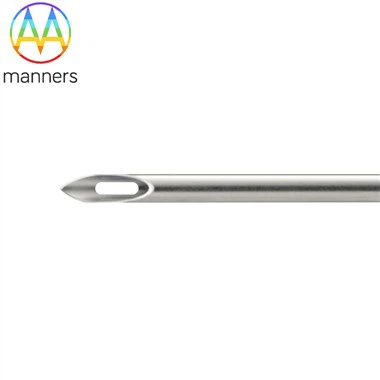
The root cause is that a spinal needle is defined by a set of dimensions that are not all visible on a simple sketch. Shaft length is obvious. Cannula outer diameter, wall thickness, stylet fit, tip grind geometry, the position of the lateral eye on a Pencil Point, hub bore, hub colour, and the assembled length from hub shoulder to tip are not obvious, and each of them can be read differently by two competent engineers looking at the same drawing.
For a product used to perform anesthesia at the third or fourth lumbar interspace, those hidden dimensions matter. A hub bore that is fractionally tight changes how the operator feels the stylet seat. A lateral eye placed a millimetre too far from the cone delays the appearance of cerebrospinal fluid, and an operator waiting for flow may advance further than intended. Anything that distorts the sense of depth distorts the decision to redirect around bone rather than push, and that decision is central to performing the procedure safely.
What a Needle Drawing Has to Capture
A drawing of the distal end, at enlarged scale, with the bevel angle and heel radius dimensioned.
A drawing of the proximal end showing hub bore, hub length, and colour specified by name rather than by swatch.
A full-length view with overall length referenced from a defined datum, so that a 90mm shaft and a custom length are measured from the same point.
A cross-section showing cannula wall thickness and stylet clearance.
A material and finish note, including the deburring requirement at the tip.
A statement of which dimensions are critical and which are reference, because a factory cannot guess priorities and will inevitably protect the dimensions it believes matter.
Most of this already exists in the supplier's documentation for the standard range. The efficient route is to return the standard drawing with the changes marked rather than to draft a new one, because a new drawing loses the accumulated knowledge embedded in the old one.
Drawing, Model, or Sample: Three Routes
The drawing route suits a change of length or hub colour where the geometry is otherwise unchanged. It is fast and auditable, provided the datum is defined.
The 3D model route suits a new tip form or a new hub, where the interaction between surfaces matters. A model can be sectioned and measured in software without projection ambiguity.
The sample route suits a product that already exists in a clinician's hands. Sending a physical needle lets the factory measure, replicate, and return a matched unit. The risk is that the sample carries wear, and that a dimension taken from a used needle is not the dimension that should be manufactured. Where a sample is used it should be new and unused, and the factory should report the measured values back for confirmation before production begins.
Many projects use all three at once: a drawing for the length, a model for the tip, and a sample as the acceptance reference.
Communicating Tolerances Without Ambiguity
Tolerance conversations fail when the buyer states a nominal value and the factory applies its own default. A shaft specified as 90mm with no tolerance may arrive at 90.4mm, which sits inside a general machining allowance and outside what the procedure note implies.
State the tolerance explicitly on every critical dimension, and state the measurement method alongside it. Length measured from hub shoulder to tip point is a different quantity from length measured over the cannula alone, and the difference is typically several millimetres, which is enough to change a clinical decision about where the hub should sit relative to the skin.
Ask the factory to confirm which dimensions it will inspect on the first article, and ask for those values to be reported. A supplier who inspects length only is not inspecting the product that will actually be used.
Finally, agree the acceptance rule before the first production run. A written statement that the first article will be measured against the drawing, with values reported for each critical dimension, converts a later argument about quality into a comparison of numbers. A Disposable Stainless Steel Spinal Needles Manufacturer accustomed to this discipline will usually offer it before being asked, and that habit is a reliable indicator of how the rest of the relationship will run.
One further point deserves its own line on the sheet: assembled length and shaft length should both be stated, because a custom length ordered to solve a depth problem is only useful if the hub sits clear of the skin when the tip reaches the subarachnoid space. Reviewing that number with the clinicians who will use the needle, rather than with the buyer alone, prevents a specification that is metrically perfect and clinically wrong. A production partner who has handled depth complaints before will normally raise the question unprompted, and a supplier who never raises it is telling you something about how the first article will be checked.
A final discipline concerns revision control. A custom project usually generates several amendments before production, and the failure mode is not a bad amendment but an amendment applied to the wrong revision. Number every drawing, record which numbers were superseded, and state on the purchase order the single revision that governs the order. Where a 3D model accompanies the drawing, keep the two in step, because a model that lags behind a drawing is worse than no model at all. Ask the Disposable Stainless Steel Spinal Needles Manufacturer to confirm in writing which revision it is working to, and to repeat that confirmation on the first article report. One sentence of this kind has settled more disputes than any warranty clause.
What Goes Wrong in Practice
Three failures are common. The first is a drawing that omits the colour, so the hub arrives in a pigment close to but not matching the agreed mapping. A custom length produced in a Light Purple that reads as Pink undermines a twelve-colour system the rest of the range depends on.
The second is a sample approved by a clinician who judged the tip by eye without measuring the shaft. The tip was right, the length was four millimetres short, and the batch was rejected after delivery.
The third is a change made during production without notice. A small adjustment to hub tooling, introduced to improve mould release, altered the bore enough to change the feel of stylet insertion. Nobody intended to change the product, and nobody wrote the change down.
Each failure is prevented by the same discipline: only versioned drawings or models, only samples that are measured and reported, and no change without a revised document.
Summary
Drawing-led customisation works when the buyer treats the drawing as a contract rather than a description. Define the datum, dimension the hidden features, state tolerances and the inspection method, agree the acceptance rule, and control the version. The twelve-colour mapping and the tip geometry should appear on the same sheet as the length, because they are part of the same product definition.
A Practical Next Step
Collect the standard drawing for the existing range, mark the changes required, and send it with a written tolerance table naming every critical dimension. Ask for a first article with measured values before the production run is authorised, and keep the approved sample sealed and labelled with its drawing revision. For a service ordering a custom length in both Quincke Point and Pencil Point versions, that extra fortnight at the front end is cheaper than a rejected batch, and it is the only reliable way to obtain a customised needle that behaves like the standard product in an operator's hand.