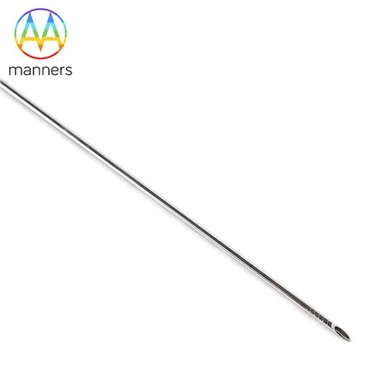
Quality Control And Industry Standards: The Compliance Pathway For Veress Needles
Jun 18, 2026
https://en.wikipedia.org/wiki/Veress_needle
From ISO 13485 to FDA 510(k): How Many Hurdles Must a Single Needle Clear?
Despite its apparently simple structure, the Veress needle is a Class II invasive medical device. Its dimensions (length, diameter, tip geometry, etc.) are only the visible tip of the iceberg-what truly determines whether a product may enter the operating room are the quality management systems (QMS) and safety standards it satisfies.
1. International Standard Framework
🔹 ISO 13485:2016 – Quality Management Systems for Medical Devices
Manufacturers must establish a QMS covering the full lifecycle: design & development, purchasing, production, inspection, storage, and post‑market surveillance.
Key elements include:
Risk Management per ISO 14971
Design Change Control
Supplier Qualification & Audit
Nonconforming Product Handling
CAPA (Corrective and Preventive Actions)
🔹 ISO 10993 Series – Biological Evaluation of Medical Devices
As a short‑term tissue‑contact device (<24 h), the Veress needle must be evaluated for:
Cytotoxicity
Sensitization
Irritation / Intracutaneous Reactivity
Acute Systemic Toxicity
Hemolysis
Pyrogenicity
🔎 Any change in material (e.g., stainless‑steel grade) or process (e.g., electropolishing parameters) may trigger re‑evaluation.
🔹 ISO 11607 – Packaging for Terminally Sterilized Devices
Disposable Veress needles require:
Validated seal strength & microbial barrier performance
Accelerated / real‑time aging stability
Sterilization (commonly EO) with residual EO ≤ 10 µg/g (or per ISO 10993‑7)
2. U.S. FDA Market Clearance
In the United States, Veress needles are typically classified as Class II (Product Code: GCJ) and require 510(k) Premarket Notification.
The applicant must demonstrate substantial equivalence to a legally marketed predicate device. A 510(k) submission includes:
Full device description & engineering drawings (with dimensional tolerances)
Material composition & source documentation
Sterilization validation report
Biocompatibility test data (per ISO 10993)
Performance test data:
Insertion / puncture force
Spring force (retraction / deployment)
Gas tightness (leak rate)
Fatigue cycling
Labeling & Instructions for Use (IFU)
Clinical evaluation / literature rationale (if applicable)
FDA review typically takes 90–180 days. Novel materials, mechanisms, or indications may require PMA (Pre‑Market Approval) or additional clinical data.
3. European CE Marking (EU MDR 2017/745)
Under the EU Medical Device Regulation (MDR), Veress needles are generally assigned Class IIa / IIb depending on reusability and associated risk.
Manufacturers must:
Undergo conformity assessment by a Notified Body
Compile a full Technical File, including:
Design & manufacturing info
Performance verification
Risk Management File (ISO 14971)
Clinical Evaluation Report (CER) based on literature and/or clinical data
Implement:
Post‑Market Surveillance (PMS) Plan
Periodic Safety Update Report (PSUR)
Assign UDI (Unique Device Identification) and register in the EUDAMED database
✅ Only after successful NB audit may the product bear the CE mark.
4. China NMPA Registration
In China, Veress needles are regulated as Class II or III medical devices (depending on special coatings or functions) under the Medical Device Registration Administration Measures.
Registration requires:
Product Technical Requirements (参照 YY/T standards, e.g., YY 0876‑2013 腹腔镜用穿刺器)
Type testing by accredited provincial/national labs
Clinical trial waiver (common for conventional Veress needles with proven equivalency) orclinical study if indicated
On‑site QMS audit per Good Manufacturing Practice for Medical Devices
NMPA review & approval → issuance of Registration Certificate
5. Key Performance Tests & Acceptance Criteria
|
Test Item |
Acceptance Criterion |
Test Method |
|---|---|---|
|
Visual & Surface Quality |
No burrs, scratches, rust, pits |
Visual inspection (10× magnification) |
|
Dimensions (OD / ID / Length) |
Tolerance ±0.1 mm |
Micrometer / Vision measuring system |
|
Bevel Angle |
Nominal ±2° |
Optical projector / toolmaker's microscope |
|
Spring Force (Retraction) |
2–5 N (per design spec) |
Spring tension/compression tester |
|
Gas Tightness |
≤0.5 mL leakage in 30 s @ 20 kPa |
Leak tester / bubble test |
|
Puncture Force |
≤10 N (through simulated tissue) |
Universal testing machine (tissue‑simulant pad) |
|
Corrosion Resistance |
No red rust after 24 h salt spray |
Salt spray (GB/T 10125 / ASTM B117) |
|
Sterilization Compatibility |
No functional change pre‑ vs. post‑sterilization |
Comparative functional testing |
6. Reusable vs. Disposable: Quality System Differences
♻️ Reusable Veress Needles
Must validate reprocessing effectiveness (cleaning → disinfection → sterilization)
Typically required to withstand ≥50 or 100 cycles without loss of function
Manufacturer must supply detailed IFU:
Manual & ultrasonic cleaning steps
Detergent compatibility
Autoclave parameters (temp, time, drying)
Inspection criteria before reuse
🩹 Disposable Veress Needles
Focus on Sterility Assurance Level (SAL ≤ 10⁻⁶)
Accelerated aging (e.g., 55 °C for 6 months ≡ 2–3 years real‑time)
Shipping simulation (ISTA / ASTM drop & vibration tests)
Shelf‑life validation
Summary
From design drawings to the surgical tray, a Veress needle must clear three gates: regulatory compliance, quality system rigor, and verified performance.
For purchasers and hospital procurement committees, selecting products bearing valid CE / FDA / NMPA certifications is not only a compliance obligation-it is a commitment to patient safety.