Quality Control And Industry Standards Of Breast Biopsy Needles
Jun 13, 2026
https://www.mayoclinic.org/tests-procedures/breast-biopsy/about/pac-20384812
In clinical practice, significant attention is paid to the physician's technical skill and the accuracy of pathological reports. However, behind the scenes lies an "invisible battlefield"-the quality control and industry regulation of the biopsy needle itself. From raw material procurement and manufacturing to sterilization packaging and arrival in the operating room, every step of this tiny needle's journey is subject to rigorous oversight. Any lapse in any segment can lead to catastrophic consequences.
I. Source Control: Stringent Standards for Materials and Craftsmanship
As Class III medical devices (the highest risk category), biopsy needles must be manufactured in compliance with the ISO 13485 Quality Management System.
- Material Certification: Whether using medical-grade 316L stainless steel or Ti-6Al-4V titanium alloy, manufacturers must provide comprehensive chemical composition analysis reports and biocompatibility test reports (conforming to the ISO 10993 series standards). These tests cover cytotoxicity, skin irritation, sensitization, acute systemic toxicity, and other dimensions to ensure the material does not cause adverse reactions upon short-term contact with the body.
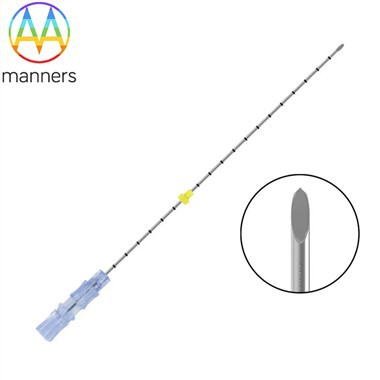
- Micro-Level Craftsmanship: The geometry of the needle tip is central to puncture performance. An ideal needle tip has strict tolerances regarding bevel angle, cutting edge sharpness, and surface finish. For instance, the cutting edges of needles used in vacuum-assisted excision must be inspected under electron microscopes to ensure they are free of burrs or rolled edges. Any microscopic defect can result in incomplete cutting, tissue tearing, or an increased risk of needle-track seeding.
- Coating Technology: To reduce insertion friction, many high-end needles are coated with lubricious layers (such as PTFE or silicone oil). The uniformity, thickness, and adhesion of these coatings must undergo rigorous coefficient-of-friction testing. Coating delamination not only affects the tactile feel during insertion but may also introduce foreign bodies and trigger localized inflammation.
II. Manufacturing and Sterilization: The Lifeline of Sterility Assurance
Biopsy needles come into direct contact with deep tissues, making sterility an inviolable red line.
- Cleanroom Manufacturing: Production must take place in Grade 10,000 or even Grade 100 cleanrooms, where the count of airborne suspended particles is strictly controlled. Operators must wear full sterile gowns and pass through air shower systems for decontamination.
- Sterilization Validation: While Ethylene Oxide (EO) sterilization or Gamma irradiation are common, merely completing the sterilization cycle is insufficient; validation is mandatory. Manufacturers must place products simulating worst-case scenarios (e.g., maximum load density, most complex packaging) inside the sterilizer, along with biological indicators (such as Geobacillus stearothermophilusspores). Only if the spores are completely inactivated post-cycle is the batch proven to meet the Sterility Assurance Level (SAL=10⁻⁶).
- Package Integrity: Packaging must maintain the sterile barrier while withstanding vibrations and temperature/humidity fluctuations during transportation. Any breach in packaging renders the entire batch unusable.
III. Standards and Feedback in Clinical Use
Quality control extends beyond the factory floor into the clinical frontline.
- Operational Guidelines and Standardization: Major medical institutions and professional societies (such as the American College of Radiology [ACR] and the European Society of Breast Imaging [EUSOBI]) have published detailed breast biopsy guidelines. These protocols dictate informed consent, imaging guidance standards, the number of cores required, and sample handling workflows. Adherence to these standards is the cornerstone of diagnostic quality and patient safety.
- Adverse Event Reporting Systems: Any complication related to the biopsy needle-such as needle breakage, tip detachment, severe hematoma, or infection-must be reported to regulatory bodies like the NMPA (China) or the FDA (USA). This real-world data is aggregated and analyzed to refine product design and manufacturing processes. For example, if a specific model frequently receives reports of "incomplete cutting," the manufacturer must re-evaluate its cutting edge geometry or spring tension.
- Recall and Traceability: Every biopsy needle carries a unique serial number or lot number. Upon discovering a quality defect, manufacturers can swiftly initiate recalls, tracing back to specific batches, production dates, raw material suppliers, and even individual operators. This end-to-end traceability is the baseline of quality management in the medical device industry.
Conclusion
When a physician picks up a brand-new biopsy needle, they hold not just a tool, but a weighty responsibility. Behind this responsibility lies the material engineer's meticulous calculation of metal lattices, the quality inspector's scrutiny under a microscope, the sterilization expert's eradication of microorganisms, and the regulator's strict enforcement of standards. It is the relentless effort on this "invisible battlefield" that ensures every breast biopsy procedure is conducted safely and reliably. Quality is, and always will be, the lifeline of the needle.