Safety Engineering In Intraosseous Needles Size Differentiation: Preventing Complications Through Design
Jul 30, 2026
https://www.sciencedirect.com/topics/nursing-and-health-professions/intraosseous-needle
Safety remains paramount when deploying intraosseous needles, particularly given the high-stress environments surrounding their use. While all sizes share the objective of rapid vascular access, each intraosseous needle size-1.5 cm, 2.5 cm, and 4.5 cm-presents unique safety challenges requiring targeted engineering solutions. Manufacturers committed to clinical excellence embed risk mitigation strategies directly into product design, transforming potential hazards into manageable variables.
For the 1.5 cm pediatric intraosseous needle, the principal safety concern involves avoiding injury to the epiphyseal growth plate or posterior cortex. Given the shallow depth to bone in infants and small children, even slight over-insertion carries significant consequences. To counteract this, manufacturers incorporate integrated depth-limiting mechanisms calibrated specifically for this size. Unlike generic stoppers, these devices feature precise mechanical interfaces preventing advancement beyond 1.5 cm relative to the skin surface. Additionally, some designs employ retractable stylet tips that automatically withdraw upon breaching the cortex, reducing the likelihood of deep tissue penetration. Color-coded hubs (typically blue for 1.5 cm) provide immediate visual cues, minimizing size confusion during chaotic resuscitations.
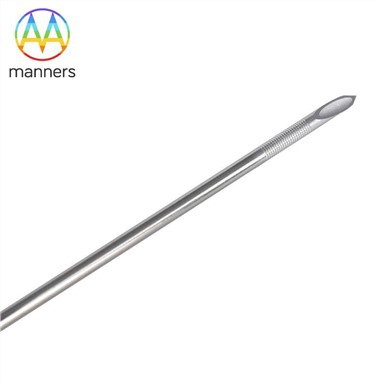
The 2.5 cm adult intraosseous needle occupies the middle ground, balancing accessibility against safety. Its predominant risk stems from variability in patient anatomy-particularly in overweight individuals where the 2.5 cm length may prove insufficient, prompting repeated insertion attempts. Engineers address this through enhanced tip geometries optimized for efficient cortical bone penetration. Multi-facet trocar tips concentrate force at the leading edge, reducing slippage and ensuring predictable advancement. Furthermore, manufacturers refine the transition zone between the needle shaft and hub to minimize stress concentrations susceptible to bending or breakage under manual pressure. Clear laser-etched depth markings at 0.5 cm increments aid clinicians in monitoring insertion progress, especially when landmarks are partially obscured.
Safety engineering reaches its zenith with the 4.5 cm long intraosseous needle designed for obese adults. Here, the extended length introduces compounded risks: increased insertion force requirements, greater susceptibility to shaft buckling, and elevated danger of posterior cortex perforation. Advanced manufacturers respond with several innovations:
- Reinforced Shaft Construction: Utilizing thicker-walled tubing or composite materials preserves column strength without excessively enlarging outer diameter.
- Ergonomic Handle Integration: Pistol-grip or T-bar handles distribute applied force evenly, reducing clinician fatigue and improving directional control.
- Smart Depth Gauges: Electronic sensors embedded within handles provide audible or tactile feedback upon reaching predefined depths, alerting operators to halt advancement.
- Anti-Deflection Profiles: Computer-aided design (CAD) simulations optimize cross-sectional geometry to resist bending moments encountered during angled insertions.
Beyond physical design, safety extends to packaging and labeling. Each intraosseous needle size ships in tamper-evident, peel-open pouches clearly denoting length and gauge. Instructions for use (IFU) include size-specific insertion algorithms, contraindications, and complication management guidance. Increasingly, manufacturers supplement physical labels with augmented reality (AR) applications; scanning a QR code launches interactive tutorials demonstrating proper technique for each needle size. Such digital adjuncts prove invaluable for infrequent users or during provider orientation.
Biocompatibility constitutes another safety dimension. All intraosseous needle sizes undergo rigorous ISO 10993 testing assessing cytotoxicity, sensitization, and irritation potential. However, longer dwell times associated with certain clinical scenarios necessitate additional evaluations. Manufacturers must demonstrate that materials comprising the 4.5 cm needle-including any specialized coatings or adhesives-remain inert throughout anticipated usage periods. Extractables and leachables studies quantify potential chemical migration, ensuring patient safety even during prolonged infusions.
Post-market surveillance completes the safety ecosystem. Manufacturers actively monitor adverse event databases, stratifying reports by intraosseous needle size to identify emerging trends. For instance, a spike in infiltration incidents involving 4.5 cm needles might prompt design revisions enhancing tip retention or clarifying landmark identification instructions. Similarly, feedback regarding difficulty removing stylets from 1.5 cm needles could trigger modifications to internal lubrication processes. This closed-loop quality system exemplifies proactive safety engineering.
Ultimately, the safest intraosseous needle is one thoughtfully engineered for its intended application. Procurement professionals should prioritize manufacturers demonstrating comprehensive risk management practices aligned with ISO 14971, supported by transparent documentation detailing how each intraosseous needle size mitigates known hazards. By selecting devices born from such disciplined safety engineering, healthcare organizations uphold their fundamental duty to protect patients-even amidst the urgency of life-threatening emergencies.