Precision, Vision And Cost Control: Decoding The Three Core Designs And Competitive Advantages Of Equine OPU Needles
Apr 29, 2026
Precision, Vision and Cost Control: Decoding the Three Core Designs and Competitive Advantages of Equine OPU Needles
In the field of equine assisted reproductive technology, Ovum Pick-Up (OPU) has become the key to obtaining superior mare genetic materials and realizing efficient rapid breeding. Its success relies not only on operators' exquisite skills, but also on the performance of the core device - the OPU needle. Unlike other animal species, the unique reproductive anatomy of horses - ovaries located in the abdominal cavity, wrapped in extensive intestinal tissues, coupled with thin yet tough follicular walls - imposes extremely stringent requirements on OPU needles. This article deeply decodes three core designs of modern high-end equine OPU needles, revealing how breakthroughs in puncture precision, ultrasonic visualization and cost control build competitive barriers for equine OPU technology.
I. Core 1: Precision Design for Minimally Invasive Puncture - Gentle Protection for Fragile Ovaries
Equine ovaries feature delicate vascular-rich structures, with far fewer retrievable follicles per session compared to cattle. Therefore, puncture accuracy and trauma control are top priorities, directly determining oocyte recovery rate, donor horse welfare and long-term reusability.
1. Echogenic Tip: A Beacon Lighting Up the Ultrasonic Haze
- Challenge: In transrectal equine ultrasound guidance, multiple overlapping interfaces (probe, intestinal wall, ovary and follicle) generate heavy image noise. Conventional needle tips present poor ultrasonic visibility. When puncturing small deep or marginal follicles (<10 mm), operators cannot accurately identify real-time contact between the tip and follicular wall, easily causing puncture failure, repeated penetration and elevated ovarian hematoma risks.
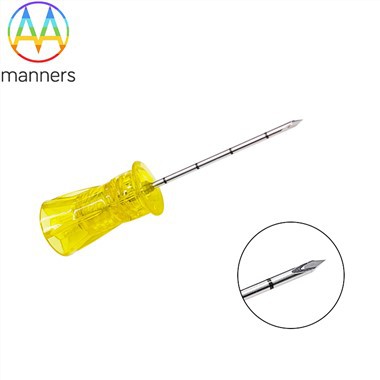
- Solution: Adopt specially treated echogenic tips. Micro-etching or microbubble-infused polymer coatings on the tip surface produce strong, exclusive ultrasonic echo signals, acting as a clear beacon amid visual interference.
- Advantages:- Precise Single-Shot Puncture: Operators visualize the entire process of tip advancement and intracavitary penetration, achieving "what you see is where you puncture" and greatly boosting success rates for small follicles.
- Reduced Tissue Trauma: Eliminates exploratory puncture and tip slippage caused by poor positioning, minimizing parenchymal ovarian damage.
- Higher Operational Efficiency: Clear visual feedback shortens decision-making and manipulation time, streamlining the overall OPU workflow.
2. Dual-Lumen Channel Design: Upgrade from Simple Aspiration to Aspiration-Flushing Circulation
- Challenge: Equine follicular fluid is relatively viscous, and cumulus-oocyte complexes often adhere tightly to follicular walls. Single negative pressure aspiration frequently leads to incomplete retrieval, especially for high-quality compact cumulus complexes.
- Solution: Adopt reusable dual-lumen needles. Two independent parallel channels allow one lumen for negative pressure follicular fluid and oocyte aspiration, while the other connects to an injection pump for timely pre-warmed medium infusion during or after aspiration.
- Advantages:- Improved Recovery Rate: Gentle flushing dislodges wall-attached complexes for thorough collection, significantly increasing the yield of viable nucleated oocytes.
- Controlled Operation: Precisely regulated flushing volume and pressure prevent excessive follicular distension, rupture or oocyte loss into the abdominal cavity.
II. Core 2: Invisible Protective Design for High-Quality Oocyte Development
Successful oocyte retrieval is only the first step; preserving developmental potential is the foundation of subsequent in vitro embryo production. Needle design profoundly impacts oocyte viability across multiple links.
1. Ultra-Smooth Materials and Inner Lumens: Reducing Transit Damage
Medical-grade stainless steel and advanced electrolytic polishing deliver mirror-level inner wall smoothness. This minimizes friction and fluid shear stress as oocytes travel through narrow lumens, protecting fragile cytoskeletons and cytoplasmic integrity.
2. Synergy with Intelligent Pump Systems: Accurate Fluid Dynamics Control
High-end needles are fully compatible with programmable negative pressure pumps (e.g., Minitube systems), supporting instant start-stop and ultra-stable adjustable pressure output. Studies confirm that excessive or unstable negative pressure is the primary cause of zona pellucida rupture and cumulus cell shedding (denuded oocytes), which drastically reduce in vitro maturation and blastocyst formation rates. The combination of intelligent pumps and precision needles ensures oocyte harvesting under the gentlest hydrodynamic conditions.
III. Core 3: Reusable Design - Balancing Premium Performance and Commercial Viability
Equine OPU clients are predominantly elite stud farms and professional embryo companies, pursuing top-tier performance while focusing heavily on long-term operational costs.
1. Cost Game: Disposable vs. Reusable Needles
- Disposable needles eliminate cleaning and sterilization yet carry high single-use costs and inconsistent batch performance, resulting in substantial annual consumable expenses for high-frequency laboratories.
- Premium reusable needles (engineered to withstand over 10 cycles of high-temperature high-pressure sterilization) feature higher upfront pricing but lower amortized single-use costs, matching or even undercutting disposable alternatives in long-term application.
2. Sustained Performance and Reliability
With proper maintenance, high-quality reusable needles maintain stable echogenicity, tip sharpness and lumen smoothness across repeated use. Consistent tactile feedback and ultrasonic visibility enable standardized operational routines and avoid performance fluctuations caused by frequent brand or batch replacement.
3. Environmental Sustainability
Reduced single-use medical plastic waste aligns with modern animal husbandry's sustainable development philosophy and social responsibility requirements.
Conclusion
Modern equine OPU needles have evolved from simple puncture and suction tubes into sophisticated integrated systems combining material engineering, ultrasonic imaging, fluid mechanics and clinical economics. Echogenic tips resolve blurred visualization, dual-lumen structures solve incomplete retrieval, and high-precision reusable manufacturing lowers long-term operational costs. Together, these three core designs enable stable, efficient and cost-effective high-quality oocyte harvesting from valuable mares, laying a solid foundation for in vitro fertilization, embryo transfer, sex selection and genetic resource preservation. In the competitive thoroughbred breeding industry, a high-performance OPU needle system secures an irreplaceable upstream advantage in the competition for premium genetic resources.